In GAD We Trust – Episode 1: Female Sleuths [w’ Kate @ CrossExaminingCrime]

You’re stuck at home, you’re bored, you could really do with a new, Golden Age Detection-focussed podcast to help pass the time, eh?
Continue reading
#652: The Sweepstake Murders (1931) by J.J. Connington
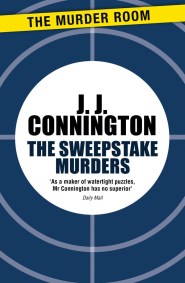


You may have missed the subtle hint I put up recently about buying some J.J. Connington books, but, with 18 to choose from, where to start? Well, if there’s a GAD touchstone I enjoy almost as much as a “no footprints” murder it’s a tontine, so The Sweepstake Murders (1931), which sees nine associates win £241,920 (or £16 million in today’s money) to be divided among them is a great place to reattempt Mt. Connington. Because £241,920 spilt nine ways is less each than when it’s split eight ways, which would be less than splitting it seven ways, which would be less than splitting it six ways…you can see how someone starts to think, can’t you?
Continue reading
#651: Minor Felonies – The Secret of Hangman’s Inn (1956) by Bruce Campbell
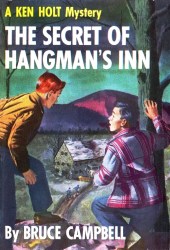
I, doubtless in common with anyone who has persevered through the stronger and weaker works of any prolific author’s career, have been moved at times to reflect at what point a long-running series becomes good before it starts to tail off in quality through the challenges of sustaining such an output.
Continue reading
#650: Puzzles for Players – The Baffle Book (1930) by Lassiter Wren and Randle McKay [ed. F. Tennyson Jesse] Problems 8 to 14

As in life, this blog has a few untrimmed threads hanging — one of these days I really must return to The Knox Decalogue and The Criminous Alphabet — but for today it’s back to The Baffle Book (1930). The first seven problems in F. Tennyson Jesse’s edit of Lassiter Wren and Randle McKay’s famous puzzle series failed to excite my reason or my enthusiasm, so how does this second quarter of puzzles stand up?
Continue reading
#649: The Curse of the Bronze Lamp, a.k.a. Lord of the Sorcerers (1945) by Carter Dickson
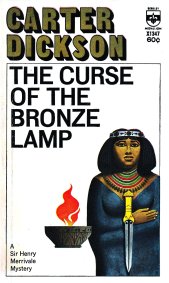
You may view the above rating of this book as too harsh, and you may be right. Honestly, I’ve struggled with how good The Curse of the Bronze Lamp, a.k.a. Lord of the Sorcerers (1945) may or may not be, and it certainly has its fans — at one point John Dickson Carr apparently considered it among the four of his own books that he enjoyed the most. But the key thing I keep coming back to is how this novel, rooted as it is in Egyptian curses and an apparent vanishing in a ghostly old family pile, written by a man who could stir up sulfur and brimstone with a well-place adjective and could summon the most wonderful patterns from the most perplexing of mysteries, is so very forgettable.
Continue reading
#648: Minor Felonies – Emil and the Detectives (1929) by Erich Kästner [trans. Eileen Hall 1959]

How Emil and the Detectives (1929) by Erich Kästner came to my attention is something I’ve long forgotten. I don’t remember anyone ever mentioning it, yet it seems to have constantly been in print while also being made into a movie and adapted for the stage. And I didn’t even know if it qualified as a detective novel for younger readers. So the only thing to do was to read it myself.
Continue reading
#647: Spoiler Warning 13 – The Box Office Murders, a.k.a. The Purple Sickle Murders (1929) by Freeman Wills Crofts
#646: The D.A. Takes a Chance (1948) by Erle Stanley Gardner
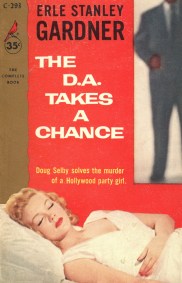
I’ve always thought of 1950 as a watermark year in the career of Erle Stanley Gardner. It’s arguably the point at which prevailing literary trends started to diverge meaningfully from the style of writing Gardner had staked out for himself. Post-1950 his Perry Mason series is a catalogue of steadily-diminishing returns, being somewhat preserved in aspic in its early-1930s incarnation, and the escapades of Donald Lam and Bertha Cool are saved only by Gardner’s many talents in not allowing that series to ever be easily pigeonholed. But for me the most compelling evidence that 1950 was meaningful for ESG is how Doug Selby never saw the light of day again after 1949.
Continue reading
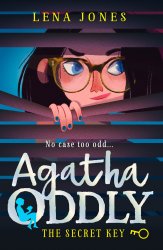
#645: Minor Felonies – Agatha Oddly: The Secret Key (2018) by Lena Jones