#693: My Late Wives (1946) by Carter Dickson
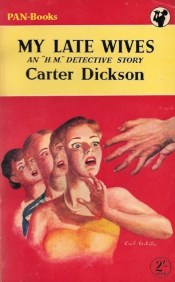


As a reader, there’s a tension to be found at the heart of every writer’s work once it’s a closed set, especially when they’ve scaled the heights that John Dickson Carr did: with nothing else to be added, at what point does The Decline set in? From Till Death Do Us Part (1944), arguably the pinnacle of his glittering career, it’s a sawtooth diagram of quality all the way to Papa La-Bas (1968), arguably the nadir, but at what point does a downward trajectory become the prevailing trend rather than the occasional, forgivable oversight? It’s obviously impossible to pick the precise moment — helloooo, subjectivity — which inevitably makes such a moment impossible not to look for.
Continue reading
In GAD We Trust – Episode 8: Uncovering Long-Forgotten Short Stories + Bodies from the Library 3 (2020) ed. Tony Medawar [w’ Tony Medawar]

Today was due to have been the sixth (sixth!) Bodies from the Library conference at the British Library but, for obvious reasons, it’s not. I can’t, alas, give you a whole day of GAD-based discussion, but I can at least fill an hour with someone from that line-up of exceptionally knowledgable people, Tony Medawar.
Continue reading
#691: Off the Record (2010) by Dolores Gordon-Smith
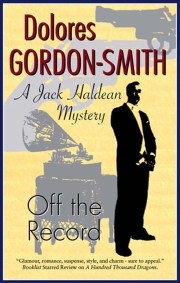
You know the drill: two men in a meeting, a shot rings out, one of them is found with a bullet in him, the other holding the gun that fired it. Stir in a “But he was already dead when I got here!” and simmer until an associate of an-amateur-sleuth-with-a-friend-in-the-police asks them to get involved (usually for personal reasons). That Off the Record (2010) follows this recipe so perfectly is a credit to how perceptively Dolores Gordon-Smith has assimilated the Golden Age detective novel, because never does it feel just like we’re jumping through hoops for the sake of it. The setup is familiar, but never less than engagingly handled.
Continue reading
#690: Minor Felonies – Alfred Hitchcock’s Solve-Them-Yourself Mysteries [ss] (1963): ‘The Mystery of the Four Quarters’ by Robert Arthur

For the fifth and final Tuesday in June — holy hell, that means the year is practically half over — the fifth and final story in this collection.
Continue reading
#689: The Green-Eyed Monster Spies a Golden Opportunity in The Case of the Crimson Kiss [n] (1948) by Erle Stanley Gardner
Serendipity is a wonderful thing.
Continue reading
#688: Sudden Death (1932) by Freeman Wills Crofts
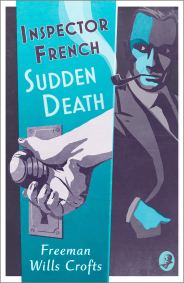
Today, three previously very hard to find novels by Freeman Wills Crofts are republished by HarperCollins: Death on the Way (1932), The Loss of the ‘Jane Vosper’ (1936), and Man Overboard! (1936). September will add Mystery on Southampton Water (1934), Crime at Guildford (1935), and Sudden Death (1932) to that, bringing the total of Crofts’ works in ready circulation up to twenty. I have no idea why they’re being published out of order, and frankly I don’t really care — it’s mainly just delightful to see him getting some traction — and I wanted to celebrate by continuing my broadly chronological reading of Crofts with this, the first of his which ever came to my attention.
Continue reading
#687: Minor Felonies – Alfred Hitchcock’s Solve-Them-Yourself Mysteries [ss] (1963): ‘The Mystery of the Man Who Evaporated’ by Robert Arthur
Having previously read two fabulous impossible crime stories by Robert Arthur, I was especially eager to see what he’d cooked up for this week’s tale.
Continue reading
In GAD We Trust – Episode 7: The Father Brown Stories of G.K. Chesterton [w’ John @ Countdown John’s Christie Journal]