 Here’s a poser for you: a woman’s body found in a castle, but the castle was searched before it was locked up for the night and she wasn’t there, and she could not have gotten in afterwards thanks to a combination of the partially-surrounding sea, a two-ton portcullis, and CCTV coverage. If it’s suicide, how did she get in? And if it’s murder, how did the murderer get in and out? No secret passages, no hidden rooms…howdunnit? After some
 #224: Coming Soon – Death on the Nile (1937) vs. He Who Whispers (1946): Some (Optional) Pre-Reading…

As Brad and I gear up for the comparison of what you — yes, you — decreed the very best individual novels by Agatha Christie and John Dickson Carr, I thought you may appreciate a bit of reading to get in the appropriate frame of mind (besides the books themselves, I mean…).
Continue reading
#223: A Study in Contrasts – Case Closed (a.k.a. Detective Conan) Volumes 11 and 12 (1996) by Gosho Aoyama

I haven’t updated you on my progress with Detective Conan for a while, so now seems like a good time to discuss the elements that make this on-going one-man Manga both so very, very brilliant and so very, very meh.
Continue reading
#222: The Iron Chariot (1909) by Stein Riverton [trans. Lucy Moffatt 2017]
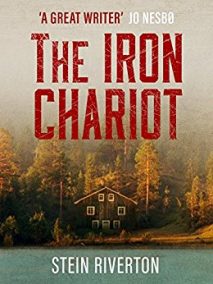 High summer, and a resident of an island tourist hotspot is found with the back of his head beaten in. The famous detective Asbjørn Krag is summoned, and as he attempts to solve the mystery of the murder we are taken into his confidence through the eyes of a nameless holiday-maker. Shenanigans, naturally, ensue. In many ways — some of which we’ll get to later — this is an archetypal GAD novel of crime and detection, but since we’re a good decade short of the form’s beginning we’re going to diverge from the expected tropes on more than a few occasions. Think of it as a piece of atmosphere with detective story interruptions for best results.
Continue reading
#221: Follow the Clues and Vintage Cover Bingo Challenges Update – January to March 2017
With 2017 a quarter done — I know, right? — I’m sure you’re all champing at the bit to be updated on my progress with the Follow the Clues and Vintage Cover Bingo challenges set by Bev at My Reader’s Block.
Continue reading
#220: Trial and Error (1937) by Anthony Berkeley
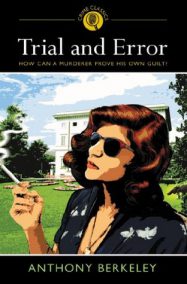 What’s in a name? When you’re dealing with GAD authors, quite a lot, which is why I’ve read 71 books by Agatha Christie but have yet to pick up any by Mary Westmacott, or why so much attention is paid to the four books Barnaby Ross published in his two-year career. So when I say this Anthony Berkeley novel would be far better were it by Frances Iles, you will hopefully appreciate my point. I thought it worth looking at the genre’s arch convention-challenger — one of the four most important male authors of his era, according to some attractive genius — for the 1937 Crimes of the Century and have come away somewhat confused, bemused, muddled, harried, and generally all a-fluster.
Continue reading
#219: No Flowers By Request, a.k.a. Omit Flowers (1937) by Stuart Palmer
 Summoned by a distant relative to a secluded family pile, a young(ish) man finds himself isolated with a fixed cast of closely-related characters as money-hungry relatives, murder, and all other sorts of puzzle plotting chicanery inveigle themself onto the scene. Yes, in many ways No Flowers By Request takes the exact same ingredients as The Search for My Great-Uncle’s Head — vast swathes of it will appear ominously familiar — and plays perfectly in the 1937 tradition that Rich has got us investigating this month for Crimes of the Century. But does the rest of the book hold up past these fundamentals? And is it any good, after the failure of Jonanthan Latimer’s stirring of these same ingredients?
Continue reading
#218: Murder on the Way! (1935) and I’ll Grind Their Bones (1936) by Theodore Roscoe Are Being Republished by Bold Venture Press…

Last year, I put up this post lamenting the dearth of classic-era detective fiction, and then one claiming that I was going to try and do something about this. And then things went quiet. Very quiet. Almost too quiet, wouldn’t you say?
Well, see, that’s because I was working at trying to making it happen. And the result of that work is this: Bold Venture Press will be republishing two impossible crime novels by Theodore Roscoe — Murder on the Way! (1935) and I’ll Grind Their Bones (1936) — over the next couple of months or so, with yours truly having edited and prepared the texts for publication as well as writing introductions for each book.
Continue reading
#217: Depth, Discovery, and the Detective Novel, via Death on the Nile (1937) by Agatha Christie

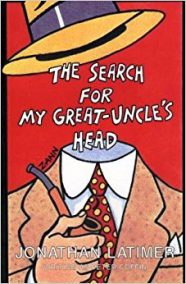 Summoned by an elderly relative to their secluded family pile, a young man finds himself isolated with a fixed cast of closely-related characters as murder, missing documents, an escaped lunatic, and all other sorts of puzzle plotting chicanery inveigle themself onto the scene. Yes, in many ways The Search for My Great-Uncle’s Head is a vade mecum for the Golden Age of detective fiction — vast elements of it will appear achingly familiar — and plays perfectly in time with the tattoo of 1937 that Rich has got many of us investigating this month for
