#454: The Perjured Alibi (1935) by Walter S. Masterman
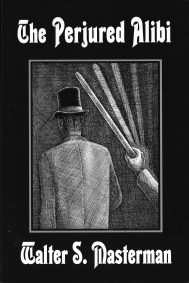


I’m on a bit of a Ramble House kick at the moment: Rupert Penny, Norman Berrow, Walter S. Masterman, with E.C.R. Lorac coming soon. The Perjured Alibi (1935) is my third Masterman title to date, and I’d intended this to be where I’d make the decision whether or not to persevere with him. But, well, I have a copy of Robert Adey’s Locked Room Murders (1991) now and that’s got me thinking that I should at least give the remaining couple of impossibilities a go — especially as it turns out Ramble House have recently republished his debut The Wrong Letter (1926), which I’ve been after for a while. So it would be churlish to stop here…
Continue reading
#453: The Criminous Alphabet – A is for…Audience

There’s a philosophical debate in Mathematics about whether mathematics itself pre-exists and is simply discovered as we progress into new areas or whether it is created as we go along and so each new discovery is less about having discovered something and more about having created it.
Continue reading
#452: (Almost) Everything in Its Right Place for The Mystery of the Vanishing Treasure (1966) by Robert Arthur
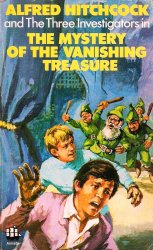
Much like last week, the intention had been to bring you another episode of the Men Who Explain Miracles podcast today, but, well, it seems we won’t get to that this month. And so let us return to the world of Jupiter Jones, Pete Crenshaw, and Bob Andrews and another mystery requiring their attentions.
Continue reading
#451: The Smokers of Hashish (1934) by Norman Berrow
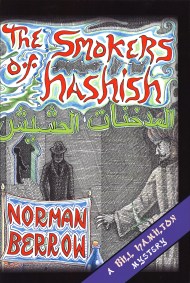
Aaaah, Norman Berrow. Such highs, such lows, so much middle ground. I can’t think of anyone else who leaves me on such a knife-edge: with a few adjustments here and there Berrow could well have written some genre classics, and it’s often an agonising fascination waiting to see which way the book falls. So now we’re back at the very beginning with his first novel The Smokers of Hashish (1934), decidedly more adventure than detection, where he applies his chameleonic tendencies to some (ahem) intrigue in Tangier. As you may expect from a book of this era with this title, the result is pulpy fun, though with two neat moments to distinguish it.
Continue reading
#450: The Criminous Alphabet – A is for…Anticlimax

Noah Stewart, one of the most knowledgable people currently blogging on the subject of GAD, once said that Romance and Detection are the two genres wherein the ending is never in doubt before you’ve even read the first page (I’m paraphrasing, of course — Noah would never put anything that pompously).
Continue reading
#449: This Post No Longer Exists
#448: The Hanging Captain (1933) by Henry Wade
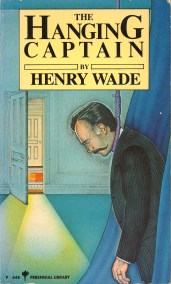
When The Murder Room, the ebook-only arm of publishing house Orion, announced a couple of years ago that they’d be releasing a bunch of Henry Wade’s novels I got quite excited and then proceeded to buy none of them. Instead, I eventually acquired three hard-to-find Wade novels in paperback — The Duke of York’s Steps (1929), The Hanging Captain (1933), and the apparent classic Heir Presumptive (1935) — and proceeded to read none of them, too. So, as I v-e-r-y-s-l-o-w-l-y make my way through these, I’m pleased to report that here it certainly seems Wade has learned a lot from that earlier book and grown significantly as an author in four short years.
Continue reading
#447: The Criminous Alphabet – A is for…Alibi [Part 2 of 2]