Why I love…

#217: Depth, Discovery, and the Detective Novel, via Death on the Nile (1937) by Agatha Christie

Worry not, I have no intention here of spoiling anything about Death on the Nile ahead of spoiling everything about it next month, but I’ve just reread it in preparation for that and some thoughts came out of it that I’d like to get down here for posterity. Also, having tackled Australian and American authors for the 1937 Crimes of the Century, it struck me that I should probably go for the English-speaking trifecta and take on the most English of English Detective Novelists, too, for completeness if nothing else.
Continue reading
#207: Five GAD Collaborations That Would Have Been Awesome

I’ve read a lot of comics in my time, I spend many hours online enthusiastically contributing to discussions about a moderately obscure area of popular culture — hell, I even wear glasses. I must, therefore, be a nerd. I mean, sure, I don’t own a single t-shirt emblazoned with some hilarious-but-obscure quote or image, but that’s mainly because the kinds of things I’d put on a t-shirt — “Hairy Aaron!” or, say, a decal of Gideon Fell above the legend Don’t irritate a man who knows 142 ways to kill you without being the same room — no-one else wants on a t-shirt and so they’re not available to buy.
Continue reading
#204: “I’m afraid, you know, one does enjoy a bit of malice now and then…” – Yearning for the Golden Age in Agatha Christie’s By the Pricking of My Thumbs (1968)
And so I enter the final decalogue of Agatha Christie’s works — from here to Miss Marple’s Final Cases (1979) — with a return visit to Thomas ‘Tommy’ Beresford and his wife Prudence, known (for reasons I genuinely cannot recall; someone will doubtless enlighten me in the comments) as Tuppence. The Beresfords are unique in Christie canon in that they are the only repeating characters who seem to age in real time, and in doing so they provide an overview of Dame Agatha’s writing career in just a handful of books.
Continue reading
#171: JDC OOP – WTF?
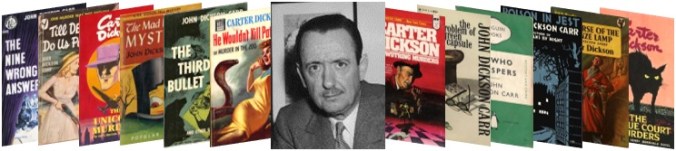
In his lifetime, John Dickson Carr published 76 novels and short story collections, plus a biography of Arthur Conan Doyle and a ‘true crime’ novel predating Truman Capote’s In Cold Blood, The Murder of Sir Edmund Godfrey. Following the closure of the Rue Morgue Press, who had five Carr novels in their books, and the coming disappearance of Orion’s ebook undertaking The Murder Room, who have around 14 or so Carr novels in their ranks, we’re not too far from a point in time where only two Car novels will be available to buy: Orion’s perpetually in-print version of The Hollow Man and the Mysterious Press publication of The Devil in Velvet. So, to return to the question in the title of this post: John Dickson Carr’s out of print — where’s the fuss?
Continue reading
#170: Dark of the Mood – Atmosphere in the Work of John Dickson Carr

Half a lifetime ago, I put up this post looking at the consistency of language across the Sherlock Holmes canon, and for my first post today in celebration of John Dickson Carr’s 110th birthday — a second post will be going up later today, then a round-up of the posts I’m kinda just trusting that other people are doing will go up this evening — I thought I’d utilise a similar approach to analyse an aspect of Carr’s writing that is often much-discussed: his use of atmosphere.
Continue reading
#152: The Nick Noble Stories of Anthony Boucher (1942-54)
William Anthony Parker White, under the nom de plume Anthony Boucher, is widely considered to have been one of the most influential voices of his generation when it came to matters of detective fiction. As an anthologist and reviewer his opinions counted greatly for their insight and fairness, but as well as talking the talk he also walked the walk in a series of seven novels and over 70 short stories published in the most highly-regarded detective and SF magazines of the day.
And yet for all his output, and in part on account of his genre-changing, it’s difficult to know how Boucher’s fictional writing should be remembered. His novels cover no fewer than three different “series”, with the longest-running — centred around Irish PI/Gentleman Detective Fergus O’Breen — comprising only three of them, and the most famous — locked room murder Nine Times Nine (1940) — featuring the marvellous wannabe-detective nun Sister Ursula but succeeded by a follow-up (1942’s Rocket to the Morgue) so inane that most people have probably never picked it up based on reputation alone (which is a shame, because Sister Ursula is one of the most wonderful characters to come out of this era).
Continue reading
#142: John Dickson Carr is Going to be 110 – Call for Submissions!


 The Invisible Event