-
Subscribe
Subscribed
Have a WordPress.com account? Log in now.
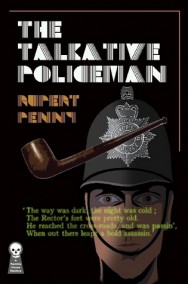 Aaah, Christmas. A time for cheer, goodwill to all men, on-trend ironic jumpers and spending time with the people you love. Look around the crime fiction blogosphere and these loved ones include a tremendous number of murderers, victims, stooges, detectives and classic authors, and so for me the time is ripe for a return to my overriding obsessions: this week it’s Ernest Basil Charles Thornett’s turn as his debut under the guise of Rupert Penny with The Talkative Policeman. And of course it’s a return to impossible crimes after a couple of weeks away with what the synopsis calls a “longer-than-usual impossible mystery,” and since Penny has written a couple of absolute doozys in this vein an extra bt of content is only to be a cause for celebration. Clap hands. Settle in. Let’s go.
 So, from one Australian author last week – the entertainingly bonkers world of Max Afford’s Owl of Darkness – to two this week – the entertainingly bonkers world of the Little Sisters. This is my first foray into the Monthly Challenge over at Past Offences, with the year for December being 1941 and so falling perfectly into my TBR pile, and it’s been a joy to reacquaint myself with these literary ladies after frankly too long away. Shades of my reviews from earlier this year – Pamela Branch’s The Wooden Overcoat and Torrey Chanslor’s Our First Murder – resurface here, with delightful overtones of everyone’s favourite crime-solving couple found in the echoes of Kelley Roos’ The Frightened Stiff, too, as a murder in a boarding house gives way to suspicion, fear, mistrust, confusion, doubt, terror and…laughter. Because as well as being a well-plotted and beautifully light mystery, this is also very, very witty indeed.
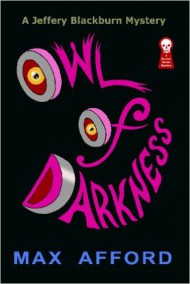 Regular readers of this blog – hello, Mum – will be aware of how much I appreciate die-hard devotees like Fender Tucker and Tom and Enid Schantz, whose (respectively) Ramble House and Rue Morgue Press imprints have for years been keeping the kind of classics everyone had long forgotten about in print just for the love of them. I won’t condescend to imply that everything they publish is of equal quality, but some of it is more equal than others and they have jointly brought some absolute delights to my attention. Unfortunately the latter’s Smallbone Deceased (1950) by Michael Gilbert proved not to be my kind of thing and so I couldn’t really review it having not read it, but it does give me a chance to talk about Max Afford’s Owl of Darkness which is published by the former and I read in those bleak and hazy dark days I now think of as ‘pre-blog’.
 John Pugmire’s continuing mission to bring us the best unheralded impossible crime stories from around the globe under the guise of Locked Room International now adds Sweden to Japan (Yukito Ayatsuji’s The Decagon House Murders), France (Noel Vindry’s The House That Kills, Henry Cauvin’s The Killing Needle, plus ongoing translations of the wonderful Paul Halter) and England (Derek Smith’s criminally ignored Whistle up the Devil and Come to Paddington Fair). Hard Cheese by Ulf Durling gives us something classically locked room – man dead in hotel room, door locked on the inside – and adds to it a knowing wink at just about every mystery convention going: the dying message, the inverted mystery, the had-I-but-known, the least likely suspect…even when these ideas aren’t being explicitly used, Durling is throwing out casual references to the tropes and traps of the genre. Add name-checks to John Dickson Carr, Agatha Christie, Freeman Wills Crofts and others, and clearly here is a man who knows whereof he writes.
 There is a branch of Mathematics known as combinatorics which studies the interactions of countably finite discrete sets. Or, in English, it’s the formal study of combining things in all the possible ways they can be combined. It’s a little bit like doing a jigsaw by picking up one piece and then going through the box to try every other piece to find one that fits with that piece, and then going through again to find another piece that fits with those two…and so on until you’ve finished the picture. Approximately a third of the thesis I wrote in my final year of university was based in a combinatorial approach to solving a particular problem (I shall spare you the details), and the formalisation of what sounds like an exceptionally dull way to go about something took on for me a particular beauty in the context of all the mathematics I has studied to that point.
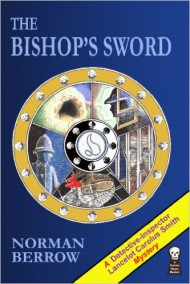 It is due to experiences akin to that of reading The Bishop’s Sword – a euphemism of a title if ever there was one, though here referring to a literal sword once owned by a bishop – that I started this blog in the first place. Picking up a book with very little to go on (a cursory, and then slightly more thorough, search online revealed not a single review of this anywhere) and having it turn out to be an absolute joy is the kind of thing I have to share with someone though, while in no way dismissing the many fine qualities that they do possess, not the kind of thing my friends necessarily share my enthusiasm for. And so I throw this to the interwebs, that you may be a way of enabling me to feel that someone who might be intrigued is going to share in this, and frankly you’re on to a corker if you decide to partake. You are, of course, most welcome. Continue reading
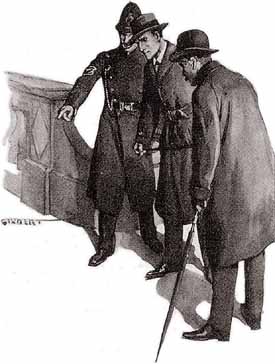 ‘The Problem of Thor Bridge’ gives us the classic impossible crime setup of a body that has been shot in the head but without any sign of a weapon to hand…and then manages to appear not at all impossible by finding the murder weapon hidden in the most likely suspect’s room, also throwing in a note from the suspected murderer arranging to meet the victim at the place of their demise and at around the time they are suspected of being having died. True, there are no footprints anywhere near the body, but – before you get too excited – “The ground was iron-hard, sir. There were no traces at all.” Oh, so that takes care of that, then.

 It is difficult to believe that Arthur Conan Doyle ever intended for his Sherlock Holmes stories to be as influential as they have proven to be. Not only are we still churning out variations on his characters in print and on radio, television and film but such is the fascination with his detective that something published before Conan Doyle even put pen to paper can achieve retrospective interest because of the similarities between the two. And so Locked Room International published this translation of Henry Cauvin’s debut novel The Killing Needle, wherein a skeleton-thin genius master of disguise who shuns social norms, declares “In my case, the brain dominates everything and is continually boiling over. This fire is eating me up and doesn’t leave a moment’s peace. The mind! The mind is a vulture that’s eating me alive” and takes opium (though in this case “to help me get some much-needed sleep”) has his adventures in crime-solving related by a doctor who becomes his confidant after being introduced by a mutual friend …yeah, okay, that’s a lot of overlap right there.
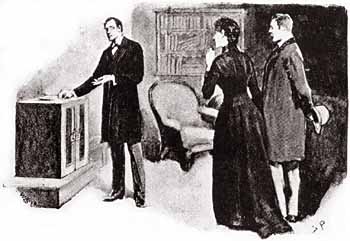 Since I can’t quite go the Full Sherlock – he’s out of my era, after all – I thought I could at least have a look at the three Arthur Conan Doyle-penned short stories that comprise the (official) entirety of his impossible crimes: ‘The Adventure of the Speckled Band’, ‘The Adventure of the Empty House’, and ‘The Problem of Thor Bridge’ (I’m excluding novella The Valley of Fear because it’s not technically an impossible crime, and remains a mystery for all of about six lines). It’s also a lovely excuse to get some of Sidney Paget’s gorgeous illustrations out for airing, too, and I don’t think anyone is going to mind that. So, first up going chronologically, is my least favourite of these three: nonsense-fest ‘The Adventure of the Speckled Band’.

