It’s fitting that Noah’s review of Dead Men Don’t Ski (1959), is what first brought the book to my attention, because the novel exemplifies for me a strata of fiction that I only got thinking about on account of Noah’s own, far superior, ruminations on the subject. Much like Murder on Safari (1938) by Elspeth Huxley, contemporary familiarity with the milieu would probably see this classified as ‘cozy’ these days — but to do so would be to ignorantly overlook the newness of this sort of setting at the time of writing. I’m tempted to call these Travelogue Mysteries, where the setting appeals as much as the crime on account of how novel it would have been at the time.
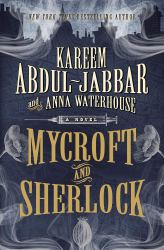
Three years ago, when The Invisible Event was but a callow youth, I happened upon a Sherlock Holmes-universe novel co-written by someone who shared their name with NBA Hall-of-Famer Kareem Abdul-Jabbar. “Wow,” I thought, “that guy must hear the same thing all the time…” — and then it turned out that it actually was NBA Hall-of-Famer Kareem Abdul-Jabbar, and, well, I became even more interested.
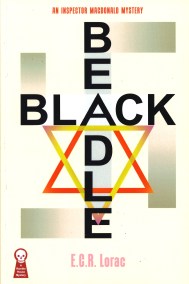
It comes to us all in the end: the moment that a prolific, tantalisingly-just-about-available author we’ve been low-key enjoying without ever really loving suddenly turns in an utter duffer of a book. It happened with the last Lorac I read — Slippery Staircase (1938) — and while Black Beadle (1939) doesn’t quite plow the same ignominious farrow, it’s not exactly leaps and bounds better. And yet Edith Rivett’s take on the standard GAD milieu is so atypical that while she’ll miss the mark on a few occasions, I don’t believe she’ll have written anything without any merit whatsoever. This is still a substandard effort, but with enough wrinkles to warrant attention.
Had I gotten round to this sooner, it may have qualified as a Modern Locked Room Mystery for TomCat attempt, but TomCat has already read this one and so really all that remained was to see if I was equally underwhelmed by it.
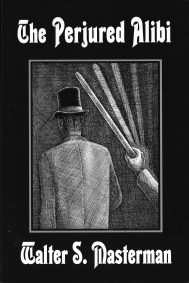
I’m on a bit of a Ramble House kick at the moment: Rupert Penny, Norman Berrow, Walter S. Masterman, with E.C.R. Lorac coming soon. The Perjured Alibi (1935) is my third Masterman title to date, and I’d intended this to be where I’d make the decision whether or not to persevere with him. But, well, I have a copy of Robert Adey’s Locked Room Murders (1991) now and that’s got me thinking that I should at least give the remaining couple of impossibilities a go — especially as it turns out Ramble House have recently republished his debut The Wrong Letter (1926), which I’ve been after for a while. So it would be churlish to stop here…
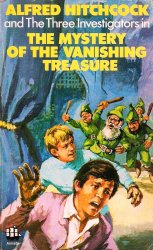
Much like last week, the intention had been to bring you another episode of the Men Who Explain Miracles podcast today, but, well, it seems we won’t get to that this month. And so let us return to the world of Jupiter Jones, Pete Crenshaw, and Bob Andrews and another mystery requiring their attentions.
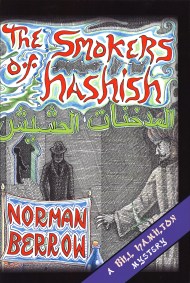
Aaaah, Norman Berrow. Such highs, such lows, so much middle ground. I can’t think of anyone else who leaves me on such a knife-edge: with a few adjustments here and there Berrow could well have written some genre classics, and it’s often an agonising fascination waiting to see which way the book falls. So now we’re back at the very beginning with his first novel The Smokers of Hashish (1934), decidedly more adventure than detection, where he applies his chameleonic tendencies to some (ahem) intrigue in Tangier. As you may expect from a book of this era with this title, the result is pulpy fun, though with two neat moments to distinguish it.
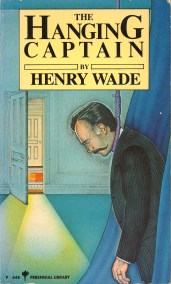
When The Murder Room, the ebook-only arm of publishing house Orion, announced a couple of years ago that they’d be releasing a bunch of Henry Wade’s novels I got quite excited and then proceeded to buy none of them. Instead, I eventually acquired three hard-to-find Wade novels in paperback — The Duke of York’s Steps (1929), The Hanging Captain (1933), and the apparent classic Heir Presumptive (1935) — and proceeded to read none of them, too. So, as I v-e-r-y-s-l-o-w-l-y make my way through these, I’m pleased to report that here it certainly seems Wade has learned a lot from that earlier book and grown significantly as an author in four short years.
For this blog alone — that is, discounting books I manage to fit in which do not feature on here — my reading has in recent weeks seen a degree of decade-hopping it doesn’t normally achieve: 1971, 1948, 2011, 1938, 2018, 1940, 1939, 2018 and now 1932. The upshot of this time travel is a reassurance that I’m still more of a fan of the legitimate 1930s style of murder mystery than I am its more modern second cousin. Even the flaws in this type of story are more enjoyable, partly I suppose because (and it bears repeating) of just how damn difficult a well-clewed puzzle plot is to write. As here, the first swing often makes up in enthusiasm for what it lacks in finesse.
The last two Saturdays on here have seen me dive into modern hardback novels, so I thought I would continue that trend and pretend once more that I’m doing this purely for TomCat’s benefit.




 The Invisible Event