Reviews

#694: “It was a small matter but very conclusive.” – The Singing Bone, a.k.a. The Adventures of Dr. Thorndyke [ss] (1912) by R. Austin Freeman

It was my understanding that William Shakespeare invented the word “eyeball”. The noun eye was extant at the time, as was the concept of a ball being something round, but that Shakespeare was the one to take the two principles and conflate them. It turns out he didn’t [see the comments below this post], but presumably someone did, and that’s all I really need to be the case for this opening paragraph.
Continue reading
#693: My Late Wives (1946) by Carter Dickson
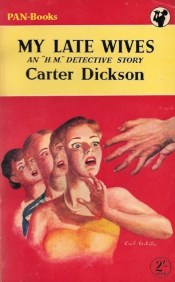


As a reader, there’s a tension to be found at the heart of every writer’s work once it’s a closed set, especially when they’ve scaled the heights that John Dickson Carr did: with nothing else to be added, at what point does The Decline set in? From Till Death Do Us Part (1944), arguably the pinnacle of his glittering career, it’s a sawtooth diagram of quality all the way to Papa La-Bas (1968), arguably the nadir, but at what point does a downward trajectory become the prevailing trend rather than the occasional, forgivable oversight? It’s obviously impossible to pick the precise moment — helloooo, subjectivity — which inevitably makes such a moment impossible not to look for.
Continue reading
#691: Off the Record (2010) by Dolores Gordon-Smith
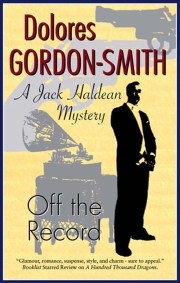
You know the drill: two men in a meeting, a shot rings out, one of them is found with a bullet in him, the other holding the gun that fired it. Stir in a “But he was already dead when I got here!” and simmer until an associate of an-amateur-sleuth-with-a-friend-in-the-police asks them to get involved (usually for personal reasons). That Off the Record (2010) follows this recipe so perfectly is a credit to how perceptively Dolores Gordon-Smith has assimilated the Golden Age detective novel, because never does it feel just like we’re jumping through hoops for the sake of it. The setup is familiar, but never less than engagingly handled.
Continue reading
#689: The Green-Eyed Monster Spies a Golden Opportunity in The Case of the Crimson Kiss [n] (1948) by Erle Stanley Gardner
Serendipity is a wonderful thing.
Continue reading
#688: Sudden Death (1932) by Freeman Wills Crofts
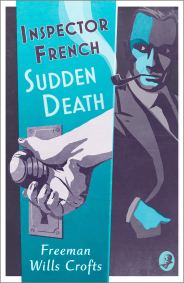
Today, three previously very hard to find novels by Freeman Wills Crofts are republished by HarperCollins: Death on the Way (1932), The Loss of the ‘Jane Vosper’ (1936), and Man Overboard! (1936). September will add Mystery on Southampton Water (1934), Crime at Guildford (1935), and Sudden Death (1932) to that, bringing the total of Crofts’ works in ready circulation up to twenty. I have no idea why they’re being published out of order, and frankly I don’t really care — it’s mainly just delightful to see him getting some traction — and I wanted to celebrate by continuing my broadly chronological reading of Crofts with this, the first of his which ever came to my attention.
Continue reading
#685: The Murders in Praed Street (1928) by John Rhode
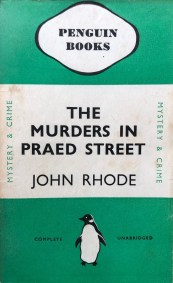
One evening, responding to a phone call from the local hospital requesting that he identify a man involved in an accident, Mr. James Tovey, Fruit and Vegetable Merchant on London’s Praed Street, discovers he’s the victim of a prank and that no such call was made by anyone at the hospital. On the short walk home, he encounters a group of men outside the local pub and…there endeth his story, for he is stabbed and dies shortly thereafter. With the group all claiming innocence, and talk of a scar-faced sailor seen in the vicinity, the event is put down to a senseless tragedy until circumstances link it to another death on the same stretch of road. And another. And another.
Continue reading
#683: “A terrible orgy of murder and crime, and it seems that we are not at the end of it yet.” – The Crimson Circle (1922) by Edgar Wallace
 The Invisible Event