Blog fun
#56: End of 2015 Review – My Reading in Pictograms
As I’ve only been blogging for a few months there doesn’t seem to be much point in a full blog review, but I thought I might look at my overall reading this year. And who doesn’t love a pictogram? No-one trustworthy, that’s who.
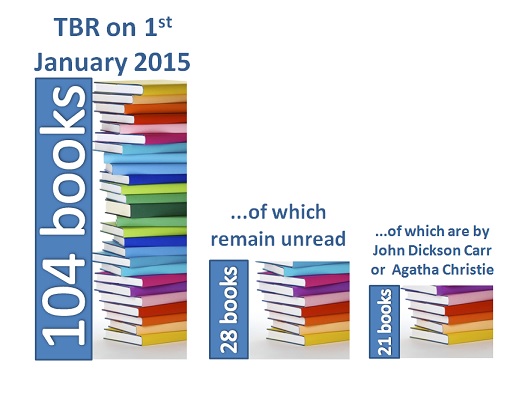
To begin with, here’s how my TBR at the start of the year fared:
 My book-by-book breakdown of tree books and ebooks throughout the year looks like this, including the nine I borrowed having finally joined the library:

#44: Who are the Kings of Crime?

The Tuesday Night Bloggers – an opt-in blogging group initially started by ‘Passing Tramp’ Curtis Evans to commemorate Agatha Christie’s 125th birthday but since expanded to include a broader program of authors from the Golden Age – has produced a glorious range of diverse posts from a variety of contributors and perspectives. Mostly I feel incapable of contributing anything half as interesting as what these guys and girls come up with, but Brad Friedman’s recent Ngaio Marsh-themed post on his excellent AhSweetMysteryBlog has got me thinking laterally about something he said, and so I’m going to run in my own direction with an idea that I’m curious about.
Any conversation about Marsh, see, veers into the debate over the Queens of Crime which is rife with obviously-Christie, pro-Sayers (hmmm), anti-Mitchell (yay!), possibly-Allingham (wooo!) debate, but Brad says that his personal “Queens of Crime” included John Dickson Carr and Ellery Queen. And I thought: hang on a minute, male monarchs? There’s a word for that…
Because, who are the kings of crime fiction?
Continue reading
#42: Defining ‘Fair Play’ in detective fiction
Partly because I’m feeling brave, and partly because it’s something that has niggled at the back of my mind given some recent reading experiences, I wanted to have a bit of a discussion – or, well, monologue – about what constitutes a fair play detective novel. I shall attempt not to go the Full Knox, and I’m not imagining that anything I say will be remotely original, but it’s on my mind and it’s my understanding that this is how blogging works. So…
I think I’m relatively safe in saying that for many people the appeal of the detective story is the opportunity to have a go at fitting the puzzle together before the author explains all at the end (differentiating here from the crime novel or the thriller, which for brevity’s sake we’ll simply say have different intentions). It’s also quite secure ground to say that finding out you never had a chance of solving the mystery for whatever reason – insufficient clueing, frank lies on behalf of the author, etc – adversely affects one’s enjoyment of such books. Having all the information there for you to colligate and deduce is what motivates a lot of said reading, but the precise nature of what constitutes a ‘fair play’ novel is somewhat hard to rigorously define. I’ll suggest up front that my own conclusions probably won’t tally with your own, but that’s all part of the fun, what?
#35: The Language of Sherlock Holmes – A Study in Consistency
In an attempt to broaden my approach to this blogging lark, I thought I’d turn my hand to some linguistic analysis. This presents a problem in the form of my being a qualified mathematician and therefore acutely aware of how easy it is to skew any set of data based on the interpretation it’s given, and thus how pointless it becomes to really bother. Nevertheless, I shall sally forth into the Sherlock Holmes canon with a quick sweep over some of the main points, and I can always come back to it later if I feel it warrants further investigation.
Continue reading
#28: Dirty Little Reading Habits
I’ve picked this up from Cleopatra Loves Books who in turn cites the following motivation:
I saw this fun post on Finding Time To Write, a great blog full of Marina’s poems, fantastic places to read as well as considered reviews. In turn Marina found this tag on the blog 50 a Year. I couldn’t resist sharing my reading rituals, honed over decades, with you all.
It’s always fun to hear/read what other people get up to, so in the grand tradition of My Blog Name in Books I thought I’d give this a go before editing my next crime-centric post:

Do you have a certain place at home for reading?
Very deliberately not; it’s something I love being able to just drop into at any particular time, and the idea of having to be sat in a special chair or surrounded by particular things seems antithetical to that.
Continue reading
#22: The Nine Wrong Answers – Popular Authors Who Fail to Impress
Much like you – well, exactly like you, I’d imagine – there are authors I love and authors I don’t. Almost as a counter-point to last week’s My Blog Name in Books, here is my list of nine ‘classic’ crime authors whose work I’m unlikely to ever touch again and – in some cases – whose continued popularity is, in all honesty, a complete mystery to me. I cast no aspersions by this, it’s just interesting to throw some ideas around and get a sense of people’s tastes and preferences.
As ever, there are rules: they must be dead (I’m not one for trolling), I must have read at least four of their books (to give them a fair chance) and they must fall into my self-imposed 1920 to 1950 envelope. Presented alphabetically by surname, too.
#18: My Blog Name in Books
Puzzle Doctor, curator of In Search of the Classic Mystery Novel, put this up the other day:
Well, you can blame Cleopatra Loves Books for this one…
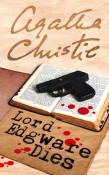
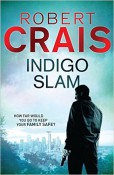
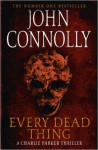
Apparently My Name In Books was a meme that went around over the summer (and over my head as well – never noticed it) but I thought I’d give it a go – namely spelling out my name in the titles of my favourite books. Now, there’s an obvious problem with a name like The Puzzle Doctor – can you spot it? But nevertheless, I thought it was worth a go. But try as I might, the only thing I could come up with for Z was Zzzz for any of the Brother Cadfael books. But this is a friendly blog, so I couldn’t possibly say that. Instead, I thought I’d do My Blog Name In Books.
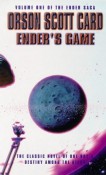
It got me thinking; I’m sticking to a self-imposed crime focus on this blog, but it might be nice to acknowledge the SF and others that have played significant roles in my reading life. And so I give you…My Blog Name in Books:

 The Invisible Event