
Author: JJ
#649: The Curse of the Bronze Lamp, a.k.a. Lord of the Sorcerers (1945) by Carter Dickson
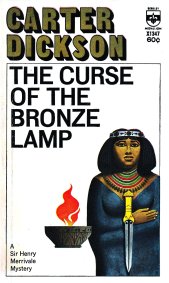


You may view the above rating of this book as too harsh, and you may be right. Honestly, I’ve struggled with how good The Curse of the Bronze Lamp, a.k.a. Lord of the Sorcerers (1945) may or may not be, and it certainly has its fans — at one point John Dickson Carr apparently considered it among the four of his own books that he enjoyed the most. But the key thing I keep coming back to is how this novel, rooted as it is in Egyptian curses and an apparent vanishing in a ghostly old family pile, written by a man who could stir up sulfur and brimstone with a well-place adjective and could summon the most wonderful patterns from the most perplexing of mysteries, is so very forgettable.
Continue reading
#648: Minor Felonies – Emil and the Detectives (1929) by Erich Kästner [trans. Eileen Hall 1959]

How Emil and the Detectives (1929) by Erich Kästner came to my attention is something I’ve long forgotten. I don’t remember anyone ever mentioning it, yet it seems to have constantly been in print while also being made into a movie and adapted for the stage. And I didn’t even know if it qualified as a detective novel for younger readers. So the only thing to do was to read it myself.
Continue reading
#647: Spoiler Warning 13 – The Box Office Murders, a.k.a. The Purple Sickle Murders (1929) by Freeman Wills Crofts
#646: The D.A. Takes a Chance (1948) by Erle Stanley Gardner
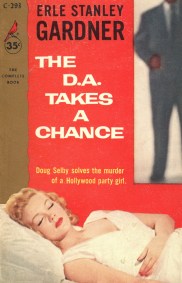
I’ve always thought of 1950 as a watermark year in the career of Erle Stanley Gardner. It’s arguably the point at which prevailing literary trends started to diverge meaningfully from the style of writing Gardner had staked out for himself. Post-1950 his Perry Mason series is a catalogue of steadily-diminishing returns, being somewhat preserved in aspic in its early-1930s incarnation, and the escapades of Donald Lam and Bertha Cool are saved only by Gardner’s many talents in not allowing that series to ever be easily pigeonholed. But for me the most compelling evidence that 1950 was meaningful for ESG is how Doug Selby never saw the light of day again after 1949.
Continue reading
#645: Minor Felonies – Agatha Oddly: The Secret Key (2018) by Lena Jones
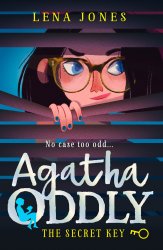
In the early 1900s, Edward Stratemeyer devised the Stratemeyer Syndicate of children’s books, where multiple volumes of the same series could be written by various authors and published under a common nom de plume. Two of its more famous alumni were The Hardy Boys by ‘Franklin W. Dixon’ and the Nancy Drew mysteries by ‘Carolyn Keene’.
Continue reading
#644: A Hundred Thousand Dragons (2010) by Dolores Gordon-Smith
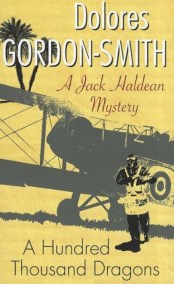
When Jack Haldean encounters Durant Craig in the lounge at Claridge’s hotel, the latter apparently carries a grievance from their war days and offers up a volley of abuse before storming out. Haldean refuses to disclose the reason for Craig’s outburst — offering only that “I let him down rather badly once…I deserve it” — and instead seems keen to forget the meeting. When a mysterious car accident during a fancy dress party raises the possibility of murder, it’s not long before Halden and Superintendent Ashley find themselves investigating a menage that involves one Durant Craig…and so it seems that Jack Haldean has a reckoning with the misdeeds of his past.
Continue reading
#643: Minor Felonies – Waste of Space (2018) by Stuart Gibbs

I’ve mentioned before how I grew up reading a lot of SF — Isaac Asimov, Arthur C. Clarke, Ursula Le Guin, Larry Niven, E.E. ‘Doc’ Smith — and how certain authors like Philip K. Dick, Sheri S. Tepper, and Connie Willis still delight me in my dotage.
Continue reading
#642: Who Would Fardels Bear to Grunt and Sweat Under a Weary Life…? – On the Subtle Art of Knowing When Not to Read a Book


 The Invisible Event