Detective fiction’s Golden Age produced many very witty books — Case for Three Detectives (1936), etc — but Family Matters (1933) by Anthony Rolls is to my mind the first time that the process of killing someone is genuinely funny. As a deployment of the detached third-person narrator it might represent the pinnacle of the genre. In many ways, this stands apart from the remainder of GAD in the way The Ladykillers (1955) stands apart from other Ealing comedies: it is savage and unsparing, and not afraid to show you the darkness beneath…but done with such a surety of touch that you don’t know whether a sentence is a joke or a profound truth until you finish it.
Following on from last week’s unveiling of the previously-unknown ‘Everythyne I Know About Detectyve Fiction’ (1925) by Captain Sir Hugh J. Lee Boryng-Payne Q.C. A.B.V. and his perspectives on the writing of an amateur sleuth, I thought I’d share the second section of this pamphlet on the perks and perils of the setting of a typical GAD novel of detection.
Let the tucket sound! Dan and I are back with our occasional podcast The Men Who Explain Miracles, and we’re taking on something rather special this month.
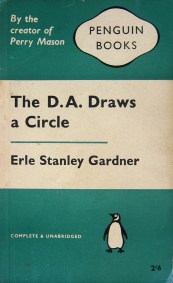
The third Doug Selby book from Erle Stanley Gardner sees an escalation in the puzzle aspects that make this series such a joy. You may come in expecting small town shenanigans and lazy Evil Big Business villains shown up by scrappy, dogged, local hero Selby, but you get a man killed in baffling circumstances with a semi-impossible twist, or a bindle-stiff gassed in equally nonsensical conditions with an elaborate scheme behind it, or — as here — a naked corpse shot twice in the same wound and spiralling accusations of complicity in murder plots that parallel and snake around each other in a particularly lethal dance. Dammit, Gardner is my go-to when I need a lift, I can’t deny it.
Recently, scouting the periodicals of the British Library for stories lest I undertake a second Ye Olde Book of Locked Room Conundrums, I found a small pamphlet entitled ‘Everythynge I Know About Detectyve Fiction’ which appears to have been self-published in a single volume around 1925 in an act of vanity by the author Captain Sir Hugh J. Lee Boryng-Payne Q.C. A.B.V. (certainly, on taking it to the desk, it didn’t appear to be on the library’s catalogue, so you may search for it online in vain…).
Right, the dust has settled on The Problem of the Wire Cage, so it’s time to pick another book to get all spoilerful over. There’s no mystery here, that book has been picked and its title is in the title of this post, but allow me a paragraph break otherwise I have no idea how I’ll work one in.
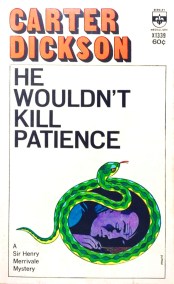
The result of a challenge between John Dickson Carr and magician-turned-author Clayton Rawson to write a murder in a room whose inaccessibility is assured by paper taped across the inner door jamb, He Wouldn’t Kill Patience (1944) also has GAD brethren in Freeman Wills Crofts’ zoo-set, poisonous-snake-centric Antidote to Venom (1938). Carr and Rawson take more puzzle-oriented routes, of course, and both happen to feature magicians, but the Reptile House subgenre is off to a good start with these two novels in it. And since you’re going to ask, in the head-to-head of this and Rawson’s ‘From Another World’ (1948), Carr wins. Boy, does Carr ever win.
I don’t know about you, but I read detective fiction mainly because I find the game-playing fun. If we accept certain components like fair declaration of clues, the killer being someone with whom we are familiar, and the freedom of a genius amateur to wander round crime scenes as a given, there are aspects within this that cause me no end of delight when they occur. Indeed, the fact that I see them present so frequently is part of what keeps me coming back.
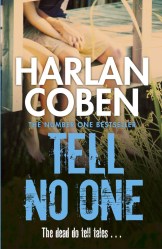
I’ll warn you now: even for me, this is niche. Following a reorganisation of books at Invisible Event Towers I stumbled across my copy Harlan Coben’s Tell No One (2001), which I read while at university, and got thinking about it in light of my more recent adoption of GAD an impossible crimes. And the above question struck me, but discussing it will require you, dear reader, to have done some rather specific reading…
Fellow GAD blogger Noah Stewart has in the past talked about intertextuality in detective fiction, part of which is how each mystery’s solution feeds into a general awareness of all other mysteries and their solutions. Essentially, reading detective fiction is then a game: has the author been able to mislead you about the solution? And the more you read, the harder this game becomes for these authors, especially as many of them wrote their books close to a century ago and so don’t really get the right of response where later developments in the field are concerned. The best GAD plots stand up to all subsequent attempts to innovate, and remain surprising.