Author: JJ
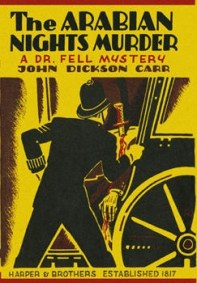 In the orchestra of John Dickson Carr’s detective fiction, his early years from It Walks by Night (1930) up to arguably The Arabian Nights Murder (1936) are very much the accordion section. Events occur in concentrated bursts, with clues and characters squeezed together to make the notes of the plot emerge, only to then be drawn apart before inexorably squeezing together again for another dense exposit you must pore over in order to follow the necessary developments. From The Punch and Judy Murders (1936) until the 1940s he wrote in the fine, clean, overlapping lines of the harp, and then the violins took over… but enough of this analogy, back to this book and the wheeze of a bellows working overtime.
#293: On Narrowness in Impossible Crimes, via ‘Locked In’ (1939) by E. Charles Vivian

I recently read, with no large amount of pleasure, Evidence in Blue (1938) by E. Charles Vivian. However, I’m not a man to write someone off after one bad book. So the presence of a locked room story by Vivian in the Martin Edwards-edited collection of such impossibilities Miraculous Mysteries (2017) from the British Library Crime Classics series was a chance to give him another go.
Continue reading
#292: Character v Plot 3 – Purpose and Artificiality

The second trailer for Kenneth Branagh’s Murder on the Orient Express was released a few days ago. People are probably furious or something. Me, I’ve already said everything I intend to about the movie until I actually see it and shall not be discussing it here beyond a few brief mentions, but it got me thinking some about character and plot and so this is a sort of Part Three to follow up on parts One and Two on this topic before.
Continue reading
#291: Evidence in Blue (1938) by E. Charles Vivian
 Finding new authors to read is a curious mix of recommendations and speculation. I started reading Rupert Penny because he appeared on this list, but then the joy of Max Afford and Norman Berrow followed purely because they were reprinted by the same publisher, Fender Tucker’s Ramble House. Such an approach has typically gone well, and while the care of my choosing could be a factor here, I prefer to think that it’s because RH generally publish very good — and if not very good then at least interesting — books. Thus, picking up this book by Vivian at the end of last year was pure “Well, it’s a Ramble House reprint” speculation, and a simple hope to continue my generally good run from them.
Continue reading
#290: 2 Tuesday Night 2 Bloggers – This Time It’s Personal…

Guys, I miss The Tuesday Night Bloggers; the passing of Agatha Christie’s 127th birthday last week really brought this home to me. For the uninitiated, the TNBs was essentially an autonomous collective of bloggers who would pick a topic each month and put up a blog post on that topic on, well, the relevant Tuesdays. It came out of the celebration of Christie’s 125th birthday — I was but a wee nascent glint in the internet’s eye at the time — and continued in various forms up until possibly March or so of this year, since when it seems to’ve been on indefinite hiatus.
Continue reading
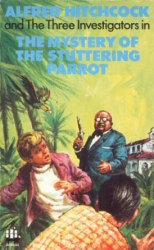
#289: The Literary Allusion That Wasn’t – Use of the Flying, Dying Message in The Mystery of the Stuttering Parrot (1964) by Robert Arthur
 The Guggenheim Mystery is almost a piece of mystery metafiction in itself: the title was discovered among Siobhan Dowd’s papers following her untimely death in 2007, implying its intention as the follow-up to her impossible disappearance novel for younger readers, The London Eye Mystery (2007)…but no more was known. It fell to Robin Stevens to puzzle out a plot from these waifish beginnings and so continue the adventures of Ted Spark, his sister Kat, and their cousin Salim. So here we are — a painting disappears from the eponymous art gallery, the police jump on the most likely suspect, and it falls to this intrepid trio to hunt out the truth, recover the painting, and save the day.

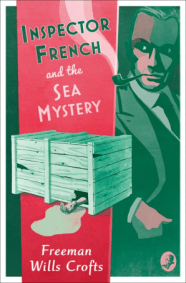 First thing first: yes, I’m aware that the 2017 Collins Crime Club edition of this novel — for which I am eternally grateful, since it has enabled me to read it in the first place — has been reissued with the title Inspector French and the Sea Mystery. What can I say? I’m a stickler for origins, and so am reviewing it under the original title. My delight at having Crofts back in print is undimmed, and if building an MCU-esque awareness through uniformity in titles helps the books gain popularity and leads to even more Crofts back in print, hell, I’m all for it. And, while we’re on the subject of these new editions, the covers are exquisite — simple, direct, clean, beautifully evocative…a great job.
 The Invisible Event