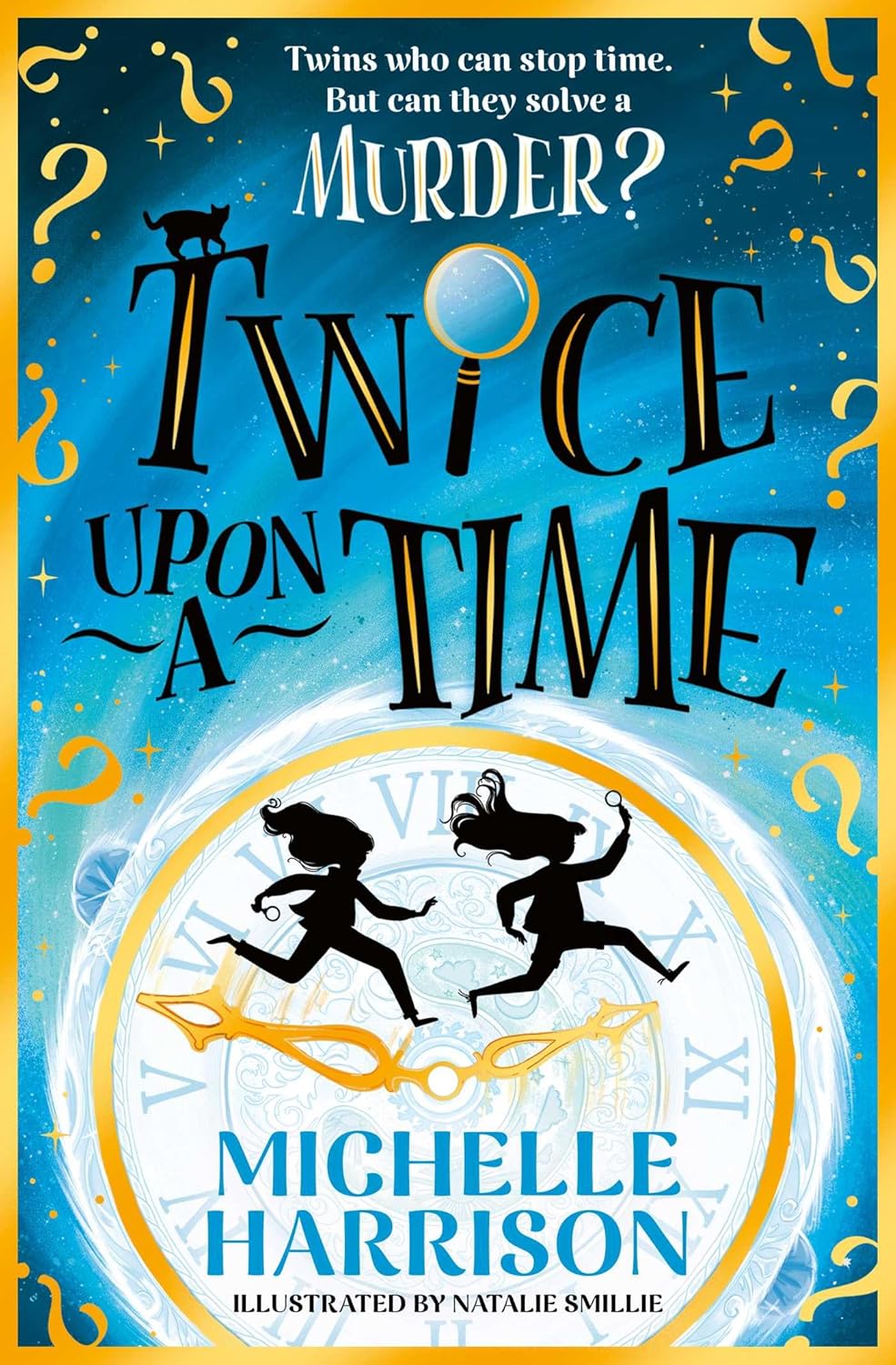
I like crossover mysteries, I like stories about time travel — these two being combined in the short-lived Anthony Horowitz series Crime Traveller (1997) — and I like juvenile mysteries. So a juvenile crossover mystery in which twins can affect the flow of time should be right up my street. Should be.
Born either side of midnight and so in different years, twins Merry and Rose — known as Spike — Morrow have unusual abilities when it comes to clocks and “objects linked to time”. Spike can make localised time advance (the first time she touches a clock in this, a vase of flowers nearby erupts into bloom) or have visions of the future, and Merry can make time rewind (the first time she touches a clock, a bird that has flown onto the windowsill flies away backwards) or maybe just slow down (the second time she touches a clock she’s hugging her mother and the hug…lasts longer?) and will have visions of the past.
When their art restorer mother is summoned to Fox House in the north of England, the twins must accompany her and face a boring summer in an uninteresting setting. Thankfully it turns out that one of the servants at the house vanished 14 years ago — remember when books dealt with things in the past that were beyond living memory? — and on page 194 of 327 it turns out that there was a murder that the twins can get involved in solving.

The core idea of Twice Upon a Time (2024) by Michelle Harrison is good, though a little confused. Merry’s precise effect on time is unclear, as you see, and surely it would make perfect sense for her to rewind time in opposition to Spike fast-forwarding it, especially as — with their powers combined…! — the girls can freeze time at will for exactly one minute. Also, the lag of the visions they have is super convenient, sometimes being mere days ahead and sometimes being years behind, so that they never really need to figure anything out: they just touch an ‘object linked to time’ (a clock, a sundial, a…stone with the impression of a leaf in it…?) and see exactly what they need to. There’s no rigour to this, no clever working out of ‘If we want to see what happened X years ago we’ll need to…’ — they just reach an impasse in the plot, and the correct thing comes to them without any effort.
As detection goes, it’s hard to get excited about; they’re not demonstrating perseverance or any laudable skill, and it’s difficult to separate this from any one of a thousand You’re Special Because You’re Special narratives that I hoped juvenile literature had moved on from or, at the very least, juvenile murder mysteries would be immune to.
Those first 194 pages are spent, then, meeting people, loosely establishing the abilities of these kids, and playing pranks or simply giving away that they have weird powers. When they first meet Alastair, the snobby little oik who is due to inherit Fox House — in one ingeniously weird touch, he’s carrying around a white rabbit — they stand and take a full force of his scornful delight and then…freeze time and run off, immediately arousing his suspicions. They then freeze time when he’s in the library and swap loads of things around to bamboozle him…and that’s it. Alastair is a vile enough presence (and “[h]e might have been handsome if he had had nicer thoughts,” is such a superb description) that he deserves to be a real antagonist to these two (well, three, because the gardener’s boy is in on it), but I guess it’s just a lot easier to not have to think through too fully the cool core conceit of the book you’re writing.
Harrison’s prose is easy to read without being notable for anything tone wise — it’s to her detriment that I read this two books after the magnificently individual Friday Barnes: Girl Detective (2014) by R.A. Spratt — and one plot development that might have older reader rolling their eyes is, pleasingly, neatly exploded at the end of chapter eight. Also, kudos for starting each chapter with a limerick which gives the essential thrust of the story to come, which is reminiscent of a far older school of literature and a nice touch. In fact, all the limericks throughout the book — Merry writes poetry — are very good indeed.
For me, the measure I use to assess these juvenile mysteries is whether I would read a sequel should one exist. There is in fact already a follow-up to this, A Clock Strikes Murder (2026), and…I don’t feel any compulsion to jump into it, I have to say. And, yes, I’m a grumpy adult who is in no way the target market for these and younger readers will no doubt get much out of the unusual setting and the off relationships the characters share; nothing is for everyone, and every book has its champion, etc. I just prefer my reads for young ‘uns to demonstrate some rigour, reasoning, and distinctiveness in their construction, and when I’m getting that and a distinct narrative voice from Alasdair Beckett-King, Tanya Landman, Andrew Lane, Stuart Gibbs, P.G. Bell, the aforementioned R.A. Spratt, and others, I don’t need to spend more time in this sort of company.
File under Fun But Inessential; those seeking intelligence in their juvenile sleuths can look elsewhere.
 The Invisible Event