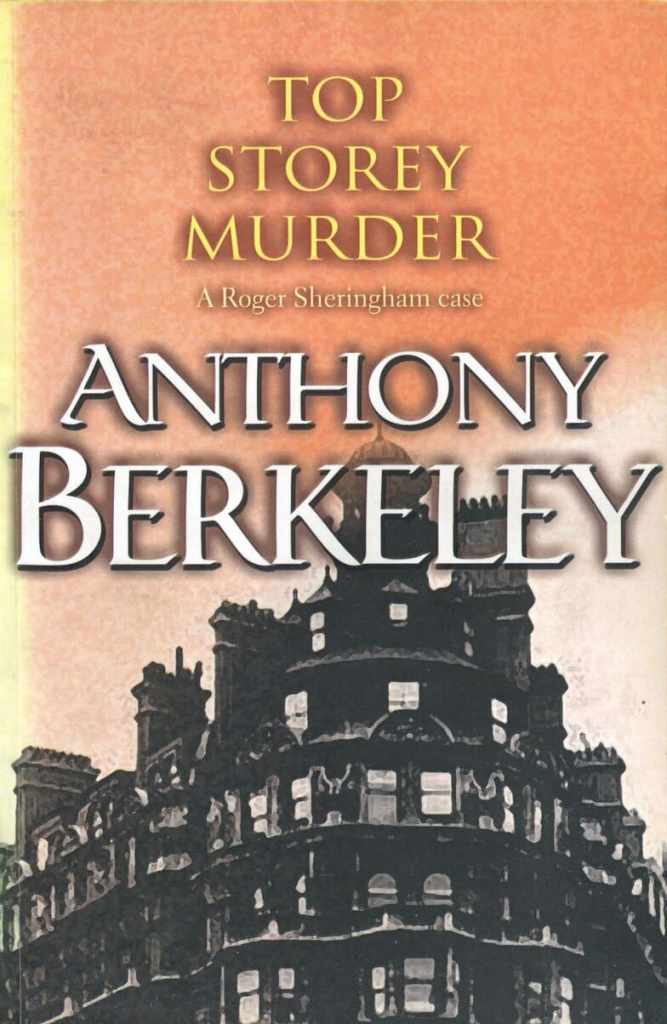

When Adelaide Barnett is found strangled to death in her fourth-floor flat in Monmouth Mansions, Platt Street — that’s a clue to the sort of time you’re in for here — author and amateur sleuth Roger Sheringham, trying to take Inspector Moresby out to lunch, is invited along to the scene of the crime. “I don’t think you’d find it much to interest you,” he’s told. “Just an ordinary case of burglary and murder. No fancy fandangos like you get in storybooks”. And yet for all the sensible detection and astute policing on display — for pure Humdrummery it’s an absolute delight — Sheringham becomes convinced that more is going on than meets the eye.
And, well, of course Sheringham will find something amiss, because that’s what amateur detectives do in these novels. And the police all know it, and view the whole thing as a big joke:
“Well, Mr. Sheringham, if you want to solve this case before we do,” winked the chief inspector ponderously, “I’d hate not to have given you every chance.”
We’re about a quarter of the way through when Roger’s doubts crystallise, for all that there are some cannily sensible explanations for what he sees as telling points (indeed, these exact explanations could be used to explain a clever reversal — and Berkeley has reversed that). The police know their crooks’ hallmarks, and evince disappointment “as of a close and respected friend gone unaccountably astray” when sure they’ve identified their man and believe him guilty of the murder.
The second quarter is where the book really springs to life, however, as Sheringham differs from Inspector Moresby’s men and begins to investigate the denizens of Monmouth Mansions. Whether increasingly drawn to the dead woman’s niece Stella (“Already he was tentatively sketching out a new book to revolve round her character…” — yes, Anthony, very clever), encountering a Devonshire chauffeur with a Yorkshire accent, or simply languishing in some wonderful turns of phrase (“Roger listened to her words as well as between them.”), Sheringham is on good form, and Berkeley is witty to a fault.
Symptoms of oncoming Celticism reminded Roger that it was high time to go.
For all the clever characterisation and amusing asides, there’s plenty of clewing going on at the same time, so that even when the case hits a complete dead end at the halfway stage the book doesn’t falter, and flies into the second half convinced of the complexity of the scheme under investigation: “[T]here was something cat-like about the affair, something prowling rather than prancing, slinking rather than striding”. And yet Berkeley very much has the detection novel as “invented…by ingenious novelists” in his sights: “It’s always possible to be ingenious, if one is content to be far-fetched,” the sensible Stella tells Roger at one point, and the wind positively pours out of his sails.
Berkeley has, of course, dealt with romance before, but to see Roger so completely discombobulated by the beautiful, wilful Stella — a woman to whom he professes himself not the least attracted — is a rich vein in this, mined heavily. As a secretary she is without flaw, and as a comrade in detection she is somewhat reluctant yet throws herself into the role, and one role in particular, estimably. It’s not merely the cosy badinage of the Troys, nor the sharp-tongued devotion of the Justuses, however, as Berkeley finds a way for a book to centre around a proto-romance in which the two romantic leads don’t even really like each other. It’s fascinating, high-wire stuff, and faultless throughout.
As the possibilities play out, then, it’s also lovely to see the canniness Berkeley is known for raise its head so confidently in the solution. I’ll be honest, I like this even more than The Piccadilly Murder (1929), and might have to start hassling the British Library to get this into its Crime Classics stable ahead of that other, almost-as-fabulous book (and The Layton Court Mystery (1925), of course). As one of two titles by Berkeley I’d not previously read, this was a complete delight, a wonderful couple of days’ reading, and possibly now one of my top ten mysteries of the 1930s. That this languishes out of print is another crime that needs investigating; Berkeley did so much for the genre, and deserves kudos from a new era of classic crime fans who would, I’m sure, hoover up every word of this avidly.
~
See also
TomCat @ Beneath the Stains of Time: I think the first five chapters constitutes the best parts of Top Storey Murder pitting the imaginative, theorizing amateur detective against the practical, experienced and well-oiled police apparatus of Scotland Yard – briefly created a proto-police procedural. Moresby has a small army of experts going over the crime scene, which, of course, include the fingerprint man and police photographer. More interestingly is the presence of Inspector Beach, “specialised in this type of crime, burglary in flats,” who makes a profile of the scene and checks the points (“there are twenty-two points I’ve got noted down”) against the methods and habits of the career criminals in their filing cabinets.
 The Invisible Event
In the US, the Kindle version is available from Amazon for 99 cents.
LikeLike
Huh, I’ve just checked the UK Amazon and there’s a Kindle edition there for 99p, too. I imagine these are both contravening copyright, however.
LikeLike
You liked this one even more than I did, but you’re right, it should be reprinted. I expected a British Library reprint for years, because it’s now the most obvious one to reprint. It’s insane The Wintringham Mystery is now easier to get than a copy of Top Storey Murder.
LikeLike
I know, right? Wintringham was almost a legend, a superstition, and I saw it in a charity shop the other day. Life is wild.
LikeLike
It hits the US public domain in January, so I don’t expect it to remain out of print long and you’ll probably be able to get a high-quality copy from Standard Ebooks in pretty short order.
LikeLike
JDC thought rather highly of it, from memory.
LikeLike
Well, that’s good; he didn’t exactly have flawless taste, so it’s nice to know he could be right once in a while 🙂
LikeLike