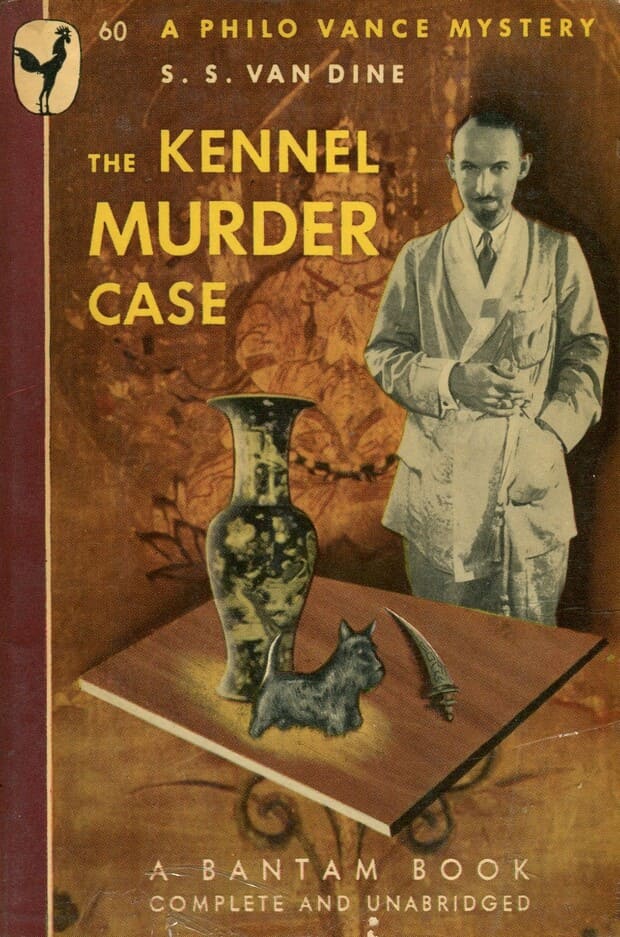

I first read The Kennel Murder Case (1933), the sixth book by S.S. van Dine to feature the love-him-or-hate-him amateur sleuth Philo Vance, when in the initial thralls of having discovered the impossible crime. I tore through it, remember little of the impression it left on me, and doubtless threw it aside for the next adventure. So returning to it 20 years later, in sequence with the other Philo Vance novels, is not so much a homecoming as finally a chance to do the book justice. And I really did remember very little, just the broad strokes of the mechanism for the locked room which opens the book and the fact that it contained a dog…so this second read might as well be a first one.
As in the canon to date, it is death which brings District Attorney John F.X. Markham and Vance together once more, with collector of Chinese ceramics Archer Coe found one morning dead in his bedroom: shot through the head with a gun in the hand of the corpse and the door bolted on the inside. Of course, it would be no fun if it were that simple, and the various complications that speedily pile up really are a delight to the reader, with Vance called upon to do what narrator Van Dine calls “the shrewdest and profoundest detective work of his career” to make sense of the much filigree’d problems that present themselves. And, given my understanding of the decline in quality from this point, he may be right.
The real joy of the books is how clear the problems remain, despite each development “shunt[ing] the case still further off the track of rationality”. The puzzle mystery was very much coming into its own at this time, and the imprecise practitioner could overload their delightful games with too much to keep straight; Van Dine, however, knows when to push and when to pull back, how to mix the pot without spoiling the brew, and so while the complications pile up and those around him wish to leap at shadowy possibilities (“There are so many other things to be ascertained before we can reach any intelligent conclusion,” Vance reminds them), each piece is distinct and memorable — if only because no damn sense can be made of any of it.
The case was teeming with possibilities, but the contradictions of the various details made logical speculation well-nigh impossible.
There is, though, more than just a meticulously-plotted, marvellously-confounding mystery going on here. As in The Scarab Murder Case (1930) there’s a sense of the Western collector not being on the right side of things (with talk of him “desecrating graveyards and removing funerary urns and figures”), and there’s also a sinister forriner for some of our less enlightened brethren to feel uncomfortable about with Chinese cook Liang Tsung Wei coming under suspicion from a few quarters (“Chinese are full of tricks. Look at the puzzles they think up.”) Ronald Knox can relax, though, as it all comes out in the wash.
And, look, I do just like Vance, who can be remarkably hard-eyed at times (“Spare me the drama, I’m deuced difficult to impress.”). Sure, there are two pages in the middle where he goes on about pottery for waaaay too long, but if you can’t enjoy his holding forth on how over- and cross-breeding is causing problems with dogs’ health (a widespread and widely-acknowledged issue these 90+ years later) or, indeed, just the concern shown for the Scottish terrier who has no place in the mystery and yet provides the key to the whole thing then, well, you’re missing out.
First time around I didn’t think anything of the spoilers offered herein for The Clue of the Twisted Candle (1918) and The Clue of the New Pin (1923) by Edgar Wallace, but it seems a little gauche now. Mind you, Wallace sold in such quantities that I suppose it was probably fair to assume anyone interested in this locked room problem might have read those ones. And the method here is a little mechanical, and so it does feel right that it’s detected from knowledge of the genre (and it’s lovely, too, to see R. Austin Freeman considered among “the classics of detective fiction”).
Best of all, though, it’s great to see Van Dine play by the rules and offer up a memorable solution that is both brilliant in its efficiency and well-prepared by what has come before in the text. Yes, there are a few moments early on where Vance just knows where to look because Van Dine needs to get a clue under our noses, but I’d rather that than the approach taken previously, and I hope it’s followed as fully in subsequent books. And a well-hidden murderer, too, whose identity I had well and truly forgotten from my first read and so whose unmasking proved a real surprise. Great work all round. If this is the peak of Mt. Vance, the view really is rather spectacular.
~
S.S. van Dine on The Invisible Event
1. The Benson Murder Case (1926)
2. The ‘Canary’ Murder Case (1927)
3. The Greene Murder Case (1928)
4. The Bishop Murder Case (1929)
5. The Scarab Murder Case (1930)
6. The Kennel Murder Case (1933)


Finally, I’ve been excited for this review since seeing that it was next on your docket! I read and reviewed The Benson Murder Case recently and enjoyed it, although Vance in that one was certainly… something. I think I said that I sometimes almost wanted him to get backhanded down a flight of stairs. He was fun though, more so when viewed as essentially a newspaper cartoon come to life.
LikeLike
I enjoyed William Powell’s version of Vance, which probably set him up for Nick Charles of the Thin Man series.
LikeLike
I also need to reread this one, but read it more carefully than you did and my memories are pretty much in line with your review. The Kennel Murder Case is the best of the first six novels with Vance at his most tolerable.
“If this is the peak of Mt. Vance, the view really is rather spectacular.”
Prepare yourself for the plunge because The Dragon Murder Case is next.
LikeLike
I’m having trouble tracking down the latter six books — I have Kidnap, but nothing else and would prefer to keep doing them in order, so it may be a while before I get to Dragon 🙂 But, yes, I understand the descent gets pretty steep from here…
LikeLike