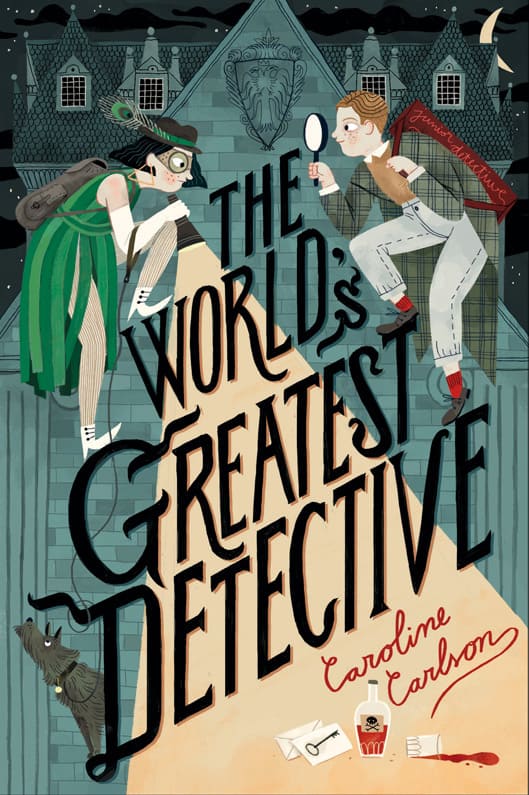
I find my books by various means, but this might be the first time I’ve taken advice from YouTube: this video recommending 15 Criminally Underrated Mystery Books was shared in the Facebook GAD group, and mentioned The World’s Greatest Detective (2017) by Caroline Carlson, with the promise of some impossible crimes amidst the youthful crime-solving…how could I resist?
“There are too many detectives in this town, Tobias, and there’s not enough crime to put food on all of our tables — or silk dresses on all of our backs, for that matter. If something doesn’t change soon, we’ll all be boarding up our windows by the end of the year, and Mr. Abernathy will have the whole Row to himself.”
Thus speaks Gabriel Montrose, private detective in the American city of Colebridge and occupant of offices on the esteemed Detectives’ Row. The eastern-most end of the road end is occupied by Hugh Abernathy, the best detective in town, whose escapades have been catalogued by his associate Mr. Peartree; the western-most end of Detectives’ Row is occupied by the no-hopers, those who wish to be detectives but simply do not have what it takes. And Gabriel Montrose lives exactly in the middle (though the walls do lean very slightly to the east, as he is often keen to point out).
Frankly, the situation in Colebridge has gotten out of hand. Peartree’s tales of Abernathy’s triumphs have “captivated the city and turned half its residents into armchair sleuths” and this “surge of interest in crime solving had sent a number of criminals to jail and encouraged the rest to reconsider their careers”. What little business there is is swept up by Abernathy, whose talents are such that he can “determine his clients’ problems a good five minutes before their open their mouths”, and the other detectives are struggling to keep body and soul together.
In a way, then, the time could hardly be worse for 11 year-old Tobias Montrose to be passed into the care of his uncle Gabriel, the last relative not to look after the boy since the death of his parents several years before. And yet a reckoning is coming that might solve all their problems: tired of his busy life, Hugh Abernathy has vowed to hold a competition for the more promising denizens of Detectives’ Row — whoever can solve the murder mystery he plans to hold in an isolated country house one weekend will be handed $10,000, all Abernathy’s business, and the title of World’s Greatest Detective.
The only problem, as far as Tobias is concerned? His uncle has zero interest in competing.
This being a book for younger readers, you will of course divine what happens: Tobias enters the competition himself and goes about investigating the crime, only for a real murder to occur during the contest and someone needing to solve that. And given how inevitable this plot is, it’s one of the flaws of this book that we’re at the halfway point before that turn of events finally comes about. There is a lot of setup here, and a tighter editorial eye would have seen this perhaps land better upon publication and spawn the several sequels that its charming world and interesting dynamics deserve.
As it is, the whole thing is a bit of a plod, reminding me of Premeditated Myrtle (2020) by Elizabeth C. Bunce in how excessively cautious Carlson is to establish its bona fides during what may well have been the Golden Age for pre-teenage sleuth fiction: kids investigate murder, that’s all you need; now get on with it. This is deftly witty (“He’s not very fast with his [injured] ankle wrapped up, but he’s excellent at shouting.”), plays the game of Everyone Suspects Everyone Else well, including a nice piece of character identity reversal in the third quarter, and has some pleasingly moving moments that don’t slather on the twee or lachrymose elements to make their point. And yet, for all the points in its favour, maybe only a third of this murder mystery is actually concerned with the, y’know, murder and mystery.
The second half plods as much as the first, and while I want to credit Carlson with the final solution being neatly clewed and lots of fun, I was a little bored with proceedings by the time we got there. I enjoyed the motive behind everything, which does a superb job parallelling the Sherlock Holmes-ish nature of Abernathy’s existence, but maybe there was just a little too much going on here for any of it to quite work as the first in the series: the setup of Colebridge, the competition, the animus between Gabriel and Abernathy, the mystery of what happened to Tobias’ parents…and that’s all before you mix the as-yet-unmentioned Ivy into proceedings and have the expected strangers-to-friends-to-falling-out-to-even-better-friends arc which is de rigueur for this sort of pre-teen undertaking.
Also, there’s not one impossible crime in the whole thing. Not Carlson’s fault, but it does make you wonder if the maker of the video recommending this had actually read it.
The positives here are a convoluted puzzle mystery that goes to the effort of laying clues for attentive readers and rewards close attention, a well-conveyed central relationship, and a surprisingly moving setup that pays off at unexpected times and is to be commended for not always taking the easy route. Against it are a positively lacklustre pace, perhaps rather too much in the way of universe-building, and the choice to build very carefully on ground that has been well and truly foundationised for the genre’s benefit. All things considered, I would absolutely read a second one of these — Tobias and Ivy are good company, and the eventual falling-out of the pattern of the plot shows a keen design — but I can sort of understand why there’s never been one. A missed opportunity, in several ways.
 The Invisible Event
I believe I saw that video too. There’s not really any GAD centered channels on YouTube. Good thing your blog exists!
LikeLike
It’s interesting that no-one has taken up the gauntlet of GAD on YouTube. There’s a gap in the market that I suppose someone could do pretty well with…
In the meantime, our community of GAD bloggers really is superb. We’re all covering our own range of interests, it’s full of very knowledgeable people, and even the films aren’t being neglected now that Tipping My Fedora is back as a podcast. This isn’t quite the Golden Age of Golden Age blogging that I feel we had in about 2017, but it’s still an excellent little corner of the interwebs that I’m very proud to be able to contribute to.
LikeLike