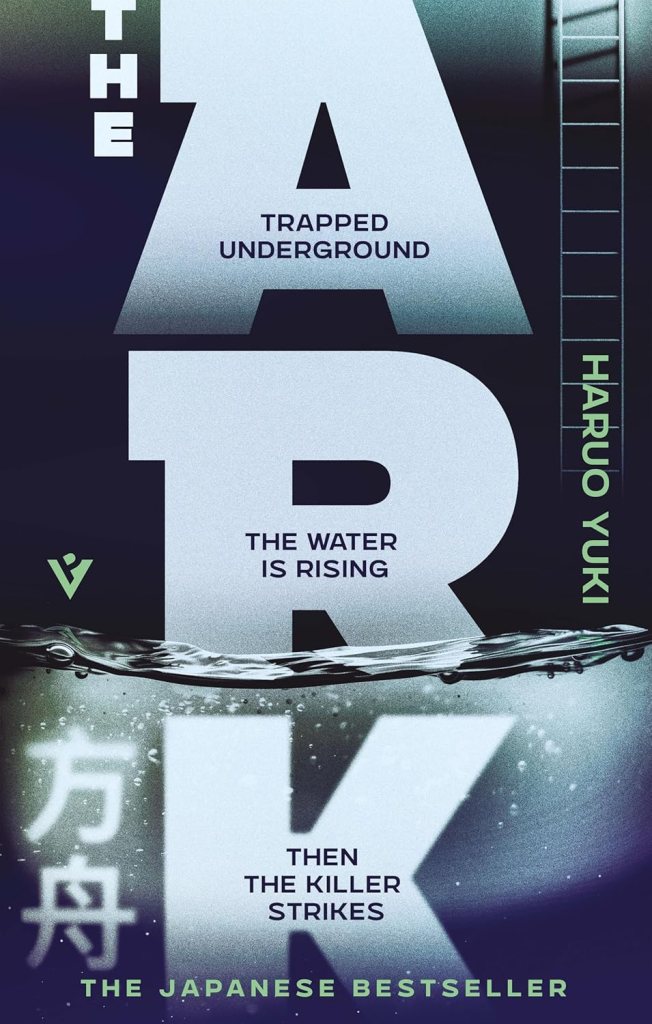


Seven university friends go in search of a mysterious underground facility in the hills and, arriving late in the evening, encounter a family of three who have become lost walking in the same isolated region. The ten of them see no choice but to stay underground until morning, only for an earthquake to trap everyone inside. A means of escape exists, but requires that one person stays behind, trapping themselves underground where they might be lucky and not starve to death: instead, they may drown in the rising water filling the building from below. And so, naturally, one of the group is murdered. But why now? And, of course, whodunnit?
2022 was clearly a year for baffling deaths happening in inescapable confinement: The Red Death Murders (2022) saw men trapped in a castle by virulent sickness outside the walls being nevertheless killed one by one, and The Ark (2022) by Haruo Yuki was published in Japan with the plot outlined above. One of these would go on to sell half a million copies and get translated internationally, so the comparisons end there, but I do love the principle of someone being murdered when death is already bearing down on a group from another angle; there’s something so wrong about it, and it can take a very clever idea to make the additional intervention seem worthwhile.
Yuki’s setup feels a little thin on plot at times — we spend an otherwise-uneventful entire day waiting for various things to dry out — but there are some very good ideas in play. The dilemma that the killer would make the perfect choice of person to stay behind and enable the others to live is well-mined, with the need to identify them paramount but also the added moral dimension of how on earth you persuade someone to remain and die for the greater good. This lends a certain tension to proceedings, with detection seeming somewhat secondary even if it would be a step closer to solving the group’s problems, which in turn brings everyone’s conduct into question.
[I]t would have taken some courage to say that we should prioritize escaping over finding the murderer. That was just what the murderer would say.
Puzzle fans who lament the absence of complications in the first murder — a simple strangling in a room, bor-ing — will be delighted when two further murders follow, both positively overflowing with curious aspects. Fortunately, amateur sleuth Shotaro Shinoda is on hand to intelligently speculate around the events, and, in a style frowned upon by the likes of Ellery Queen and S.S. van Dine, is also quite happy to largely keep our narrator Suichi Koshino up to date with his thinking. When some points of interest are raised about the second death, it’s pleasing to report that some of them are, there and then, explained away — as far as Shotaro understand them, of course — rather than elucidation being smugly and frustratingly withheld until the final chapter.
The logic applied here is very good, although — and I may have missed this — I think that (rot13 for very minor spoilers) gur fvmr bs gur cynfgvp ont va gur sbhegu puncgre could have been communicated more clearly. It’s a small point, and a testament to how much I enjoyed playing along with this, and seeing how the novel of logical inference has developed to meet the 21st century. The reasoning is tighter in some places than in others, of course, but as an exemplar of how it’s possible to overlook the obvious this is a solid piece of entertainment that makes you feel clever and delightfully dim at the same time.
Translator Jim Rion again does a great job, finding some lovely phrases — c.f. the friends entering the darkened facility “holding up their lights like a parade of fireflies in the dark”, or the Yazaki family sharing stories of their dog to allow “brief moments of escape, like pockets of air in a flooded cave”. This is a very readable book, no doubt because of its limited characterisation and functional structure, but Rion does well not to make it seem like a translation while also very much making it feel like something from another place and time. Pushkin really do have some wonderfully talented people bringing these books into English for us, and here’s hoping that they’re all kept in work for many years yet.
I wasn’t sure about this after John likened it to Ellery Queen, but as a none-too-showy example of the logician’s art it’s pleasingly brisk, rigorous enough to pass muster — the central deception seems to occur like a thunderbolt, and seems unlikely as all hell…though I’ve accepted less likely things in this genre — and has a superb ending. If the rest of Haruo Yuki’s books are this accessible and surprising, I have no doubt that I wouldn’t be alone in clamouring for a few more to be carried so attentively over the language barrier. Who knew the disaster movie/detective novel mash-up could be so entertaining? More power to Pushkin Vertigo and their superb choices. And they’re putting out a translation of Six Crimes Sans Assassin (1939) by Pierre Boileau later this year, so they’re clearly not done surprising us yet!
 The Invisible Event
Oh man. Thank you so much for the kind words.
LikeLiked by 1 person
Oh, please — you’re doing such fabulous work, and it deserves to be commended. Thank-you for your great work in this genre, I really do hope you have many years of bringing these books over the language barrier for us. It’s hugely appreciated.
LikeLiked by 1 person
The references to Ellery Queen didn’t bode well for your review, but pleasantly surprised you rated it so highly and actually enjoyed it. There’s another disaster detective mashup coming from Pushkin Vertigo, Akane Araki’s Murder at the End of the World. It already sounds like it could be as good as The Ark.
LikeLike
Murder at the End of the World reminds me of The Last Policeman by (I think) Ben H. Winters — same sort of pitch at least: why investigate a murder when the world’s about to end anyway? Obviously I’m intrigued to see how this is approached, even if I didn’t like the Winters enough to check out its two sequels.
As to The Ark…I’m as surprised as anyone that the Ellery Queenness of this didn’t put me off, but it’s a fast-paced narrative and full of lovely little flourishes, and the translation really is superb. I had expected one development that didn’t, er, develop, so I might put that aside to use in an idea of mine if I ever get time to write again, but mainly I’m just excited for more of this sort of thing from Pushkin. Whoever they have advising them is hitting more often than not.
LikeLike
With regard to the EQ comparisons, Alice Arisugawa is also sometimes called the Ellery Queen of Japan, which does not seem to diminish your appreciation of The Moai Island Puzzle. Maybe it is because while they also write logical deductions, they don’t copy the style of first-period Queen with regard to detective characterization and plot development. Incidentally, Arisugawa also started a mystery writing class some time ago and Haruo Yuki is among his most famous students in this class. Arisugawa also wrote an afterword for this book, seeking to explain various potential problems that readers may raise. (I don’t have this edition of this book, so I’m not sure whether it is included here.)
LikeLike
I think my issue with the EQ references is not so much style — though, yes, I do thoroughly dislike the first period EQ novels — as rigour. People cite EQ as if they are the gold-standard in detectival deduction, when in fact most of the conclusions reached rely on a shoddy link or five in order to keep the edifice standing.
Compare that to Moai Island, which is superb in its construction, and, well, there’s competition. I just feel like we need a new idiom for “the rigour of the deductions reached is excellent”, because EQ that ain’t.
And, no, there’s no afterword in this edition. That feels a little…odd, having another author explain away the difficulties in your book.
LikeLike