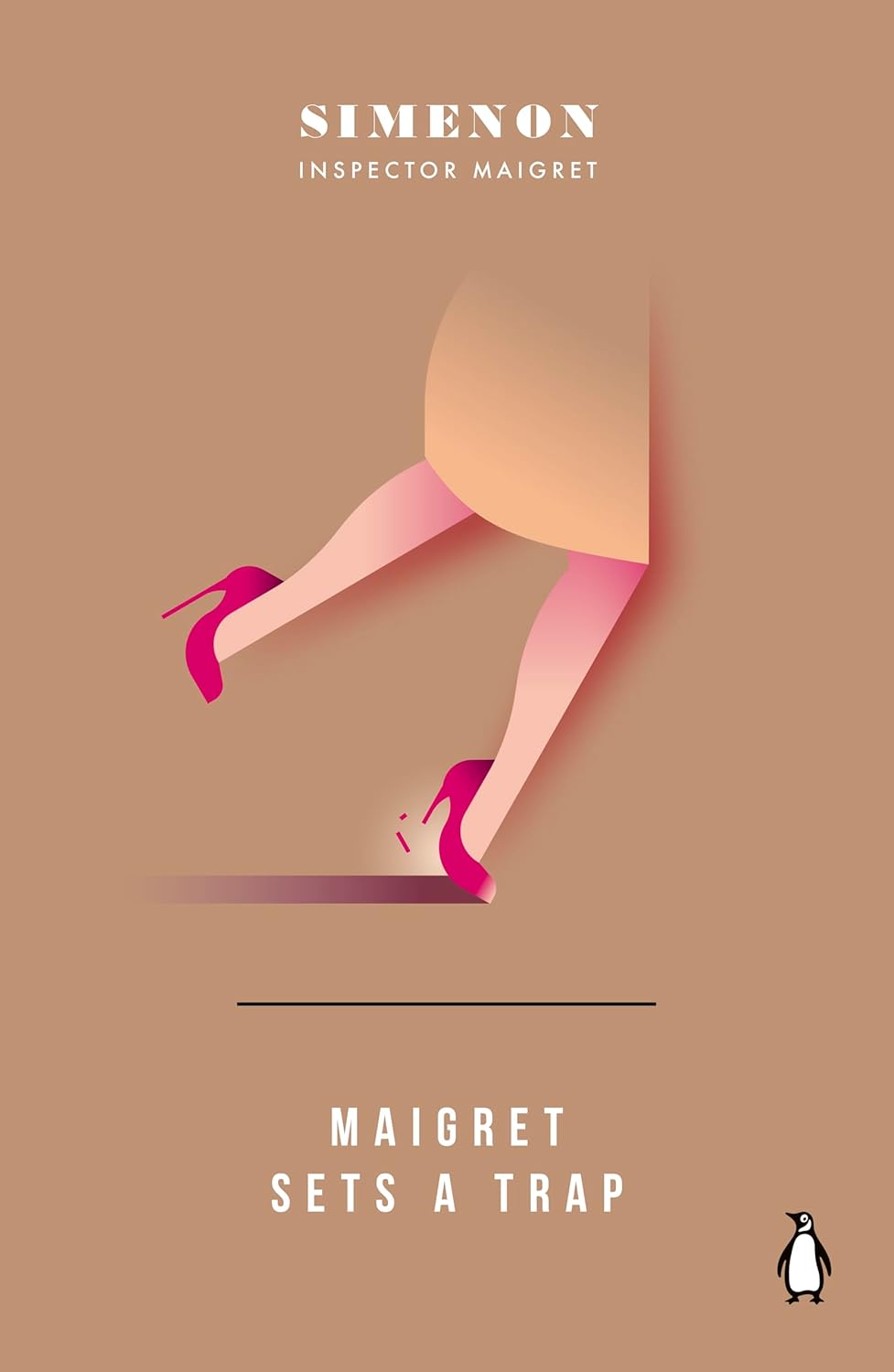


Despite enjoying a few standalone titles by Belgian minimalist Georges Simenon — thanks in no small part to the Orion Crime Masterworks series — I was left rather ambivalent by my first encounter with Inspector Jules Maigret in The Late Monsieur Gallet (1931). A recent comment on that post, however, directed me to a few titles which might be to my liking, and so here we are with Maigret Sets a Trap (1955), the forty-eighth of seventy-five books featuring the character. A serial killer has already murdered five women in the same Paris arrondissement, and while much of what follows feels very familiar, you also have to wonder if it was Simenon who established a pattern that others would so intently adhere to in the decades ahead.
We begin with something already afoot, Simenon sparsely yet easily painting Maigret as famous in his methods where the watching Press are concerned — “When [he] sent for a trayful of beers, it indicated that he thought they would be there for some time.” — and awake to the seriousness of what he is undertaking (“Five women had died, and there was no reason to think it would stop there.”). That the eventual reveal leans into the emerging psychology that was finding its way more and more into crime novels in this era is unsurprising, and the threads of psychology picked up throughout feel familiar now but as if they are asking genuinely startling questions in 1955:
“At what moment did the impulse seize him? Do you see what I mean? At what moment does he stop acting like you or me, and start acting like a killer? Does it strike him at some point during the day, and does he then wait for nightfall to prepare his plan of action? Or on the contrary, does the impulse come over him the instant an opportunity offers itself? At the very moment when, walking down an empty street, he sees a possible victim?”
Reflections on how responsible the killer may be for his actions rub against the growing discomfiture of the populace at large (“Everyone is watching the neighbours with suspicion. We’ve received hundreds of letters informing us about the strange behaviour of perfectly normal people.”). And while the psychological toll on Maigret isn’t exploited in the way that you feel a modern crime novel would wring him out and flap him around a bit, there’s a sense of a man under pressure feeling himself separate from the world around him — lying to his wife, which he hates — and being always aware of his status as a public figure, with associated pressure more implied that explored.
And so, in this region of the capital with its “hundred dark corners where an attack could take place almost without risk”, Maigret sets his trap and must deal with the fallout. Again, one feels that a modern author — or one who relied more on shilling shocker techniques — would delve into this more deeply, but there’s a power of sorts in Simenon’s minimalism, and the translation by Siân Reynolds both keeps the developments taut and finds some unlikely poetry at times:
The police would still be scouring the Montmartre area, street by street, house by house, until the dawn lit up the dustbins pulled out on to the edge of the pavements.
Very little herein with surprise or even really fully engage the modern reader, who has seen it all a million times, but, as I said above, this is both a period of genre fiction in transition, with the forensic science evinced nearly five decades earlier by Dr. John Thorndyke still holding sway (“After all, three years earlier, had they not identified one criminal thanks to traces of sawdust on a handkerchief, and another through a spot of printer’s ink?”) yet modern concerns like an awareness of the importance of keeping the Press on-side very much in Maigret’s thoughts. Plus, again as above, it’s to be wondered if the developments which seem to hoary now were ever quite deployed in this way before. It seems unlikely that Simenon would write so trammelled a book, with the concentration of his efforts deserving perhaps more consideration for innovation than we now realise.
Little moments speak loudly, such as our embattled Chief Inspector being likened to a concert pianist as he prepares to confront a suspect, and while the final recourse to psychology of two women involved in the case doesn’t quite ring true for me — innovation will always stumble at some point, the ground being unmapped — this might just have the most perfect final sentence of any book I’ve read in the past decade of this blog, with a sentiment that reverberates back into what you’ve just experienced and paints elements of it in a new light.
This has been, then, an interesting delve into Simenon’s oeuvre, which hints at a power in the concentration of his writing which was conspicuous by its absence in my earlier sample from this series. It would overstate the situation to say that I’m now a convert and will dive hungrily into his other works, but there’s definitely something about this which makes future visits to the Maigretverse a far more likely and appealing prospect. I won’t be reading all seventy-five of them, but the occasional toe in these Parisian waters might be just the sort of revitalising experience the GAD doctor ordered. Expect developments.
 The Invisible Event