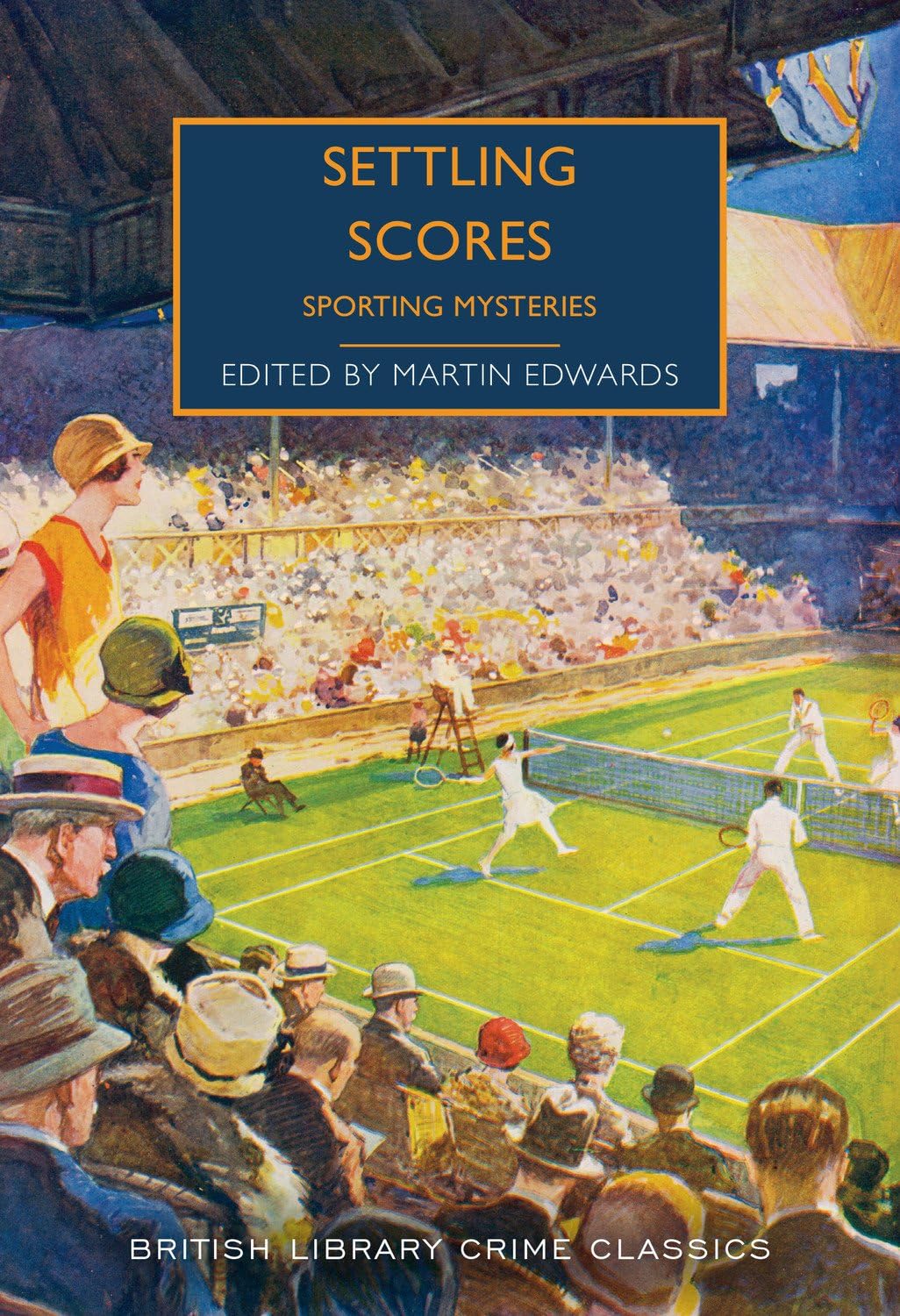
Fifteen tales of murder and mystery centring around various athletic pastimes would, you imagine, be a fairly difficult undertaking to assemble, and so Martin Edwards is to be commended for finding enough to fill the pages of Settling Scores [ss] (2017) for the British Library Crime Classics series.
For no particular reason, it has taken me until this last year or so to make a regular feature of reading these expertly-curated anthologies, and I was drawn to this one in part because I’d read so little of what’s in it, but also because I was intrigued to see how the Golden Age of Sitting Down and Employing the Grey Cells would apply itself to more active endeavours. So, let’s (ahem) dive in.

Like, I’m sure, many of you, I’ve read some of Arthur Morrison‘s stories featuring Martin Hewitt, the avuncular anti-Sherlock Holmes, but I’d struggle to name them or recall their details. So ‘The Loss of Sammy Crockett’ (1894) is a canny inclusion, though struck me with a sense of déjà vu that makes me wonder if this is one of the ones I’ve encountered before.
The mystery involves the disappearance of a runner — who I honestly thought was a horse until he speaks — ahead of a big race, and Hewitt’s engagement in finding him. The detection is fairly staid and the intelligence hardly earth-shattering (it does not occur to a pub landlord that someone could take off their shoes, for one), so you can see why author and character both have been somewhat absorbed by history, but it’s a nice primer for this volume overall.
One of only two stories in this collection that I’d definitely read before, I’m not going to talk about ‘The Adventure of the Missing Three-Quarter’ (1904) by Arthur Conan Doyle. I’m working my way through the Holmes canon one short story at a time (beginning here) and would rather give this the same attention as the others thus far discussed, so expect it to crop up on The Invisible Event in due course.
While ‘The Double Problem’ (1922) by F.A.M. Webster lacks a little in the finer arts of misdirection, it is a fascinating capsule for an era in sport when increasing professional involvement is seeing the amateur status and love of sport for sport’s sake being stripped away. “[T]he growing popularity of [athletics] has attracted the attention of the bookmakers”, we’re told at one point, with the likes of cricket having “fallen into disfavour with the uneducated and unintelligent”.
A dud cheque, a stolen list of athletes that was being kept away from the nosy press, and a talented hammer thrower who has “courted a quite unnecessary degree of notoriety by growing a beard” all combine to an interesting motive and some good deductions by sometime chemist Ebenezer ‘Old Ebbie’ Entwistle. I would be very interested to read more of Webster’s writings about him.
J. Jefferson Farjeon‘s ‘A Fisherman’s Luck’ (1925) is perfectly fine, but Detective X. Crook figures out a sinister crime without the reader ever being let in on what he sees or any of the key evidence. I find Farjeon easy reading, and cannot lament his regular appearance in these collections on those grounds, but I do wish there was more detection about him, y’know?
Once more H.C. Bailey commends himself as someone I really need to read more with ‘The Football Photograph’ (1929). Starting out with a not uncommon burglary-and-murder setup, this goes interesting places in the discussion of the evidence against the suspected party, the role of the police in setting up a trial, and then talking us through the trial and beyond. It borders on the inverted at times, and contains nothing in the way of a surprise, but the structure and pains taken with its milieu are undeniably compelling. Yes, Bailey really must be a focus of mine in 2026.
A corpse on a golf course dead not of boredom, as would be reasonable to expect, but a nasty head wound confronts us in ‘The Red Golf Ball’ (1938) by Gerald Verner. Being Verner this is cleanly and propulsively written, with well-delineated characters and some lovely turns of phrase…
The air quivered with a concentrated selection from a vocabulary acquired during thirty-five years in the Indian Army
…but unfortunately does nothing to set up a very set-uppable revelation that drops on the final page to clear up the problem. It’s a fun story, but would have been brilliant if some sort of clue were laid on the way to that telling disclosure.
No mean athlete in his time, David Winser writes of ‘The Boat Race Murder’ (1940) from a position of knowledge that you can’t help but feel is hard to match among Golden Age practitioners. When the stroke seat of the Oxford team faces replacement, it’s not long before murder intervenes and…well, you’ll have to see how it plays out. Like the Verner story before it, this benefits from tidy telling and a pleasant voice (I learned a new word: tohu-bohu), and like the Verner it holds back a key point until the conclusion, rendering it again enjoyable but, alas, disappointingly remiss in the matter of rules.
My mixed experience with the work of Gladys Mitchell continues with ‘The Swimming Gala’ (1952), which is at least short and proves to be a bit something and nothing. Of course, it was originally published in the Evening Standard, so we shouldn’t expect too much of it, and on that front it’s hard to object to, as it’s certainly well written and, not being afforded the space to hang about, gets its very minor problem of the shooting at a swimming competition out of the way quickly.
‘The Case of the Man in the Squared Circle’ (1944) sees a return of these collections to the work of Ernest Dudley, whose Dr. Morelle is perhaps the most pompous fictional character I’ve yet encountered (“When [his secretary] made foolish mistakes in her note-taking, [Morelle] would become loquaciously condemnatory of her limited intelligence.” — what a dick). This involves a murder at a boxing meet, and a well-described fight with plenty of good, visceral writing is unfortunately its strongest element.
Edwards’ characteristically excellent thumbnail sketch of an introduction makes Dudley sound like a fascinating man (“an actor, a novelist with three books filmed, a radio and television scriptwriter and presenter, a journalist, a screenwriter, playwright, jazz critic, dancer, songwriter, artist and one of the world’s oldest marathon runners”). I just wish I liked his writing more.
The second story in this collection I’d read before, ‘I, Said the Sparrow’ (1951) by Leo Bruce concerns a man shot through the roof of his mouth by a bow and arrow. I read the collected Bruce short stories in Murder in Miniature [ss] (1992) several years ago, and seem to remember this being about the best of them. Would have been nice if Sergeant Beef could have found the key oversight to prove his surmise, but it’s a neat little story all the same.
A bookie, some blackmail, and the violent consequences thereof form the basis of ‘Four to One — Bar One’ (1933) by Henry Wade, and the more Wade I read, the more convinced I become that he was most comfortable being able to spread himself out over a long narrative. This isn’t bad, and it ends on a nice note, but it feels a little bland for all its trappings and realistic-feeling argot. It’s fine, I guess, but I feel like I always say that about Wade’s short fiction.
Cricket rears its head in ‘Death at the Wicket’ (1956) by Bernard Newman, with spice added to a local game between sides thanks to the somewhat borderline behaviour of one of the batsmen. Most of this is concerned with explaining the history of ill-feeling, with the murder coming late and spy-catcher Papa Pontivy wisely realising the method and motive with very little effort, but it’s an enjoyable little story for all that. I’d read more Newman on this evidence, most certainly.
When the great white hope of British tennis vanishes after winning his quarter-final at Wimbledon, there is understandable confoundment and uproar — thus, broadly, runs ‘The Wimbledon Mystery’. a.k.a. ‘The Centre Court Mystery’ (1956) by Julian Symons. Symons is to be commended for the richness of the milieu he conjures up here, but the era in which he’s writing, and his own genre interests, sees this devolve into Communist spies and other folderol. Goes on for far too long, so, while being well-written as you’d expect, I have to say this rather tested my patience.
Once again, I find myself a little confounded by a story by Michael Gilbert, with ‘The Drop Shot’ (1950) being a simple enough tale that could have a Roald Dahlian sting in the tale if structured differently, but is just sort of a loose idea put down without too much consideration.
Edwards is increasingly veering out of the Golden Age with one or two stories in these collections, but always displays excellent judgement when doing so, as in the case of ‘Dangerous Sport’ (1976) by Celia Fremlin. This slightly overlong story of an adulterous husband takes a while to swing round to sporting matters, but is devastating when it does and ends on a note of pure perfection.
And so, with that all said and done, a top five:
- ‘The Double Problem’ (1922) by F.A.M. Webster
- ‘Dangerous Sport’ (1976) by Celia Fremlin
- ‘Death at the Wicket’ (1956) by Bernard Newman
- ‘The Football Photograph’ (1929) by H.C. Bailey
- ‘I, Said the Sparrow’ (1951) by Leo Bruce
Not only, then, has Edwards done a great job in finding enough stories to fill out a selection on the theme of sports, he’s also managed to cover a really very impressive range of athletic endeavours. Lovely to see a range of approaches here, showing just how richly the Golden Age was able to apply itself to any brief, and some fine writing from some obscure quarters really elevates the collection overall.
I come away from this hopeful that some of F.A.M. Webster’s ‘Old Ebbie’ stories may yet find their way into my hands — and I really must put on a bit of a spurt in acquiring a Reggie Fortune collection or two, and very much look forward to another of these compilations in another couple of months. I really don’t know why it’s taken me so long to get to them, but I’m catching up now — and the one scheduled for later this year, Puzzles of the Parish [ss] (2026), sounds like it could be a belter.
~
British Library Crime Classics anthologies on the Invisible Event, edited by Martin Edwards
Capital Crimes: London Mysteries (2015)
Silent Nights: Christmas Mysteries (2015)
Crimson Snow: Winter Mysteries (2016)
Continental Crimes (2017)
Foreign Bodies (2017)
The Long Arm of the Law (2017)
Settling Scores: Sporting Mysteries (2020)
Final Acts: Theatrical Mysteries (2022)
Crimes of Cymru: Classic Mystery Tales of Wales (2023)
Who Killed Father Christmas? and Other Seasonal Mysteries (2023)
As If by Magic: Locked Room Mysteries and Other Miraculous Crimes (2025)
 The Invisible Event