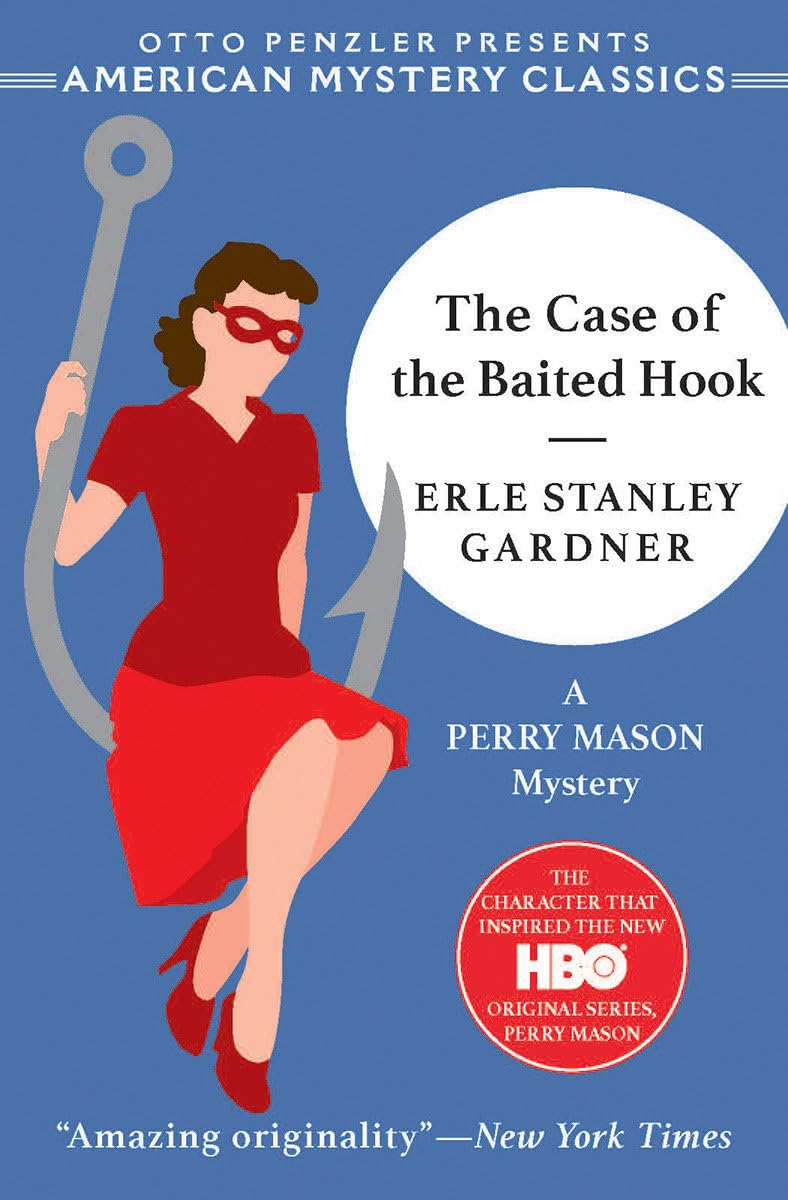
I first read The Case of the Baited Hook (1940), the sixteenth novel by Erle Stanley Gardner to feature go-fast-and-hit-hard attorney Perry Mason, back in about 2002. Its recent republishing in the American Mystery Classics range, then, was a chance to revisit it — an intriguing prospect, given that I was even vaguer on the events herein than usual.
Awoken at home just after midnight by the ringing of his unlisted phone, Perry Mason is summoned to his office by an unknown man offering him $2,000. Some quick work by Paul Drake’s detective agency means that 20 minutes later, when Mason enters his office, he knows the man is Robert Peltham…much to Peltham’s consternation. What Mason is unable to assert, however, is the identity of the young, masked woman who has accompanied Peltham, a woman Peltham offers Mason $10,000 to represent should the need arise. Her name, her situation, her requirements, or the circumstances which may arise are, presently, kept secret, but the hook is baited by Peltham giving Mason a section of a $10,000 bill, the rest of it being handed over to the young lady at the core of things.
As if events weren’t already mysterious enough, an approach is then made by sexagenarian Abigail E. Tump, guardian of the comely Byrl Gailord. Mrs. Tump’s precise intention isn’t at first clear, but it seems that she has her doubts about Robert Tidings, one of the trustees in charge of Miss Gailord’s legacy, and, since financial irregularities have recently come to light at one organisation where Tidings held the purse strings, Mrs. Tump wants something done, something that might even see control of the money pass to a certain A.E. Tump. Oh, and that organisation with the financial irregularities? One of the purse strings appears to be held by a certain Robert Peltham.

One of the things that real comes through in this book is the reputation Mason has established for himself via his extraordinary legal shenanigans. He has become a byword in legal situations as someone who is bound to find in favour of whoever hires him, and this naturally puts up the backs of certain individual he encounters:
“I’m going to warn you, young man,” he said, “that you’re due for the surprise of your life. Your rather spectacular courtroom victories have been made possible because you were pitted against underpaid public servants and political appointees. You’re going up against the best and highest-priced brains in the legal business now.”
Mason, however, bears this newfound infamy with a certain lightness that does rather encapsulate the character and everything he stands for:
“Lots of lawyers go into court with a case founded on false testimony. Sometimes they make it stick. Sometimes they don’t. Personally, I’ve never dared to take the risk. Truth is the most powerful weapon a man can use, and if you practice law the way we do, it’s the only weapon powerful enough to use.
“A lawyer doing the things that I have done and relying on anything less powerful than truth would be disbarred in a month.”
There’s something delightfully old-fashioned about these books written in the 1930s and 40s that this is enough for a character to run on. These days he’d have a par of cuff links with something pithy engraved on them, or would have to underline everything by railing against injustice or something lofty. Mason just believed that the truth triumphs and that’s enough to allow his sometimes dubious conduct. There’s a lovely moment in which Mason is accused of doing what he does in the interest of criminals, and he retorts that, since all of his clients have so far been found innocent, he hasn’t actually represented any criminals as the definition goes.
Indeed, the best parts of this book are where we dig into Mason’s psychology:
“Every time you stop to figure what the other fellow’s going to do, you unconsciously figure what you’d do in his place. The result is that you’re not fighting him, but yourself. You always come to a stalemate. Every time you think of a move, you think of a perfect defense.
“The best fighters don’t worry about what the other man may do. And if they keep things moving fast enough, the other man is too busy to do much thinking.”
To an extent, that’s Gardner’s writing in a nutshell: just as you, the reader, think you get a grip on something, Mason, or Donald Lam, or Doug Selby manages to turn in a different direction and start solving apparently unrelated problem that nevertheless circles back around to join up with the conundrum initially confronting them. It means that the books can sometimes be less than memorable — honestly, I struggle to remember them a week after I put them down, where Agatha Christie or Freeman Wills Crofts books I read years ago are still fresh — but it keeps things exciting. If I could change one thing about Gardner’s writing, I’d have a Gather the Suspects at the end where he got them all together and walked them through the case as is traditional, but, well, those chapters are hard to write and, if I’m honest, I quite enjoy the challenge of joining the dots sometimes without being led through it by the nose.
This does have the unintended consequence that sometimes, as in this book, you’re left with the feeling that things don’t quite join up.
While there’s some solid and intelligent reasoning at times (“It’s a rule of the sea that women and children go first.”), and some very good detection at others (the discussion about shoes and what might or might not be on them), I won’t deny that at times there are some leaps or marvellous narrative reversal which come out of practically nowhere and, yes, veer you off unpredictably on another course, but also leave you with a sort of ‘Hang on, does that…?’ feeling which Gardner is understandably keen for you not to examine too closely. “I do appreciate good detective work when I see it,” Mason is told in the closing stages, and I agree, but there’s a subtext here which implies we have seen it in this novel and…I’m not convinced.
I mean, what actually happened? Once again, I finished this book confused, and not just because of all the talk about buying and selling stock which left me cross-eyed. Gardner’s too much of a class act to abandon all reason or good writing, and so while this may have been plotted on the fly it is at least an entertaining read. I mean:
“He doesn’t stand out any more than cigar ashes on a gray rug on a misty morning.”
Or:
Only her lips were smiling.
There are also wonderfully tight character moments, like Mason and Della Street scouring the papers for events that might have seen Peltham consult him only for Perry to “promptly [turn] to the sporting pages”, or the wry moment he acknowledges that “[t]he police think we find too many corpses” (very nearly the title for this review). Also, Perry Mason “detest[s] umbrellas”. Who knew?
I wouldn’t go so far as to say I didn’t enjoy The Case of the Baited Hook, because the main characters are the sorts of people I enjoy spending time with (Paul Drake lounging across the chair in Perry’s office, laconically summarising the latest developments, Mason and D.A. Hamilton Burger going at each other with thinly-veiled disdain…who doesn’t want to sit in on that?!). But for clarity and brevity of scheme, this is not where you go if you wish to believe Perry has Saved the Day again. Indeed, when in chapter 1 he says “It’s goofy. It doesn’t make sense”, one feels that, too, might have made an excellent title for this review.
~
Perry Mason on The Invisible Event
Novels:
1. The Case of the Velvet Claws (1933)
11. The Case of the Lame Canary (1937)
12. The Case of the Substitute Face (1938)
13. The Case of the Shoplifter’s Shoe (1938)
15. The Case of the Rolling Bones (1939)
16. The Case of the Baited Hook (1940)
28. The Case of the Borrowed Brunette (1946)
Novellas and Short Story Collections:
 The Invisible Event
I just read this a couple of weeks ago and posted a review of it. My opinion more or less matches your: this is great fun, but the solution is…”out of nowhere” is too strong, but we get a lot of running around for a very abbreviated solution.
It’s interesting how Gardner varied these books. I’ve read three Masons (technically four, one was a novella), and Gardner made them feel fresh just by tweaking how in control Mason is. In one, he’s a step ahead of everyone. In another, he’s a step behind and gets outplayed a couple of times. Here he’s in everyone’s faces and constantly on the move. He gets mean in this one. I enjoyed the ride and now I’ll be keeping an eye out for more Masons.
LikeLike
I enjoyed your review (I can’t comment on your blog, because I don’t have a Google account), and was glad that someone largely held the same opinion of me knowing this was coming up in a few weeks. My perspective on Gardner is often a little flexible, since I’ve read bunches before and often struggle to remember what…so a book might make me feel a little jaded because I’ve read it once already 🙂
I’m thinking I might go back to the first Mason next, which I remember being rather different. I agree that ESG did a fabulous job of varying the plights and stakes from book to book — and consider all the other novels and stories he was writing at the same time, too…! — and it’ll be fun to see what his conception of the characters and series first was given the behemoth we know it went on to become. Watch this space…
LikeLike
The Mason of the early novels is much more hard-boiled, but you knew that already. Looking forward to seeing more of him! I’ve read one of the A.A. Fair’s, You Can Die Laughing, so I might have something to say when you get there.
And thank you for reading and enjoying my blog, it’s encouraging. 🙂
LikeLike