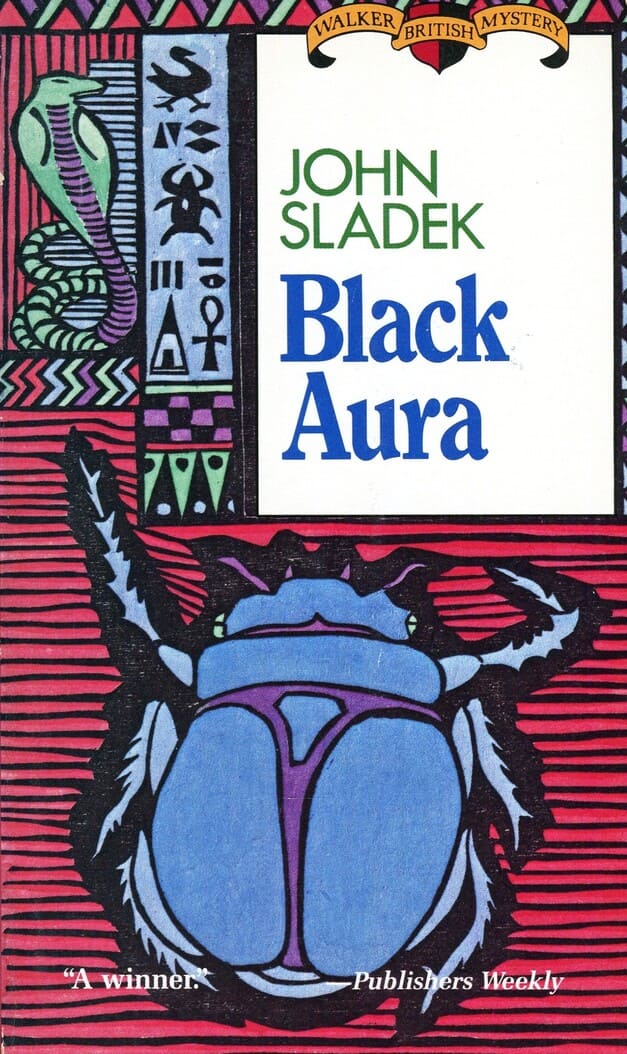


I hold John Sladek’s second and final detective novel Invisible Green (1977) in very high regard indeed, but have not read his first, the slightly less successful Black Aura (1974), for well over a decade. It’s pretty incredible that something which gave so much air to three baffling impossibilities was written as late as 1974 at all, and so revisiting it and finding a book which doesn’t quite fulfil the expectations of any idiom — it’s too puzzle-focussed for the gritty style that was popular at the time, but too nebulously handled to satisfy true puzzle heads — isn’t really a surprise. There’s still some enjoyable stuff in here, but this is very much the apprentice work for the masterpiece Sladek would produce three years later.
London-based medium Viola Webb is making quite a name for herself among the fashionable and — perhaps more importantly — wealthy Kensington set, with her Aetheric Mandala Society of believers attracting great attention from those outside the townhouse-based commune. Her lectures and demonstrations are often sold out affairs, with many people attending in the hope of contacting loved ones on the other side of the veil. When the Society attracts the attention of displaced American wannabe-sleuth Thackery Phin, it is only a matter of time before Phin is invited into the inner realms…just in time, too, as all manner of inexplicable happenings are about to unfold.
Sladek’s writing is gorgeously atmospheric in the setup, establishing not merely the oddness of Viola Webb’s followers buy also the general drear of London in the 1970s — an early mention of an overpass as “a grey dinosaur’s belly…standing on fat grey dinosaur’s legs” is superb. And it’s clear that Sladek has a keen eye on the potential moodiness of the forthcoming events, noting early on that “[h]umour and horror are never so far apart, and shaking with laughter often looked like shaking with fear”. And he is awake to the humour when it’s there to be found, such as retired Wing Commander Bruce Dank chatting at a seance via Mrs. Webb with “an old RAF mate whose memory was as vague as his vocabulary unmilitary”.
Once Phin is ensconced in the house with the “middle-aged hippies” who will cause Chief Inspector Gaylord such headaches, the book became less well-structured than my memory would have it. We veer from tedious conversations to sudden miraculous happenings, and everyone seems to react as if these are everyday occurrences — even when one of their number plunges to his death having been seen levitating outside a fourth floor window. I know these people are believers, but Sladek rarely invests these incredible events with any sense of incredulity for the reader, who has been invited on more than one occasion — not least through the presence of sceptic Professor Merihew Hackel — to view these people and events askance.
The three impossibilities lived up to my memory of them: the vanishing from a locked toilet is still ridiculous, the levitation doesn’t quite work, and the vanishing of a mourner from a funeral parlour is exceptionally good in its sheer simplicity. There is, however, a disappointing lack of detection — rarely, it must be said, much of a concern for the American writer of puzzle mysteries — and all these years later it really is not simply the what happened of the crime which I enjoy but also the how the sleuth got there. In ever other regard the book almost lived up to my memory, but in this one it drops a little in my reckoning, the final chapter containing much in the way of my never-loved ipsedixitism as Phin simply tells us what he knows and expects the scant clues dropped throughout — a thread here, a coin there — to prove sufficient.
Still, as I say, the existence of this book is pretty miraculous in itself, with impossible crimes being in somewhat short supply in this decade — Leonardo’s Law (1978) by Warren Murphy keeping Sladek company, and proving a hugely enjoyable time in the process — and we should celebrate that Sladek chose to dip his toe in the water and swirl some intriguing patterns for our amusement. And, hey, maybe with slightly lowered expectations I’ll return to this in another decade-plus and find it delightful once again; it certainly doesn’t deserve its obscure status, but quite who would reprint it in these wonderfully GAD-focussed days is another matter…
 The Invisible Event
I enjoyed reading your thoughts on this one. I remember it pretty fondly, though it has been a while since I read it. What I recall thinking is the individual impossibilities were less interesting in isolation than they were together. The issues you point out with the detection process seem fair and of the three impossibilities, one is clearly far better than the other two!
LikeLike
Invisible Green is the better novel, but not by much. I remember this one delighting me with its 1970s New Age satire much the way the films The Long Goodbye (1973) and Invasion of the Body Snatchers (1978) used it for comedic and horrific effect respectively. I totally get that a mystery doesn’t live and die with commentary, but it added a lot to the pleasure of the novel. As for the tricks, I wasn’t nearly as bothered as you with the locked toilet “vanishing” because it was layered into the story (pushing the narrative ahead) without being a showpiece. I liked the levtiation trick more than you and (as you say) the disappearance from the funeral parlor boggles the mind with its effectiveness/simplicity ratio — it’s a lesson for all writers of impossible crime.
Comedy is a tricky thing in detective novels. As great as Carr was, his comedy was rarely welcomed. Sladek had a gift for it.
I suppose we’ll have to disagree about this one. At least we can agree on the disappointment of no other Sladek mystery novels and no other Thackery Phin investigations. For me, great detectives are either crotchety or smooth and Phin was a terrific example of the latter.
LikeLike
Having come back to this with such fond memories, my reaction was always going to be a little muted. Now that I view it less favourably, perhaps in another decade I’ll rereread it and absolutely love it — books are tricky things!
Sladek is very good at the comedy of the collection of people thrown together in the commune, and he mines Phin for good comedy in Invisible Green, I agree. There’s a subtlety to it which I no doubt underappreciated in being so meh’d by the mystery this time around.
LikeLike
I’ve yet to read Black Aura but your comparison to Altman’s Long Goodbye definitely piques my interest (on top of my love for Invisible Green.)
LikeLike
In Black Aura, Phin has to infiltrate a commune. They are a new-age(y) group that believes in spirits and things of that nature. I remember his dealings with them being especially funny (eg a ghost being scared half to life) and the scenes reminded me of a lot of TLG’s absurdities eg Marlowe living next to the yoga nudists. Both works have a lot of fun at the expense of the American 70s ideas of fulfillment, therapy, and happiness — especially when juxtaposed with the strict code of the private eye.
LikeLiked by 1 person
A local theater screened Long Goodbye a couple years ago and I went on a whim having never seen it before. Was kind of blown away. I’d seen a couple Altman films before that and TLG wasn’t anything like them. It’s absolutely genius in how it deconstructs the private eye as a concept by making Marlowe such a bumbling chatacter (which Elliott Gould does perfectly.)
LikeLike
I really hope someone would reprint John Sladek’s mystery stories (the novel and the short stories). I think the only time I have seen a case involving impossible levitation is in the Case Closed vol. 44 manga. I thought the trick is very clever, even though it probably won’t work as well in real life. Wonder whether similar trick is used in Black Aura.
LikeLike
I lost interest well before vol. 44 for Case Closed, but you make me want to check it out if only for another levitation trick 🙂
And Sladek’s mystery stories — presumably all of them — are available in the Maps collection, which has been reprinted in recent years. Go grab it!
LikeLike
I second your recommendation for the Sladek collection, but sadly misses at least two of his best detective stories, “Scenes from the Country of the Blind” (collected in Alien Accounts) and “The Locked Room” (collected in Keep the Giraffe Burning).
The levitation tricks from Case Closed, vol. 44 and Black Aura are iconic, but all they have in common is that they’re levitation tricks.
LikeLike
Thank-you for the additional information; ‘The Locked Room’ clearly needs checking out…
LikeLike
I’d say we agree on this one pretty much entirely other than I did like the solution to the bathroom disappearance. Being more of a Christie fan than a Carr fan, it’s exactly the sort of solution I do enjoy. The levitation trick doesn’t quite work and I think I had a slightly better one in mind (though, of course, I have no way of knowing whether that would work at all), but it’s pretty clever stuff.
Overall, Invisible Green is the better book, though not by much. It’s funnier, better-paced, has “fleshier” characters, and a more compelling plot. My biggest gripe with Black Aura is that, even though a lot happens, it feels slightly uninvolving. Like a series of events unconnected by a coherent narrative.
However, and I hate to burst this bubble again, Invisible Green has a lot of the same problems you criticise Black Aura for. It has even less detection (in fact, I’d argue that Phin does absolutely NOTHING in that book at all beside witness other people solve the case for him), the first impossibility is not well clued, and the second is a cheat. Having now read all of Sladek’s Phin stories, my biggest grip with Impossible Green is that it turns Phin into too much of a clown. In the two short stories and Black Aura, he’s a much more rounded figure. In Invisible Green, he might as well wear a red nose and honk a giant trumpet.
I think Sladek showed a great deal of promise, but neither of his novels really live up to it. If he’d gone on to write another 10 mysteries, we’d probably look back on these two as lesser examples of his genius. Perhaps he was wise to return to sci-fi where his sense of humour, sharp writing, and otherworldly tendencies weren’t as beholden to plotting requirements and a need for the protagonist to actually do something.
LikeLike
Yes, I think you’re correct about Sladek’s return to SF being a good call on his part. And I see no reason why Invisible Green sholdn’t suffer from the same problems as this, since the two are similar in my mind — I love your description of Black Aura as “a series of events unconnected by a cohesive narrative”.
I can believe that 2026 Jim would probably be less taken with IG, so maybe the answer is not to reread it for a while and to let my impressions of BA start to colour my expectations for that eventual reread. Stands to reason I would have been blown away by it at the time, but my tastes have honed somewhat, so I can easily believe that a wonderful novel a decade ago might not hit the same high spots today.
Ah, well…
LikeLike
I think it’s sometimes a good idea not to revisit old favourites. Keep them in your mind as you enjoyed them back then. I definitely a have a few “sacred cows” which I prefer to keep as happy memories. Sometimes the real benchmark is not necessarily the quality of the novel, but rather our reaction to it. Not even certified masterpieces like “And Then There Were None” can ever compare to the experience of reading them for the first time.
The two Sladek novels are similar, but Invisible Green is definitely the more mature work. You can tell just by how more profiled and human the quirky characters seem in that novel as compared to Black Aura. He also does a much better job of integrating all the impossibilities into a solid plot.
LikeLike
Yes, it’s very much as case of the book staying the same and the reader changing. I find this with the Going Home posts I do semi-occasionally on here, where I loved the crime novels of the early 2000s at the time, but now I look back and wonder sometimes how I was ever so caught up in so much gloop.
And I’ll still keep rereading the classics, of course, because sometimes — The Franchise Affair, Suddenly at His Residence — I love them second time around having been a little unimpressed at first blush. Stuff gets tarnished, yes — I’m less of a fan The Plague Court Murders now — but that’s fine. Shows growth, or something.
LikeLike