
Having now read — and in some cases, reread — all eight of Leo Bruce’s novels to feature sometime Sergeant William Beef, my ordered mind inevitably moves to ranking them.
So, er, here goes; from my least favourite upwards we have…
8. Case with Four Clowns (1939) [Sergeant Beef #4]
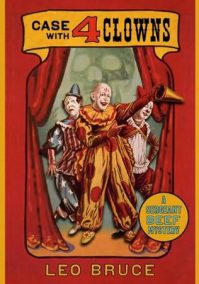
A circus should be a setting ripe for playing with the conventions of the genre — identity, location, hidden skills (“I hear she used to be an acrobat…”) — but this fourth entry in the series is so tedious in its pacing that, even when the murder does eventually happen, there seems to have been very little in the lead-up that was necessary for solving it. I was excited to get a copy of this at the time, because it proved phenomenally difficult to track down until this reprint, but rarely has the excitement of finally getting a book been exposed to the reality of that book’s many and obvious flaws so blatantly. I always say, and men, that I’d rather have read it and know I don’t rate it than spend another twenty years wondering…and frankly that’s just as well here. [My review]
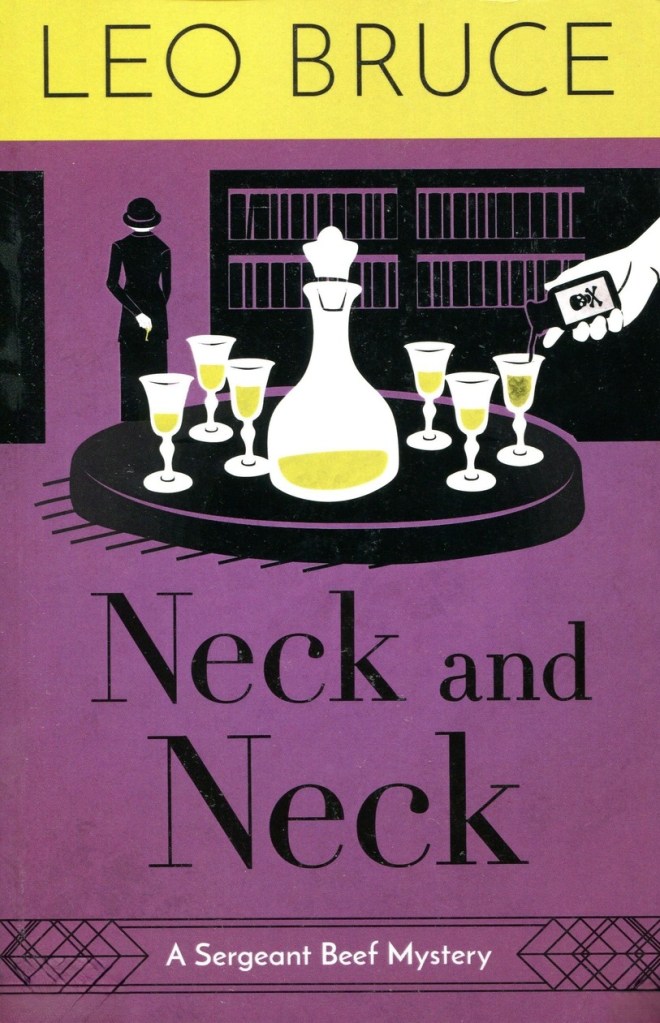
7. Neck and Neck (1951) [Sergeant Beef #7]
A clever idea at the core of this — making the mystery more personal, and having Townsend call on Beef since he now cannot deny the ex-Sergeant’s skill at unpicking these complex skeins — doesn’t save it from its repetitive execution. Once the murder of Townsend’s aunt is fully limned, we then throw in Beef’s ‘other’ case and are subjected to interview after interview after interview, which palls quickly anyway, but does so with increasing rapidity when you realise that someone in Case A knows someone in Case B and that the apparently perfect alibi for each person only applies in the obvious direction. Not a canny enough piece of plotting to justify the torpid lengths taken to get there. You can smell the end of the series from here quite pungently. [My review]
6. Case for Sergeant Beef (1947) [Sergeant Beef #6]

A fun time is had by all when Wellington Chickle moves to the country with the express purpose of killing a man he has no connection to, thus escaping undetected. Aah, the best-laid plans… This being Bruce, there must of course be a wrinkle on this, and he draws the setting and people well, using Chickle’s repeated assurances of his own brilliance marvellously to thoroughly hoist our would-be murderer by his own petard from an early stage. Flounders slightly in the closing stages in trying to fill in too many gaps with surprises — but, well, Bruce is certainly not the first author to do that, and the ride as a whole is a lot of fun and deserves credit for being done so smoothly and succinctly. [My review]
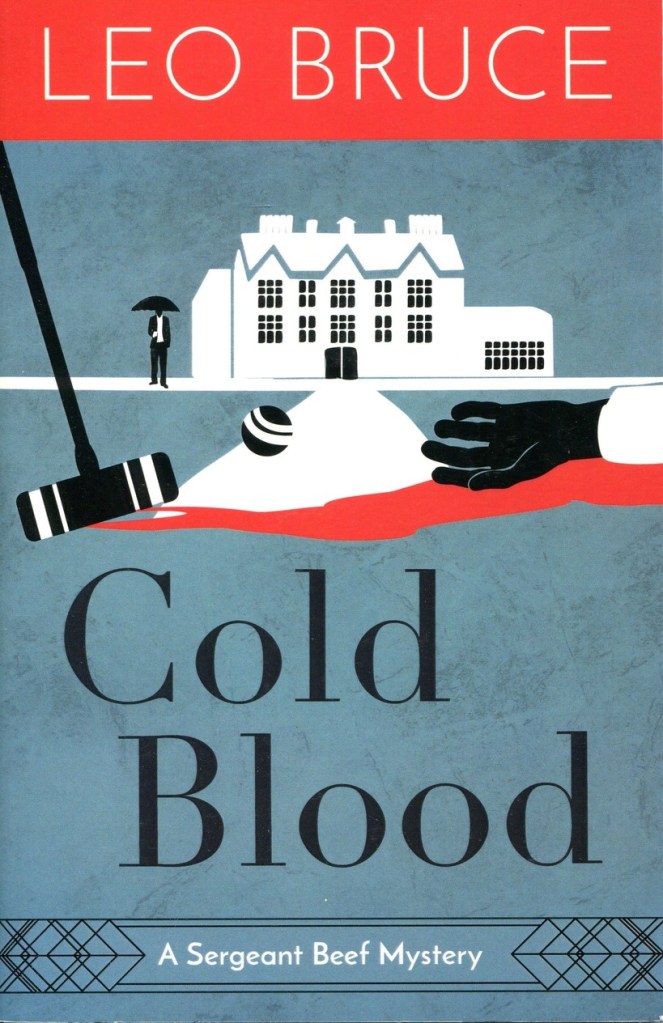
5. Cold Blood (1952) [Sergeant Beef #8]
Some great ideas present themselves in Beef’s final long-form case — the repeated use of an umbrella is especially good — and the revelations that close out all this back-and-forth are clever. This loses ground on its brethren, however, for being slightly over-long and for lacking much of the Beef/Townsend axis which has been so well-deployed elsewhere. It can be easily understood why Bruce gave up on these novels after this, because he really had challenged nearly every convention going, but it’s always fun to watch the good Sergeant pull things together. This feels, though, like the final death rattle of the Golden Age, and perhaps Bruce was wise to move on to other pastures. [My review]
4. Case without a Corpse (1938) [Sergeant Beef #2]
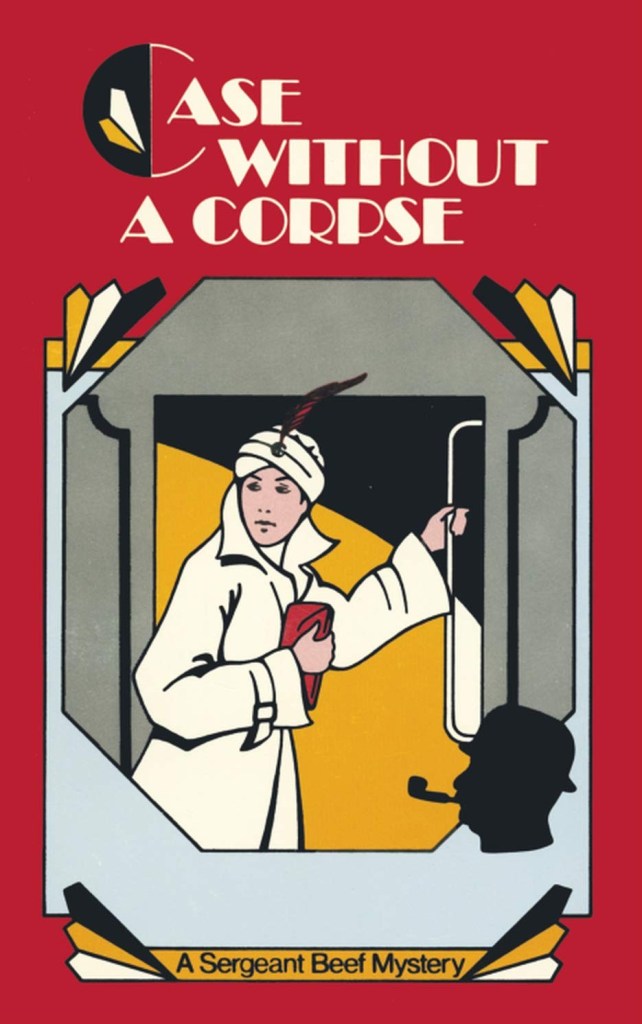
Perhaps the strongest hook of the entire run: a man enters the pub, tells Beef he’s killed someone and it’s up to Beef to prove it, then takes poison and dies immediately. Inspector Stute from Scotland Yard is called in, and spends the entire book being very smug about Beef’s clear inadequacies. Fine, but, like, Beef is established as the series detective with this second volume, and there’s simply no way that he won’t solve the case. Would have made far more sense to publish this first, then up the stakes in the second novel by having Beef try to beat not one but three detectives. As a book it’s very smart; parodying the Humdrum novel of detection by writing a straight example of that type being perhaps the most difficult thing Bruce ever attempted. [My review]
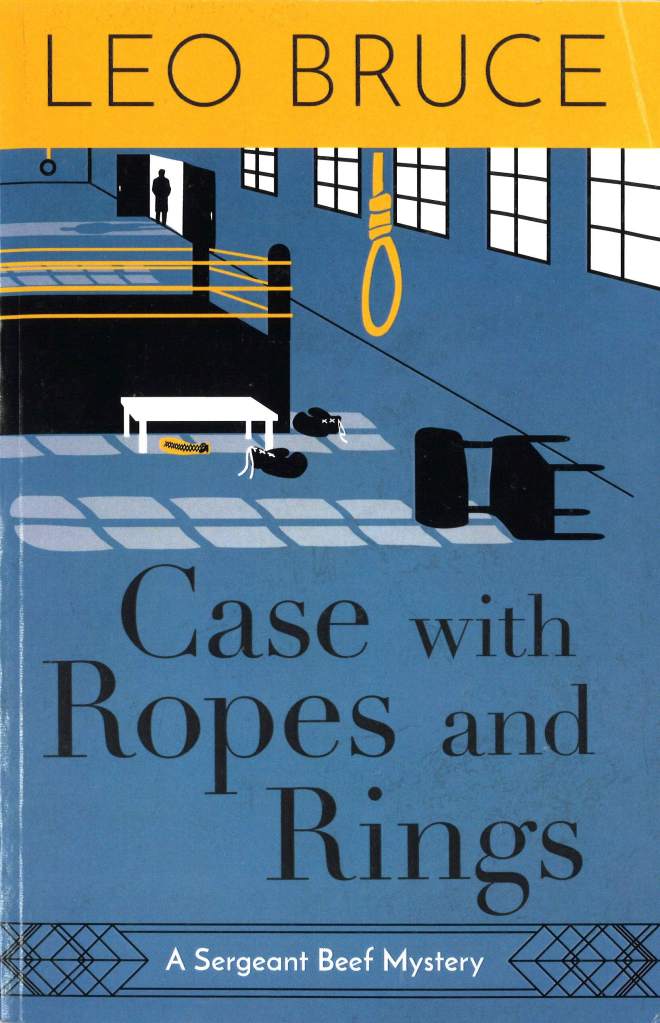
3. Case with Ropes and Rings (1940) [Sergeant Beef #5]
An entertaining book that see Beef become a porter at Townsend’s brother’s esteemed school following a death, this situation and the comedy it’s mined for — darts, ignoring bells, general chaos — being perhaps more memorable than the mystery itself. There’s one very clever clue that I was foolish enough to overlook, and it’s difficult not to enjoy the frustrations of Townsend as the earthy Beef is taken to the bosom of the student body…but only a short time after reading this I was already a little vague on what exactly happened. Which isn’t necessarily the book’s fault, and immediately upon finishing this I might nudge it a place higher, but I need to differentiate between these titles somehow and that’s my explanation here. [My review]
2. Case for Three Detectives (1936) [Sergeant Beef #1]

I have a feeling that one should read Case for Three Detectives (1936) once and once only, because it’s such a brilliant parody of the formal novel of detection that any repeated exposure is bound to lessen its impact. An excellent example of how to pull the genre apart while also playing the game, it’s a joyful romp of the highest order, and contains some superb surprises in the final stretch. It’s easily most successful, though, in sending up the High Table of the Golden Age, and must have caused quite a stir on first publication, coming for a debut author who surely had no right to have so much fun at their expense. A delightful time, but it sparkles slightly less brightly at second visit. [My review]
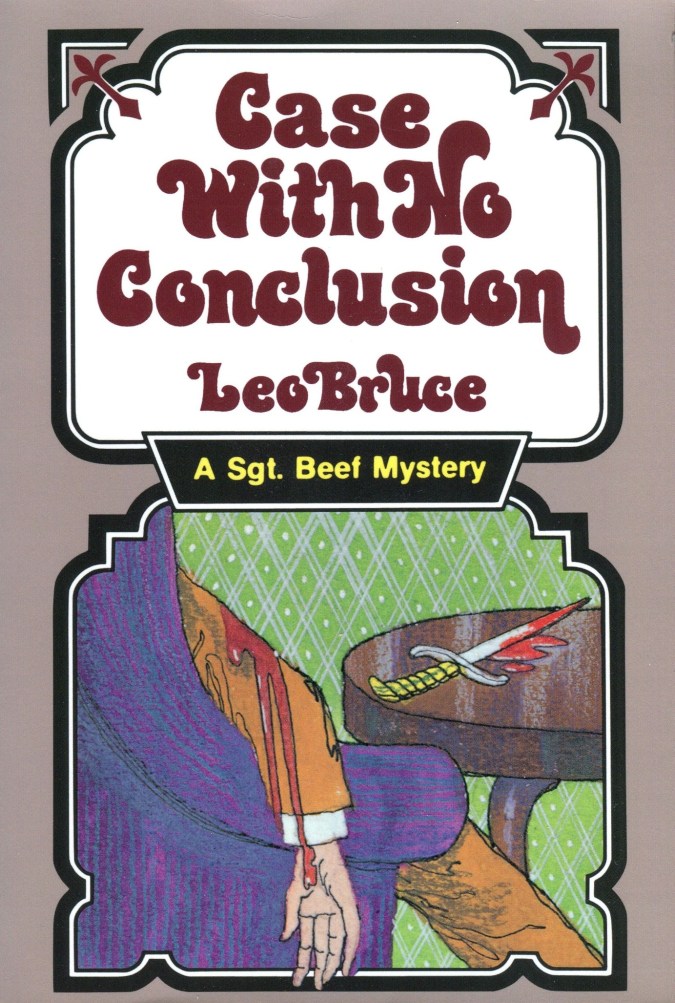
1. Case with No Conclusion (1939) [Sergeant Beef #3]
I loved this when I first read it, and thankfully this was one of those times that rereading a novel sees it rise in your estimations. Beef, now set up as an independent investigator, and must save a man from the gallows, and does so in his own inimitable style. Rich in its meta-disdain for the genre’s seemingly moribund conventions, this is one of those books that so wonderfully highlights why genre expectations are such a good thing: any game that can laugh at itself this openly while also being played with an impressively straight face is surely worth engaging with. Superbly written, minutely observed, and says more about the Golden Age than any ten retrospectives combined. [My review]
~
Series rankings on The Invisible Event:
- The first ten Gideon Fell novels (1933-39) by John Dickson Carr
- The first ten Sir Henry Merrivale novels (1934-40) by Carter Dickson
- The DCI Edward Beale novels (1936-41) by Rupert Penny
- The first 15 DI Joseph French novels (1924-36) by Freeman Wills Crofts
- The Five Find-Outers novels (1943-61) by Enid Blyton
- The first ten non-Robert Arthur Three investigators novels (1968-73)
 The Invisible Event
“…any repeated exposure is bound to lessen its impact.”
Not true! I loved Case for Three Detectives even more the second time around and has only gone up in my estimation as one of the best, most entertaining 1930s detective novels. It should have been your number one pick! Case for Sergeant Beef should have taken third or second place. I remember it being as fun and nearly as good as Case for Three Detectives. Other than that, thanks for the reminder Case without a Corpse is still lingering on the big pile.
By the way, Pushkin Vertigo is going to publish a translation of Pierre Boileau’s Six Crimes without a Murderer in November!
LikeLike
Yeah, I too would have put Case with Sergeant Beef higher…until I reread it, and there really are a lot of large hops in the final stages to cover some ground the novel didn’t get round to addressing. And Case without a Corpse would have been much lower, except that it turned out to be charming and wonderfully clever on second read, so that was great news. I hope you enjoy it when you get there.
Amazing news about the Boileau. John Pugmire translated it in the hopes that he might one day get the rights and was kind enough to let me read it, but an official English translation is spectacular news. Pushkin Vertigo really are doing god’s work.
LikeLike
It was fun reading your list and comparing it to my own. Despite our differing tastes I think we have the same books in positions 2, 3, 4 and 8. We swapped our books in positions 6 and 7, which is still pretty close. Our only big difference was the books in 1st and 5th place which we had swapped.
LikeLike
Well, great minds think alike…so I guess we draw our own conclusions from our differences here 🙂
LikeLike