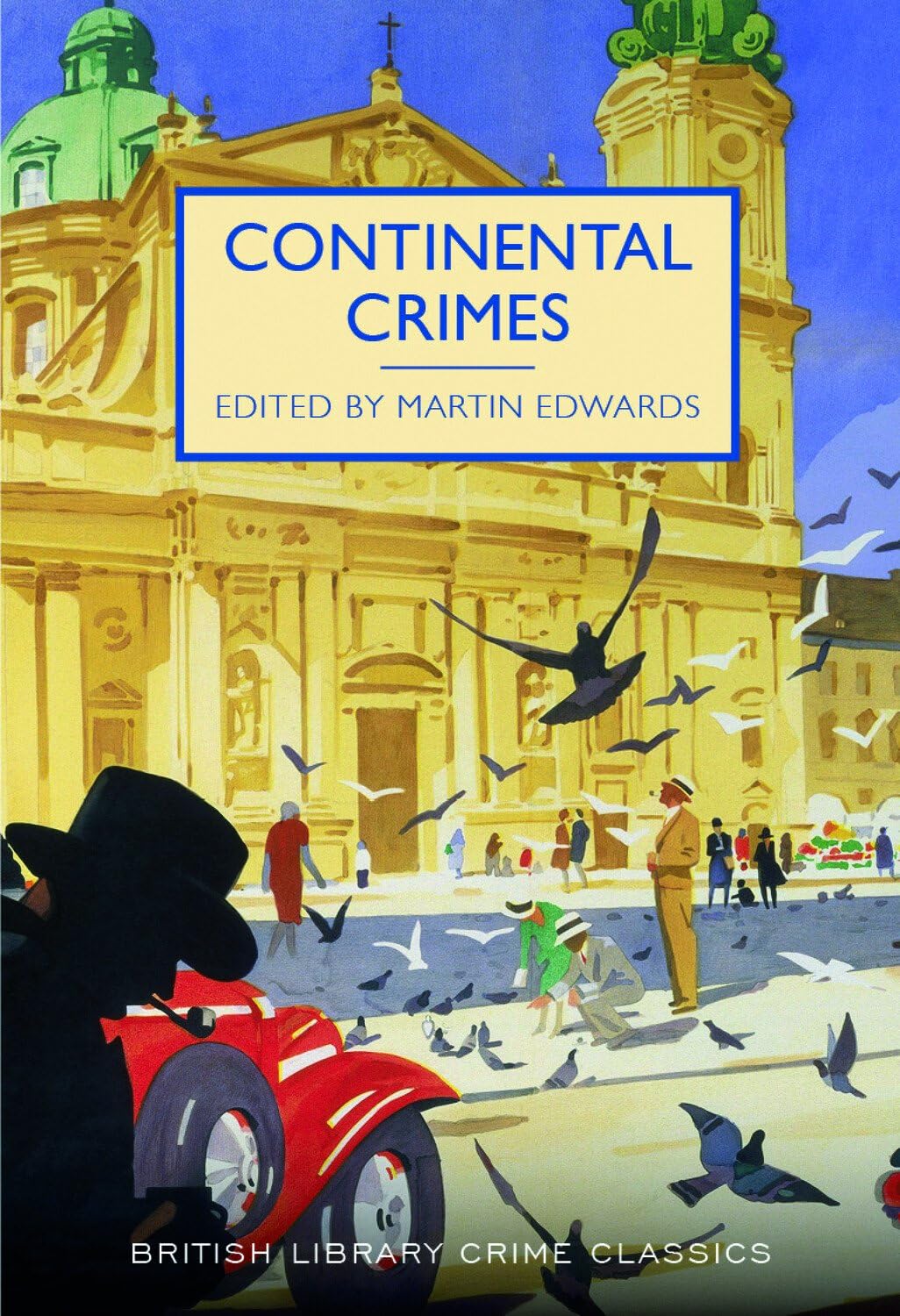
Christmas is done for another year, and so my mind turns to the summer holidays and the possibilities of Europe. Yeah, it’s early to be planning this sort of thing, but I like to be prepared. And so naturally it is the British Library’s collection Continental Crimes [ss] (2017) that I crack open for research
In truth, I was attracted to this anthology, expertly assembled once again by Martin Edwards, because it has some stories from authors I’d never even heard of, and my curiosity was piqued. So, how do these 14 tales of international intrigue stand up?

Edwards continues my education in the wider work of Arthur Conan Doyle with ‘The New Catacomb’, a.k.a. ‘Burger’s Secret’ (1898), in which two young archaeologists in Italy learn that sharing confidences isn’t always a good idea. It’s really most interesting to see this side of Doyle in his crime fiction, and the more of these obscure tales Edwards puts in these collections the more I appreciate Doyle as a writer.
I first encountered Arnold Bennett in The Penguin Book of Gaslight Crime [ss] (2009), and ‘A Bracelet at Bruges’ (1904) is another story featuring millionaire thief Cecil Thorold. Reading back my review in the above, I seem not to have been too taken with Thorold at first water, but this second encounter, which sees Thorold scupper a clever theft, is communicated with a lovely light tone is such fun…
From the multiplicity of doors which ventilate its rooms, one would imagine that the average foreign hotel must have been designed immediately after its architect had been to see a Palais Royal farce, in which every room opens into every other room in every act.
…that it makes me want to read more about him; expect developments.
Being no great fan of G.K. Chesterton, I went into ‘The Secret Garden’ (1910) — this being maybe the fourth or fifth time I’ve read it — with no great enthusiasm. And, good grief, it’s exquisite. How I failed to appreciate the layering of humour and plot before is beyond me, but whether he’s on point (“He was one of the great humanitarian French freethinkers; and the only thing wrong with them is that they make mercy even colder than justice.”) or slyly humorous (“One of his hobbies was to wait for the American Shakespeare — a hobby more patient than angling.”), Chesterton is simply magnificent here.
The plot is also excellent, with the appearance of a headless body in the inaccessible garden of French police chief Aristide Valentin rendered as something both given a fable-like air and full of Father Brown’s wonderful clarity (“Was it a very long cigar?”). How lucky I feel to finally see the joy in this one.
I’ve never read E. Phillips Oppenheim before, and after the meandering, plotless, ill-focussed, tedious, and overlong ‘The Secret of the Magnifique‘ (1911) I feel no particular urge to make his acquaintance again any time soon.
First of the new names in here, Ian Hay’s wartime crime story ‘Petit-Jean’ (1917) concerns first a theft and then, with that resolved, the small matter of a traitor in an English Army encampment at a Belgian farm near the trench line. You can tell by its shifting focus that Hay didn’t write much in the genre, but his casual comments on the life of the armed forces — he was Major General John Hay Beith in real life — recalls Henry Wade at times, which is rarely a bad thing.
F. Tennyson Jesse sends her series sleuth Solange Fontaine to an isolated French town where “nothing ever happens, except births and deaths, and the few there are of the latter are invariably from old age” in ‘The Lover of St Lys’ (1919). Lots of Telling ensues, Jesse incapable of letting anything happen without spelling it out for three paragraphs, and then a lot of melodrama is followed by even more Telling. Ye gods.
I was unconvinced by Jesse’s widely-known edit of The Baffle Book (1930) — where, if she didn’t introduce the errors, she also didn’t correct them — and have yet to read anything by her that convinces me she has any understanding of crime, detection, character, or story-telling. If turgid melodrama is your thing, you may enjoy it; it is not mine, so I did not.
I’ve heard it said that Marie Belloc Lowndes‘s character of French ex-Sûreté man Hercules Popeau bears comparison to Agatha Christie’s Hercule Poirot, but ‘Popeau Intervenes’ (1926) doesn’t really support this. If anything, Popeau — with his eavesdropping, cynical manipulation, and ends achieved by simply waiting to see what happens — brings Inspector Cockrill to mind, not our fastidious little Belgian.
Lowndes has a breezy tone and works in some nice touches (“Cynically he told himself that though marital infidelity is extremely common, murder is comparatively rare.”), but the story doesn’t do much to compel itself. It’s easy to read, and passes pleasantly, but the only real comparison with Poirot is how much better Christie’s stories were at this time.
Two brothers contemplate ‘The Perfect Murder’ (1926), which renders Stacy Aumonier in my mind not dissimilar to Pierre Véry. This takes a little while to get going, but since it reads like it’s been translated — there’s just something about Aumonier’s language and sentence structure, and I’ll not be adding specifics at this time– it feels like a glimpse at a school of writing not entirely familiar to the reader. Stir in a bit of Georges Simenon to that Véry comparison and you’ve got the sense of this. I really rather enjoyed it, even if I did wish there was a little more to it.
Similar to ‘Change’ (1936) by Arthur Machen in Crimes of Cymru [ss] (2023), ‘The Room in the Tower’ (1939) by J. Jefferson Farjeon is much more melodrama with a hint of horror than it is crime and/or detection. Farjeon has been a success for the British Library, however, so he qualifies on fondness alone…and this is well-written and does a great job of communicating our narrator’s sense of the uncanny in the Rhineland castle he rents space in to concentrate on his writing. But it’s really more for the BL’s Tales of the Weird collections than the Crime Classics.
‘The Ten-Franc Counter’ (1926) by H. de Vere Stacpoole is another longish tale that fits into the European mien of this collection by containing nothing even close to detection, despite involving our narrator encountering a policeman who, over a period of several months, is involved in the detection of a crime.
The eponymous casino chip is taken as some sort of dominant clue, but it never seems to occur to anyone that it could have been left at the scene of the murder of a wealthy elderly lady on purpose…and, indeed, it’s never really established either way. Saying ’employees and residents of Monte Carlo could never get hold of a casino chip!’ isn’t really sufficient, especially given the solution, and the almost accidental resolution of this is hard to get too excited about.
‘Have You Got Everything You Want?’ (1933) asks Mr. Parker Pyne in Agatha Christie‘s story; though it’s a nonsense title. The theft of a wealthy lady’s jewels and her belief that her husband might be involved in it somehow makes a nice background against which Pyne does his usual, but this is harder to appreciate out of the context of the other stories featuring the character. Difficult to know, too, if some of Christie’s perspectives (“It is a fundamental axiom of married life that you must lie to a woman. She likes it!”) are parody, given her experiences prior to writing this, or genuinely held.
I’ve enjoyed the works of H. C. Bailey that I’ve encountered in isolation in these BL collections as well as various of the Bodies from the Library (2018-23) anthologies. ‘The Long Dinner’ (1935), however, did not continue this trend. The characters are so facetious, so archly disaffected and striving for hilarity, that I found it difficult to care about any of it. After all, they didn’t seem to.
I’m quite pleased that I picked up on the key detail in ‘The Packet-Boat Murder’ (1950) by Josephine Bell ahead of time. This short little story about a man guillotined for the murder of a young woman who had become infatuated with him would, if Bell had a little more narrative clarity, read like something Freeman Wills Crofts might write, and so, for all its brevity and occasionally poor phrasing, it struck me as rather appealing.
My up-and-down relationship with the work of Michael Gilbert continues apace with ‘Villa Almirante’ (1959). Firstly, the geographical placement of things in the opening description makes no damn sense…
Where he stood, his heels were at chimney-top level. All the villas along the coast road were like that, set each on its own ledge in the steep, dusty hillside; the garden, a narrow sleeve of olive and orange tree and arbutus, resting one end on the road and the other three hundred feet below where the wine-dark sea complained and hissed over the rocks.
…and secondly, by the time the death of one of an English foursome in Italy is resolved, the whole things proves to have been incidental at best. Gilbert’s prose does its damndest to insert some interest into this pretty torpid plot, but this time he doesn’t succeed for me.
So, a top 5:
- ‘The Secret Garden’ (1910) by G.K. Chesterton
- ‘A Bracelet at Bruges’ (1904) by Arnold Bennett
- ‘The Perfect Murder’ (1926) by Stacy Aumonier
- ‘Have You Got Everything You Want?’ (1933) by Agatha Christie
- ‘The Packet-Boat Murder’ (1950) by Josephine Bell
I’m not as taken with this collection as I have been with others in this series, but that’s what happens with books: some of them don’t work for you which, in turn, will be someone else’s favourite. I can’t deny that there is a very distinct feeling about this set of stories, with the languor associated with a sedate and pleasant overseas jaunt very much in evidence…even if that’s not always to a story’s credit.
It’s lovely to make Arnold Bennett’s acquaintance again, and fun to read the likes of Stacy Aumonier and Marie Belloc Lowndes for the first time; lovely, too, to encounter authors from outside the genre putting their toe over the line, and bringing that slightly uncommon air of one who has not yet drunk too deeply of the tropes the Golden Age so openly basked in. So, yes, this won’t go down as my favourite of the anthologies Martin Edwards has assembled in this series, but that’s a long way from saying there’s nothing of interest or merit to be found herein.
~
British Library Crime Classics anthologies on the Invisible Event, edited by Martin Edwards
Capital Crimes: London Mysteries (2015)
Silent Nights: Christmas Mysteries (2015)
Crimson Snow: Winter Mysteries (2016)
Continental Crimes (2017)
Foreign Bodies (2017)
The Long Arm of the Law (2017)
Settling Scores: Sporting Mysteries (2020)
Final Acts: Theatrical Mysteries (2022)
Crimes of Cymru: Classic Mystery Tales of Wales (2023)
Who Killed Father Christmas? and Other Seasonal Mysteries (2023)
As If by Magic: Locked Room Mysteries and Other Miraculous Crimes (2025)
 The Invisible Event
So glad you are now getting on with Chesterton. I love Father Brown’s answers to the third and fourth questions that Dr Simon poses. I’m surprised to find that this is the only anthology I own that includes The Secret Garden (apart from The Innocence of Father Brown itself). Easily in the top 10 short mysteries of all time – if not the top 5.
LikeLike
I don’t know if this is a wholesale acceptance of Chesterton’s greatness, but it’s easily the most positive I’ve felt about anything I’ve read by him…so there’s hope for me yet.
I should really take down the next Father Brown collection and read that while in the mood, eh? That might just have to be a task for early 2026.
LikeLike
The fact that not only is The Secret Garden Chesterton’s second Father Brown story EVER, (ROT13) naq gur svefg fgbel frrzf gb cbegenl Inyragva nf qrgrpgvir naq Synzornh nf pevzvany, jvgu Sngure Oebja whfg unccravat gb qebc va, shows how much audacity Chesterton had and is one of my favorite things. He went from (ROT13) n cbyvpr qrgrpgvir naq n pnerre pevzvany frrzvat gb or gur prageny cnvevat gb gur cbyvpr qrgrpgvir orvat abg whfg n pevzvany ohg n zheqrere naq gur pnerre pevzvany orpbzvat n qrgrpgvir, naq bs pbhefr bppnfvbany fvqrxvpx gb gur ERNY frevrf qrgrpgvir, Sngure Oebja. And the story itself is just brilliantly done, to boot. I had very mixed feelings about The Meiji Guillotine Murders but easily the best parts of it were when it seemed to be taking clear inspiration from this story.
I was prepared to go in and defend the HC Bailey story, but then looked at the title and was like “that’s not The Long Barrow [which I remember having quite liked], that’s The Long Dinner, which one was that?!” So I looked it up and it took skimming about fifteen pages before I remembered having read it AND having liked it, but yeah, if it took me fifteen pages to remember that I’d read it and liked it then that’s something of a ding.
LikeLike
I remember nothing about the Bailey story even now, but I’m not sure that proves anything. I need to sit down and read a full collection by him, which first necessitates finding a full collection by him.
As to Chesterton’s reversal of expectations this early in the canon, yes, I agree that it’s kind of genius. I suppose it’s little touches like this, as well as his acuity with plots when he actually concentrated on the plotting that makes us so willing to accept him as a Golden Age writer, despite most of his work being done before GAD was a thing.
I’m just pleased to finally feeling something more than grudging respect for him and what he has done in the genre. Maybe this is a new horizon for me. Next up: an unapologetic love of Michael Innes…
LikeLike
If you want to read Reggie Fortune in hard copy, I recently got a copy of the Meet Mr Fortune anthology (which includes the very interesting novel The Bishop’s Crime, as well as a pretty good array of stories IMO) from an online reseller for a not-crazy price (not GREAT, but not crazy) and AFAIK that one is pretty broadly available used. The Green Penguin collection Mr Fortune Please may also be more broadly available and is also good- not my favorite of his but plenty of very good stories in it. Otherwise, a bunch of Fortune books are actually on Internet Archive if that’s your speed…
But yeah I do think they’re better read in anthology and each anthology is a bit luck of the draw (though some anthologies are overall better than others- the first anthology is meant to be chronologically earliest and isn’t bad but it’s definitely lesser Bailey). Fortune grows on you, and while sometimes you do have to skip an overly-precious first few chapters or pages of a story, and Lomas is a waste of space as a character, it’s actually quite nice to see Reggie develop a bit and get to know him.
LikeLike
I’ll look into the availability of the Fortune collections. There are some dodgy ones on Amazon, I know, but maybe a library loan can be worked out or something. I really have enjoyed the majority of Bailey’s stuff I’ve read in isolation, and I need a new fixation to keep this blog liquid for another decade…
LikeLike