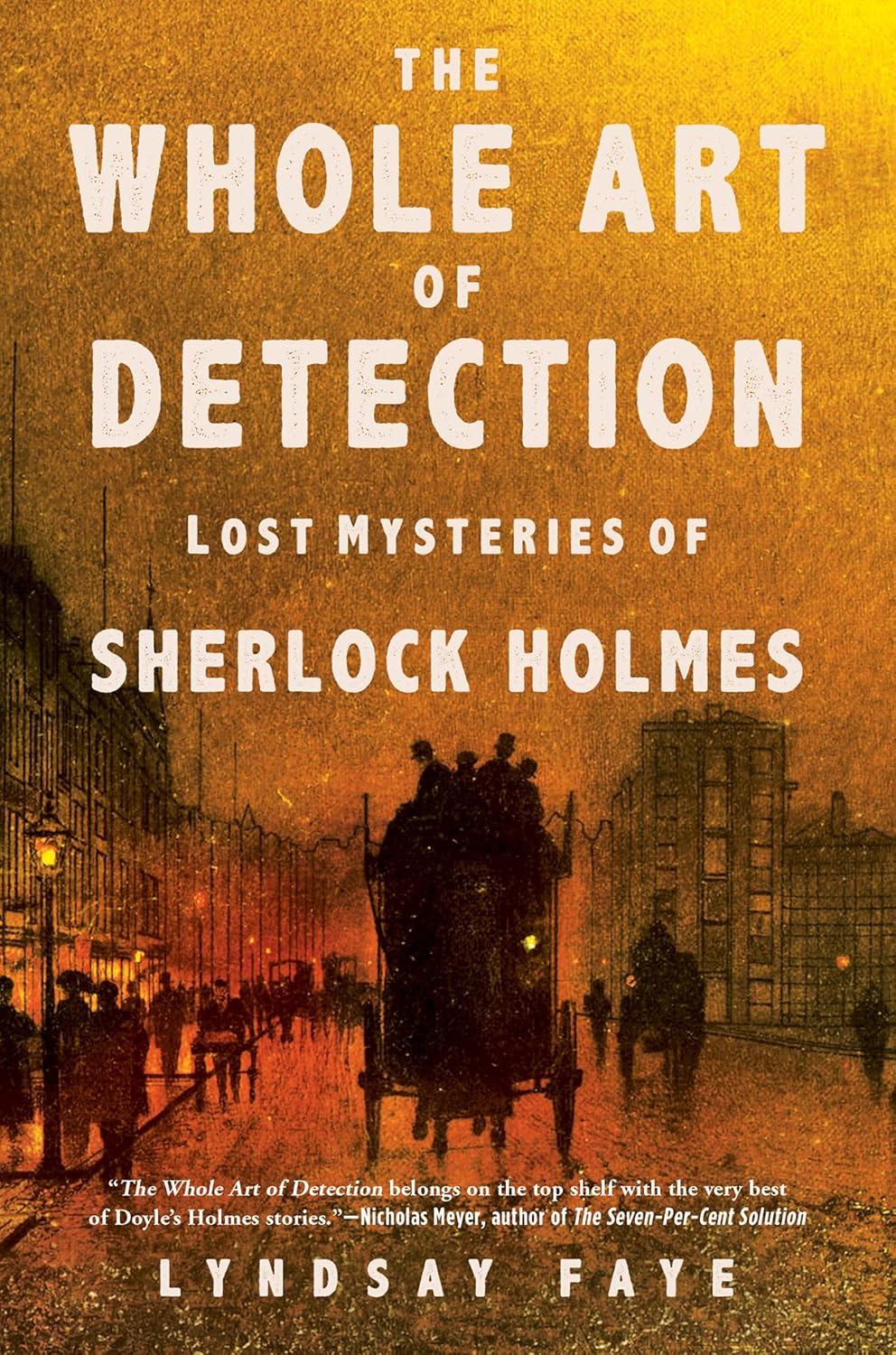
Lest we forget, I was not enamoured of Lyndsay Faye’s Sherlock Holmes novel Dust and Shadow (2009), but her characterisation was strong, people seem to rate her pastiches, and Holmes arguably finds his firmest feet in the short stories. And so to Faye’s anthology of Holmes stories The Whole Art of Detection [ss] (2017) do we turn today.
Split into four sections, to represent the approximate era in which Faye set these stories, the collection is non-chronological in the writing but rather, I think, in their occurrence. So the old chestnut of ‘start and finish with the best two stories’ might not necessarily apply. Something to bear in mind as we dive in…

Part I: Before Baker Street
‘The Case of Colonel Warburton’s Madness’ (2009) is, of course, a reference from ‘The Engineer’s Thumb’ (1892), and sees a newly-qualified, San Francisco-based Watson happening upon the eponymous old soldier as he appears to be having the latest of many hallucinations. The untangling of this, seeing as it is being told to Holmes many years later, requires a few coincidences, but Faye does a good job of making the case none-too-complex, even if the workings of the scheme seem a little unlikely.
Less a crime story and more a case of filling in some lore, ‘The Adventure of the Magical Menagerie’ (2015) sees a 22 year-old Holmes making the acquaintance of “Old Mr. Sherman”, whose dog Toby was to play such a key role in The Sign of the Four (1890). Faye has a good sense of the characters here — “[H]e is the seventh most abhorrent man I have ever put behind bars.” — and it’s a lovely conceit to have an unskilled Holmes learning his various trades. The canon it plays with is certainly more important than the case itself, and that’s no bad thing.
There’s a good sense in ‘The Adventure of the Vintner’s Codex’ (2011) of Holmes again as a younger, callower investigator, but, in common with the previous two in this volume, it takes bloody ages — nearly half the story — for anything to happen. This was an issue in Dust and Shadow, too: for all the undeniable atmosphere of Faye’s writing, she singularly lacks anything close to the pace and drive of Doyle’s prose and plots. The damp cotton wool here is a great clue, but even that flies in the face of Doyle’s canon, with clewing hardly a high priority for him most of the time.
Part II: The Early Years
It was during ‘The Adventure of the Honest Wife’ (2010) that I finally allowed my doubts to overwhelm me, with the tired old maxim of Holmes As Misogynist trotted out and Watson describing a client as “contumacious” — far too complex language for these to pass as genuine pastiches. Again, about half of what’s here is not needed, and that once more pads out a story so that it appears a reputable length. I just do not see me gelling with Faye’s style of writing, so should I continue to read this collection? Another 11 stories await; do I want to put myself through them now that I suspect I won’t like them?
So the timing of ‘The Adventure of the Beggar’s Feast’ (2009) could hardly be better: see, this is the sort of creative thing that should be being done with Holmes pastiches, embracing the weirdness of the best of Doyle’s tales and building new lore in the process. The puzzle of a well-dressed beggar enables some fascinating detail about begging customs — maybe none of it’s true, but crucially I believe it — and the story builds nicely to its delightful, joyous, season-appropriate climax. Wonderful stuff, and hopefully a sign of more to come.
Okay, it’s taken a little while, but everything comes into focus with ‘Memoranda Upon the Gaskell Blackmailing Dilemma’ (2013), told through diary entries of Holmes’s while Watson is at Baskerville Hall. Faye’s interest in Holmes isn’t so much conjuring up abstruse crimes as trying to make the world in which he exists more textured: see the reflections on Watson and Mrs. Hudson herein, while the simple matter of a blackmailer is at best a tertiary strand. Faye is here for the characters and the milieu — at both of which she excels — not the plots. I shall bear this in mind going forward, because it really helped this very, very good story pass more favourably.
Trust Faye, then, to deliver perhaps the most densely-plotted story yet, with ‘The Lowther Park Mystery’ (2011) giving us a Spanish businessman’s briefcase emptied of untold capital while residing in the locked study of the host of the garden party at the eponymous stately home. Maybe it’s my newfound tolerance for Faye’s excess detail, but this is a pastiche that reads like one and would fit perfectly well into any anthology thereof. Fast-paced, minor, plenty of fun, and with Holmes on bitchy form. Slight, but very enjoyable.
Part III: The Return
A dual narrative greets us in ‘An Empty House’ (2014), with Watson mourning the loss of Mary Morstan (“I buried my wife today.”) and using this as a background to reflect on the loss of Holmes, and, alongside, the story of the murders of the Abernetty family. This is the famous “parsley sunk into the butter” clue, referenced in ‘The Adventure of the Six Napoleons’ (1904), and Faye’s explanation is very intelligent and fitting. Again, this is too long — Faye digging into Watson’s grief to make his brace of separations tangible — but, if you’re into that sort of thing, there’s plenty here to get your teeth into.
The receipt of a trinket and a cryptic note about the sender’s location sets us off on ‘The Adventure of the Memento Mori’ (2012), but Faye’s real aim here is to get Watson back into Baker Street. Again, the beats between the characters are lovely and this is far more about the story around the story than the investigation itself: some slight geographical detection being about the only intelligence allowed to seep through. Nevertheless, I won’t deny that great thought has been put into the wider elements of the world (“Forty-seven times.”), and it would be a hard heart that could not enjoy those aspects.
‘The Problem of Thor Bridge’ (1922) of course gave us the tantalising hint of the man “stepping back into his own house to get his umbrella, [who] was never more seen in this world”, a thread picked up by no less authority than John Dickson Carr in ‘The Adventure of the Highgate Miracle’ (1954). ‘Notes Regarding the Disappearance of Mr. James Phillimore’ (2014) introduces an identical twin brother and plays out exactly as you’d expect, but I’m signed up to Faye’s characters now and having a very enjoyable time:
“My name is Atlantus B. Conger, and I’ve a meaty bone to pick with you.”
“How unfortunate,” my friend drawled, tilting his head as he studied the intruder. “On both counts.”
The setup of ‘The Adventure of the Willow Basket’ (2015) — a man found completely desanguinated, without a mark upon him to show how — sounds familiar, and I have a feeling I’ve encountered it elsewhere. A little research tells me Faye took this from another reference in the canon, ‘The Adventure of the Golden Pince-Nez’ (1904), so it’s not impossible that I have read another pastiche which used the same basis as a jumping-off point. The story itself is fairly bland, with the most interesting parts being the opening and closing sections, which do not deal with the central crime.
Part IV: The Later Years
A spiritualist with a scientific way of summoning the dead is the focus of ‘The Adventure of the Lightless Maiden’ (2012) and, I’ll confess, the purpose of this tale is sort of lost on me. And does it not require Miss Constance Cooke to be especially, well, dense? Yes this is an odd one all round, perhaps the first real false step of the collection, but I suppose its very oddness, and the fact that no real crime is being committed, makes it interesting in its way. And nice to see Holmes and Watson having curry for breakfast again; glad I’m not the only one who picked up on that.
One of two stories newly-written for this collection, ‘The Adventure of the Thames Tunnel’ (2017) concerns a criminal recently released from prison found shot in the middle of the eponymous railway tunnel, his footprints in the mud making the commission of the crime a little obscure: for how could the man possibly have emerged from a blank stone wall? The answer is fine, and it feels Doylean in its eventual solution, but I can’t see much here that makes this tale essential; it’s not an unrecorded case as far as I can tell, and all feels rather perfunctory.
One three separate occasions, Horatio Falconer has been kidnapped and awoken in a strange room, where he is held for a few days until being chloroformed once more and redeposited back in Covent Garden, where he sings for money. Such is ‘The Adventure of the Mad Baritone’ (2017), a pleasingly weird setup that plays out more or less as you’d expect, complete with “shockingly credulous” dupe. It’s one of the few plots herein that feels like something Doyle would conjure up, but the effort is again liable to go unappreciated largely because it is, once again, deflatingly long-winded.
We end with ‘Notes Upon the Diadem Club Affair’ (2015), in which Holmes is approached by a foppish, dandyish member of the aristocracy and invited to attend a meeting of the eponymous club. Quite what the purpose in writing this story was, I am unable to discern; far from, as I suggested at the top, ordering this collection so that it finishes with the strongest offering, the result of putting this last is that the anthology concludes on perhaps the singlemost annoying Holmes pastiche I have ever read.
To being the end with, then, a top 5:
- ‘An Empty House’ (2014)
- ‘The Adventure of the Beggar’s Feast’ (2009)
- ‘The Lowther Park Mystery’ (2011)
- ‘Memoranda Upon the Gaskell Blackmailing Dilemma’ (2013)
- ‘The Adventure of the Magical Menagerie’ (2015)
Given the eight years over which these were written, as well as the order Faye would have conceived of them, it would be churlish indeed to deny the thought and care that has been put in to so superbly colouring in the lines and shading of Arthur Conan Doyle’s creations. Something about the wider considerations of the relationship these men have clearly spoke to Faye, and she’s done a masterful job of expanding on the raw materials of the original canon to build a consistent and well-realised universe for them.
That said…there’s definitely a point here where the characters do feel like hers rather than Doyle’s, and a lot of the criminous plots don’t really pass muster when held against the creative delights that Holmes has investigated both in his original incarnation and since. At times, Faye is so determined to make the world she’s writing about breathe that she forgets to make it fun, undeniably a key facet of what made Holmes and Watson such great company to begin with: the chase was on, intrigue abounded, and you were right there alongside them as they crouched in darkness or pursued a hell-hound across the moors.
And so I come away from this collection a little conflicted. Faye clearly has a novelist’s take on the universe, wanting to feel the grit between her fingers and smell the breeze against her cheeks, and I’m delighted to have figured out her approach and thus gotten more out of this anthology than I initially feared I might. As pastiches, however, that sense of freewheeling adventure is missing; I’ll happily read most of these a second time if I encounter them in other collections, but I can also readily believe that there’s something more to my taste out there.
 The Invisible Event
Not at all a pastiche person so have never read any of Faye’s, but reading your review made me realize I’d never ready any of Carr’s either and that seemed like a bigger oversight. So I just read the James Phillimore one, which was fun, but which also seems to me to have been directly cribbed from (ROT13) Ntngun Puevfgvr’f fubeg fgbel Gur Qvfnccrnenapr bs Ze Qniraurvz. There are, in fairness, only a certain number of plots in the world, but it’s VERY VERY close. Makes me wonder if the plot was Adrian Conan Doyle’s idea and he got it after reading Christie…? I feel like Carr wouldn’t be that unsubtle.
LikeLike
Hmmm, good point. I don’t know how much is known about the writing of these — and I imagine it’s quite difficult to separate out the roles in a paired undertaking such as those first collaborations.
The general principle is probably If It’s Good, It’s Carr; If It’s Bad, It’s Doyle 😄 But, equally, I suppose there are only a cetain number of ways to resolve a plot of that nature, and they already had the statement in the original canon forcing their handa little…so maybe Christie got the idead from ACD and in turn went on to inspire Carr and Adrian…good grief, I’m going cross-eyed…
LikeLike
Cribbed from what? “Ntngun Puevfgvr’f fubeg fgbel Gur Qvfnccrnenapr bs Ze Qniraurvz”?
LikeLike
Oh, you want rot13.com in order to decrypt this 🙂
LikeLike