
Having previously poked their tongue into their cheeks with Your Guide to Not Getting Murdered in a Quaint English Village (2021), Maureen Johnson and illustrator Jay Cooper turn their minds to committing crimes rather than evading them with The Creeping Hand Murder (2025). I have Brad to thank for bringing this to my attention, and, having recently held forth on the hiding of clues, it seemed the perfect opportunity to look at the inevitable use of the visual to communicate that which would be far more obvious, or difficult to convey subtly, in prose.
“How was a man stabbed in a room full of people, yet no-one approached him and no-one saw a thing?” — thus is the murder of novelist Roy Peterson set up on the very first page here, stabbed with six others in the room and the ice pick that killed him found under the chair in which his corpse reposed. With the police adamant that “there were no ghosts involved [and] there is no murderous creeping hand on the streets of London”, can any solution be found? Well, yes, that’s what the genre was built around, after all. But can you, dear reader, untangle the mystery before all is revealed in the solution document that closes out this volume?
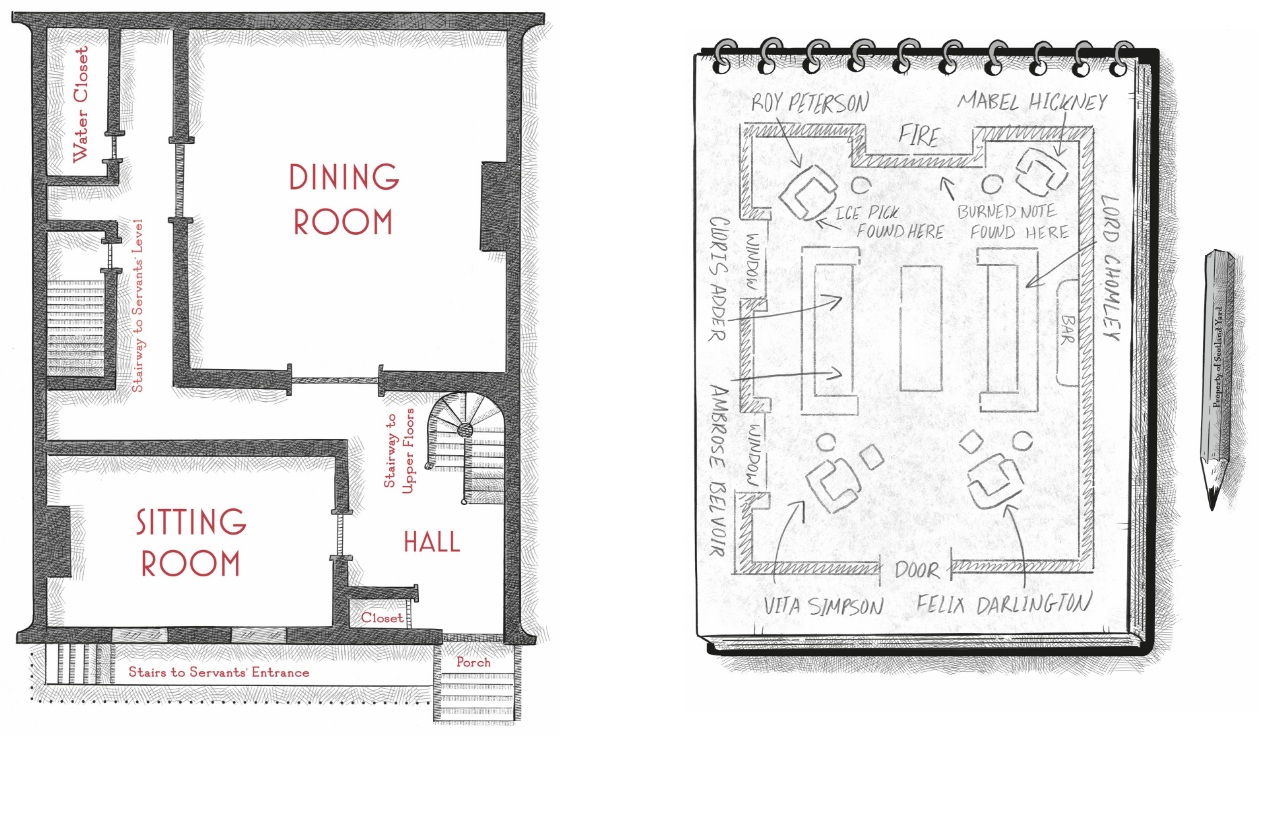
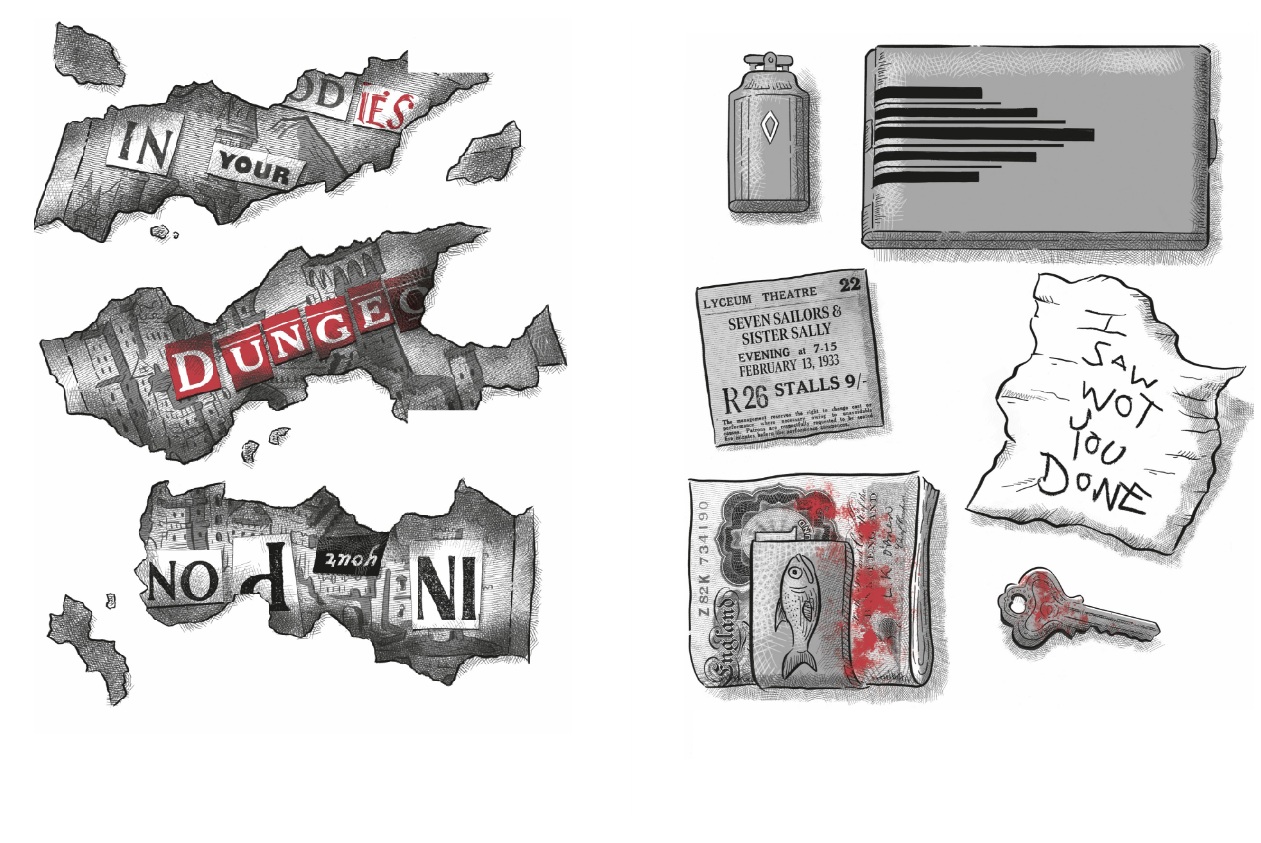
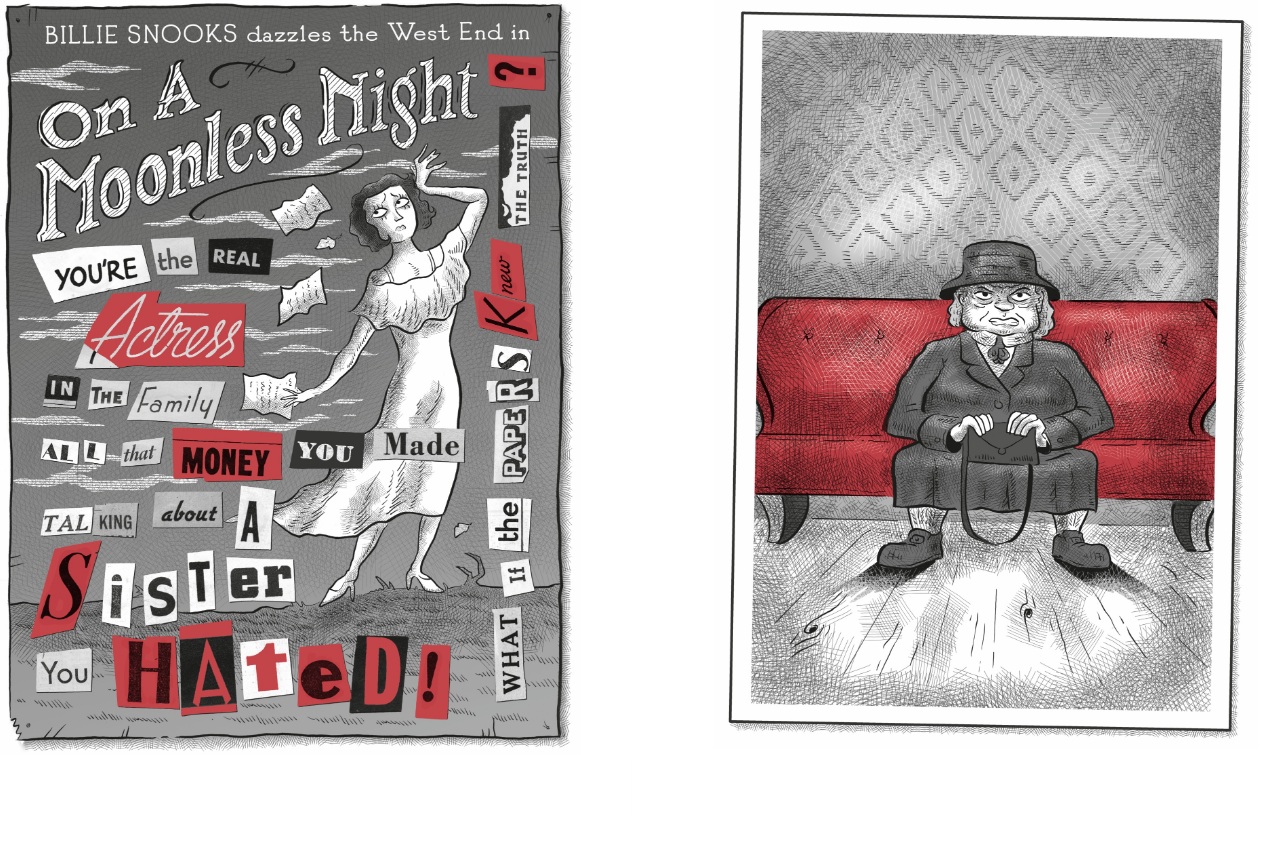
The 1933 setting is nicely limned through Cooper’s idiosyncratic art, rendered as in his previous collaboration with Johnson in greys with striking red highlights. We get floorplans, ‘photos’ of the scene of the crime and various rooms in the house, pictures of the suspects prior to each one being interviewed, and more besides. And you find yourself poring over these delightful images, wondering how they’re going to be relevant later and what you’re missing (I picked up on one detail early on, though it must be said that the images contain less than you might anticipate…).
Plot-wise things are fairly simple: the six people present at 19 Tootley Row, home of Ambrose Belvoir, all received a poison pen letter exhorting them to be at that address at a given date and time else some ‘orrible secret from their past will be communicated to the police. Of course, everyone denies knowledge of any wrong-doing, opting at times for the sort of BYT attitude that pastiche writers seem to think was prevalent in fiction of the time…
AB: Well, as you know, we all received rather naughty little letters. Poison pen, I believe, is the term?
I: Yes. This must have upset you.
AB: On the contrary! I was positively beaming about it! Everyone who’s anyone gets a poison pen letter.
…but, still, here they are, and, after a short while, there the dead body is.
There’s plenty of Johnson’s wit in the prose — “The book is perhaps most famous for the last eleven pages, which are comprised entirely of punctuation marks.” — and, in a manner not unlike The Maze (1931) by Philip MacDonald, you learn much about these people from their interviews with the increasingly-confounded Inspector Jensen:
FD: I was tooling along at a lovely seventy miles per on a clear spring morning on a country road, nothing but blue skies ahead of me and the engine purring like an absolute lion, when out of the hedgerow leaps this man. Just springs right into the road and into my Zipawae. Got her repaired, but she was never the same.
I: Neither was the man.
FD: Well, no, I expect not, after the dent he made in the Zipawae. Nothing I could do, inspector. Walked right in front of the car. Can’t help a thing like that.
The structure does, it must be said, get a little repetitious — shades of Murder on the Orient Express (1935) by Agatha Christie and the much-vaunted “dragging the Marsh” (© Brad Friedman) in the rounds and rounds and round of interviews. I’m also not completely sure how fair the solution is, given a lot of what we’re told being…well, no spoilers, but if you don’t solve this — and maybe I’m just put out because I didn’t — I think you have good cause to cry “Foul!” on a few points. But, well, it’s in good company in that regard, given that the solution shares for me one of the most distinct problems with the highly-regarded The Hollow Man (1935) by John Dickson Carr.
But, as an experiment, it is fun. Johnson and Cooper complement each other well in their various roles here, and it leans pleasingly into the tropes of the era in which it is set. No-one would doubt that it was done as a piece of pastiche with a lot of love, rather than the tolerant dismissal found in other modern attempts at Golden Age pastiches published in recent years, I just wish the balance between pictures, interviews, and slabs of text — the final section is a letter of confession, à la, well, so many examples, but And Then There Were None (1939) of course jumps to mind — was a little more finely observed. Maybe the decision to keep too much out of the pictures was a decision based on the fact that you’re never sure how people are going to read your book these days (on an e-reader it might be difficult to study the images so intently…) but it feels like there’s a brilliant idea here which has been used only moderately well.
For fans of the era, and for those who yearn for the mixed media telling of a straightforward story in the style of the Dennis Wheatley murder dossiers, The Creeping Hand Murder is a jolly time that will pass an hour or two in the sort of company you likely already enjoy. If Johnson and Cooper collaborated on another one of these, I’d read it with the same pleasure and probably enjoy it more knowing that I’m not likely to put it all together before the end. It’s nice to see something uncommon attempted with the form, and it’s to be hoped that the success they enjoy here encourages our authors to be a little more free with their clewing should there be a next time.
 The Invisible Event
I’m very fond of that copyright symbol! Now – when do my royalties start pouring in?!?
LikeLike
Now I know what I’m going to ask for Sinterklaas or Christmas this year!
LikeLike