
Having adored the Ealing black comedy Kind Hearts and Coronets (1949) as a teenager, I was somewhat underwhelmed by the novel from whence it sprang, Israel Rank: The Autobiography of a Criminal (1907) by Roy Horniman. Thus, to the film do I return for the first time in easily 30 years to see if it holds up in the many ways I remembered it improving on its source material.
Set sometime close to the book’s early 20th century milieu — women in England do net yet have the vote, so it’s pre-1918 at the very least — we join events near the end, with hangman Mr. Elliott (Miles Malleson) arriving at prison the evening before he is due to perform an execution of a duke at 8 o’clock the following morning, after which he will retire (“After using the silken rope, never again be content with hemp.”). Said executee, we then learn, is Louis D’Ascoyne Mazzini, Tenth Duke of Chalfont (Dennis Price), whom we meet in his cell putting the final touches to his memoirs A Brief History of the Events Leading Hereto Written on the Eve of His Execution.
Louis’s reminiscences take us back to book’s setting of Clapham, with his birth at 73 Balaclava Avenue, S.W., and upbringing remaining largely the same: born into penury to a woman who has distant claim to the Dukedom of Chalfont, but disdained it to marry a man of low birth. When her husband dies — of a heart attack, upon first sight of his newborn son — she brings up young Louis with an awareness of the dukedom, which “for services rendered to His Majesty [Charles II] after his restoration…was granted the unique privilege of descending by the female as well as the male line”. Alas, 12 people seem to stand in the way.
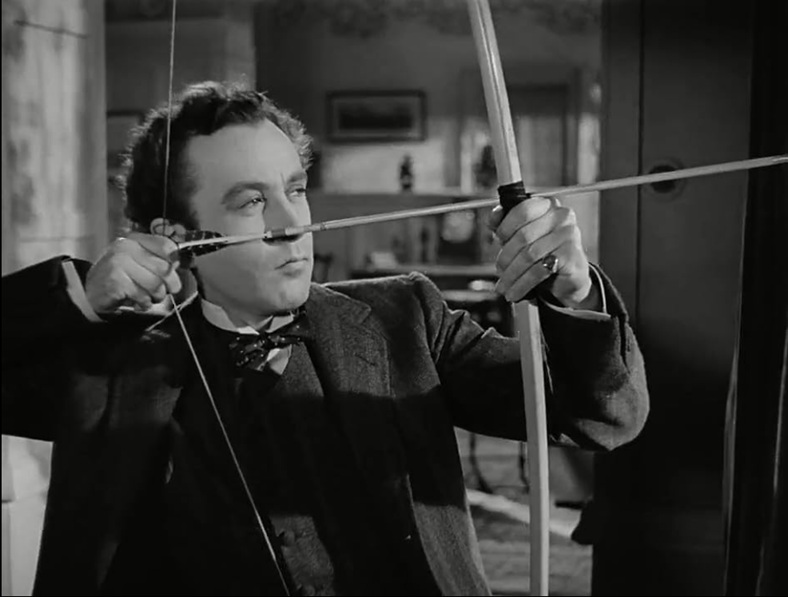
What’s captured here early on is a sense of social evolution, where mere mortals are edging creeping closer to the aristocracy (“People of quite good family go into the professions nowadays, I understand…”), and Louis’s attention is focussed on the living members of the D’Ascoyne family as a result of ill-feeling after his mother’s death (“But what could I do to hurt them? What could I take from them? Except, perhaps, their lives.”). Alongside this, his sweetheart Sibella (Joan Greenwood) — as in the book — betroths herself to Lionel Holland (John Penrose) (handled much more quickly and subtly than in the source material) and, steadily, the D’Ascoynes procreate and perish (“The advent of twin sons to the Duke was a terrible blow. Fortunately, an episode of diphtheria restored the status quo almost immediately…”) and so the die is cast and the cast will, well, die.
This introduces one of the many coupes de grâce in the shape of the peerless Alec Guinness as the various — now eight — D’Ascoynes who remain between Louis and the title. In his mid-thirties at the time, Guinness’s task here is to portray everyone from a diffident 24 year-old to an elderly clergyman — via, of course, Lady Agatha — and he gives each member of the brood their own mien, mannerisms, and distinct personality. It’s a breathlessly brilliant series of performances that does amazing work in establishing these characters as real, living people in a necessarily small amount of screen time. We rightly regard Guinness as acting royalty now, and it would be interesting to know how he was regarded at the time of this masterclass, which was, by my understanding, only his third credited role. Just phenomenal.
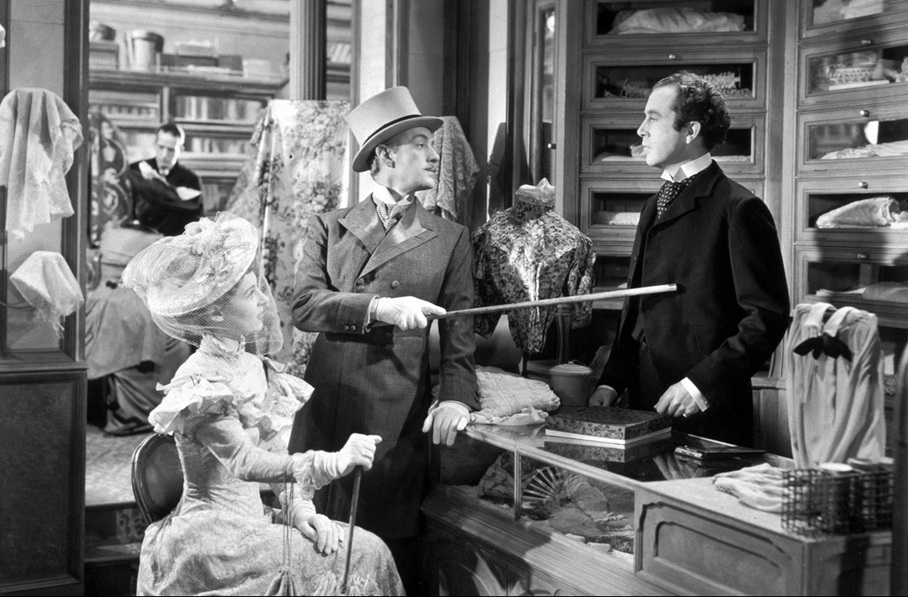
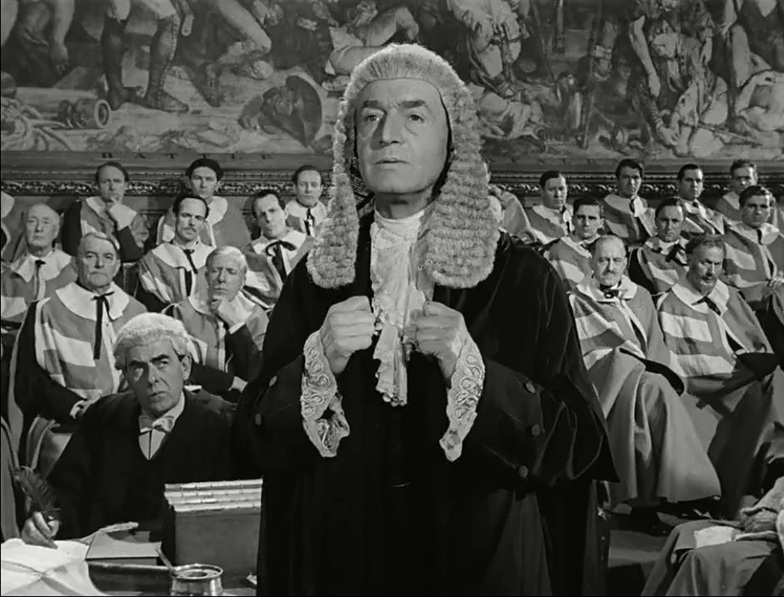
Thankfully, the other players, and indeed the film in which they find themselves, are more than up to the excellent standards Guinness sets. It is — my memory did not trick me — a decided improvement on Horniman’s novel, with events packed in much more tightly, and the condensing of various elements done in such a way as to enhance what remains. Louis is more active in his scheme this time, rather than waiting for opportunity to come knocking as he (or, well, Israel Rank) tends to do in the book (though arguably the time spent there was at least in part to make the whole undertaking feel at least a little achievable). What’s lovely here is the seamless way Ealing make you aware you’re watching a comedy, and so a certain amount of real world expectation is allowed to go by the way, without resorting to pratfalls or lazy tropes to hammer home a Big Laugh. The comedy is much nearer the surface, but like the best of these stiff-upper-lipped parodies you’re required to understand why something is funny in order to get the joke (the muted explosion which signals the death of one D’Ascoyne is simply magnificent foley work).
Equally, Price’s dry, emotionless narration sets up this story of murder, infidelity, and blackmail in the least moral terms imaginable, helped along by a script that is so damn sharp it cuts you in ways that it would be entirely possible to miss.
“He wanted to improve his mind.”
“He has room to do so.”
This is simply excellent old-school film-making, with long, patient scenes — c.f. the moment Louis poisons the port of the Reverend Henry D’Ascoyne, done without a single cut — and the few dramatic moments dropped without a musical nudge to tell you a Significant Happening has just occurred (indeed, the one such musical cue feels like the only false step in the entire edifice).
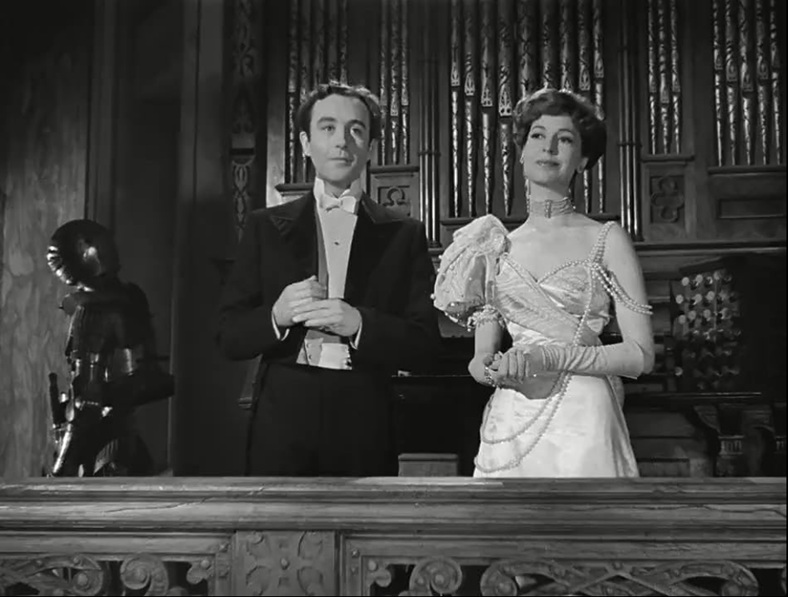

Other changes are ringed (rung?), from the novel, too, however, and do more to make this work as an excellent film rather than just an excellent comedy. The anti-Semitism faced by Israel in the book is absent and, in an era when we had much to thank our armed forces for, Louis crucially plays no role in the death of Admiral Lord Horatio D’Ascoyne, nor in the demise of the one person in the lineage who shows genuine interest in and sympathy for his well-being. Indeed, murdering this second D’Ascoyne might otherwise make our, er, protagonist something of a callous bastard in the average viewer’s eyes (personally, I would have liked it, but the mores of the time were doubtless correct to win through). Greenwood, sporting some magnificent hats throughout, also has a chance to give Sibella slightly more life and edge than was admitted to her in the novel, with her final scene bringing much into the light which was left unconsidered first time around.
Robert Hamer and John Dighton, then, have done a superb job in picking out that which makes the story interesting, resisting the urge to include details that any intelligent viewer is able to fill in for themselves. Like the best Ealing comedies, it has a morality all of its own, the final sting being as superb as anything that has ever left and audience in doubt as to what they want the outcome to be. A delightful experience, and one I’m sorry to have left three decades to experience again; rest assured, I’ll be revisiting more Ealing in the months and years ahead. For now, if anyone laments in your earshot that no film is better than the book it adapted, you can confidently point them in the direction of Kind Hearts and Coronets.
~
All images are taken from the IMDb page for the film.
 The Invisible Event
I hadn’t realised this was only his third film role but looking at his filmography reminds me that I really want to see his Father Brown, which it turns out shares a director with this film.
LikeLike
The film of Father Brown is decidedly unChestertonian, but worth watching. It’s said that playing the part persuaded Guinness to become a Roman Catholic.
LikeLike
I, too, would be curious to see this. I’ll add it to the list…
LikeLike
The Admiral’s death was probably inspired by that of Vice-Admiral Sir George Tryon in 1893, which puts the film in late Victorian or Edwardian times. The ending, with its twist, is appropriate, but I think it was only put in because of the US Hays Acts moral requirements.
Hamer himself was a tragic figure: a homosexual or bisexual alcoholic, he never matched Kind Hearts… ,but, then who could? Some of his other films are good. School for Scoundrels matches Kind Hearts‘s cynicism and It Always Rains on Sunday and The Spider and the Fly – made before and after Kind Hearts are fine – and very different – crime films.
LikeLike
Oh, I remember School for Scoundrels vaguely — yes, it was quite cynical, wasn’t it? Didn’t realise it was directed by Hamer, so thank-you; I might try and track it down for a rewatch.
Thanks, too for sending me down a Sir George Tryon rabbit hole. The death of Admiral D’Ascoyne seemed like such a parody of the Unyielding Military Commander trope that it would never occur to me that it could have been based on real events. Life really is stranger than fiction sometimes!
And, yes, surely the ending here was a result of the Hays Code — one of the (rare…?) occasions where the refusal to let the criminals profit from their schemes works out particularly well.
LikeLike
There was a sequel on Radio 4 a few years back, with (I think) Mazzini’s daughter going round kiling people on some pretext, although I don’t remember it being awfully good
LikeLike
Ooo, so there was (from Wikipedia):
In May 2012, BBC Radio 4 broadcast a sequel to the film called Kind Hearts and Coronets – Like Father, Like Daughter, written by David Spicer. In it, Unity Holland, the illegitimate daughter of Louis and Sibella, is written out of the title by Edith Duchess of Chalfont. Unity then murders the entire D’Ascoyne family, with all seven members played by Alistair McGowan.
I’ll be honest, I’m more intrigued by this than by the Broadway stage adaptation. It might not be good — thanks for the warning! — but I’d be intrigued to see how it transferred to radio.
LikeLike
You mention that he plays no part in the death of the only person who showed him kindness and support- sharp contrast to the novel where it’s – Oh by the way I murdered your son.
LikeLike
Yes, that is rather savage, isn’t it? And would hit harder if the book had a bit more pace and life to it.
LikeLike
It has some brilliant bits in it- here’s a few quotes: “She was most decidedly a snob, but not of an objectionable type. As a matter of fact, I have always considered well-bred snobs rather pleasant people, and have often wondered whether they would have been as well bred if they had not been snobs.” / “Always answer lazily when a well-bred Englishman addresses you for the first time. It impresses him.” / “There is something mysterious about you. There always was even as a boy, and it has grown with you.” I did not like to hear this. Above all people, a secret murderer cannot afford to suggest the mysterious. / It was no surprise to find that Horniman was an admirer of Oscar Wilde.
LikeLike
Yes, there are some lovely moments in it — I included some of my favourites in my review. So it’s to the film’s credit that they found the thread which makes the whole thing tick and extracted it so well — Price’s delivery is so perfect as Lionel, you almost wish he’d done an audiobook recording of the novel 🙂
LikeLike