
For the restraint alone in not calling this dog-as-detective story an ‘im-paw-sible crime’, this 14th entry in the Sebastian (Super Sleuth) series by Mary Blount Christian deserves checking out.
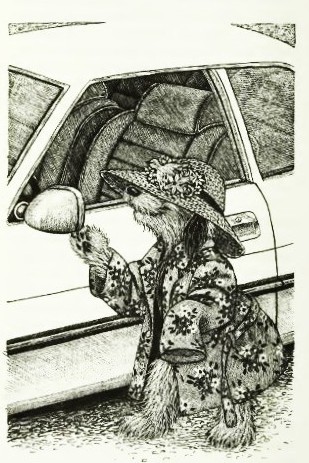
As was to be hoped from that cover, the essential idea of this series seems to be that a super-intelligent dog “Sebastian (Super Sleuth), the clever canine, the hairy hawkshaw, the daring dog detective (unpaid and underappreciated as he was) had to solve the cases for his kindhearted but bumbling human”. Said human is police detective John Quincy Jones, who, while well-meaning, might not be the sharpest tool in the box…but, then, since not one person in this entire universe — from police officers to members of the general public — seems to be able to discern the difference between a human being and an Old English Sheepdog in a police uniform…perhaps the whole set of tools are blunt, eh?
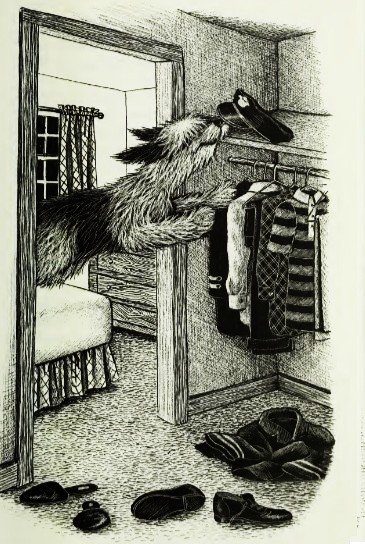
Sebastian is at home with John when the Chief of Police calls and tells John to simultaneously put on the news and get to the scene of a crime (hmm, that bluntness seems more likely now). The Chief is at the museum for the unveiling of a recently-discovered rare painting when the lights had gone out for five seconds and, when they came back on, said painting had vanished from the room in which it was displayed.
“Except at the main entrance, the doors to the museum were all locked at the time, and guards were posted at the main entrance and in the hallway leading to the exhibit room. Ladies and gentlemen, we’re faced with an art theft that couldn’t have happened!”
Sebastian wiggled excitedly. Wow! A once-in-a-career opportunity to solve a locked-room mystery. And what an elite list of suspects! Some of the city’s best-known people were there. Even international experts! The eyes of the world would be on this crime.
The security precautions at the museum include motion-activated cameras at the exits and a special manner of marking the artworks ensuring that alarms would have gone off should the painting be taken through any of the (also alarmed) doors. So, the painting can’t have left the room, but it’s also not there. Yes, you could argue for a little more rigour, but this is, allowing for the slight loosening of principles for the juvenile market, a good swipe at an impossible crime.
Sebastian is wise to the possible cheats in such a setup — “He’d cut his teeth on Edgar Allan Poe stories — literally — until John whacked him with a newspaper and took the book away.” — and is aware that the museum is only five years old and so lacks secret passageways, and that the “air ducts aren’t big enough for a person to get through alone, much less with a big piece of framed art”. So how to explain it? And who could be responsible, given that the room at the time “had been filled with the rich and powerful, not your usual list of suspects”?

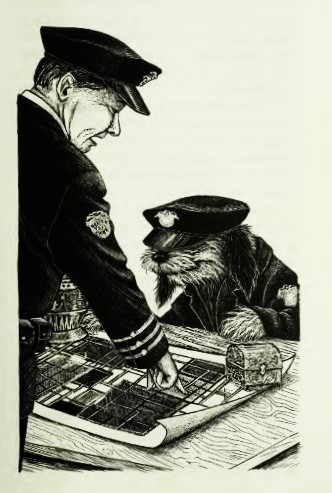
For all the slightly ludicrous conceits you’re expected to accept for Christian’s story to work, the investigation itself, while hardly Humdrum in its rigour, is pleasingly intelligent, and clues are honestly placed for you to pick up on along the way. It is freely admitted that some of the behaviour, actions, professions, or indications regarding the people present — a bounced cheque, say — make those people suspects, treating the audience as intelligent readers who will be able to follow the implications clearly. This is, of course, a simple form of red herring-ing, but I like that Christian doesn’t simply have one suspicious action in the whole shebang and then — gasp! — the person it relates to turns out to be guilty at the end.
And, c’mon, we’ve all seen that happen. And, no, I’m not just talking about juvenile mysteries.
Simple touches — like acknowledging that someone intelligent enough to set up a device to cut the lights would have been intelligent enough to ensure they didn’t leave fingerprints — show the police officers as broadly professional people who just, er, don’t recognise that a dog in a coat isn’t a middle-aged woman. Sebastian himself is able to vouch in his own mind for the uprightness of two of the officers who could have come under suspicion and…I dunno, I like this. I like when professional police, about to be shown up by an amateur, are still recognised as decent and upright human beings — this, I think, is one of the reasons I get on so well with Philo Vance — and I think it’s important that books for younger readers reinforce this. No, I’m not a fan of everything every police officer has ever done in every country throughout all history, but dismissal of them as incompetent simpletons doesn’t therefore present itself as the only other option.
The eventual solution also relies on a sort of negative evidence, and, while it would have been nicer if that had been set up earlier as some of the other clues are, it’s still a good way for the reasoning to be completed for the comprehension of the younger mind this is aimed at. The solution is reached, we don’t hang around, everyone goes home happy…what’s not to love?

Having heard of this purely because it would crop up when I searched for ‘impossible crime’ in various locations, I leave Sebastian (Super Sleuth) and the Impossible Crime (1992) honestly really rather eager to read more in this series. Christian has a good handle on how to clue, writes with just the right mix of humour and precision to make her universe work without too much cavilling in the mind of the reader, and makes this very charming conceit work extremely well. It’s taken me a while to track this down, and the other titles listed at that link above seem to vary wildly in availability and price, but I’ll be keeping an eye out for more of these. Much to my surprise and delight, I may have found a new detectival obsession to track down over the next decade or so. Wonderful!
 The Invisible Event
This one also turned up in my searches, time and time again, when hunting for new and obscure impossible crimes, but never gave it much consideration. I figured it would be a fun curiosity at best and a complete waste at worst. Guess I was wrong. That’s what you get for judging a book by its cover.
Sebastian and the Impossible Crime has been added to the locked room wishlist. Cue the opening theme of Dog City.
LikeLike
Don’t rush out for it, it’s definitely an impossible crime for younger readers and as such a minor an unoriginal example of the form, but it has a lot of charm. I’ll definitely be keeping an eye out for others titles in the series, which is more than I expected to say going into this 🙂
LikeLike