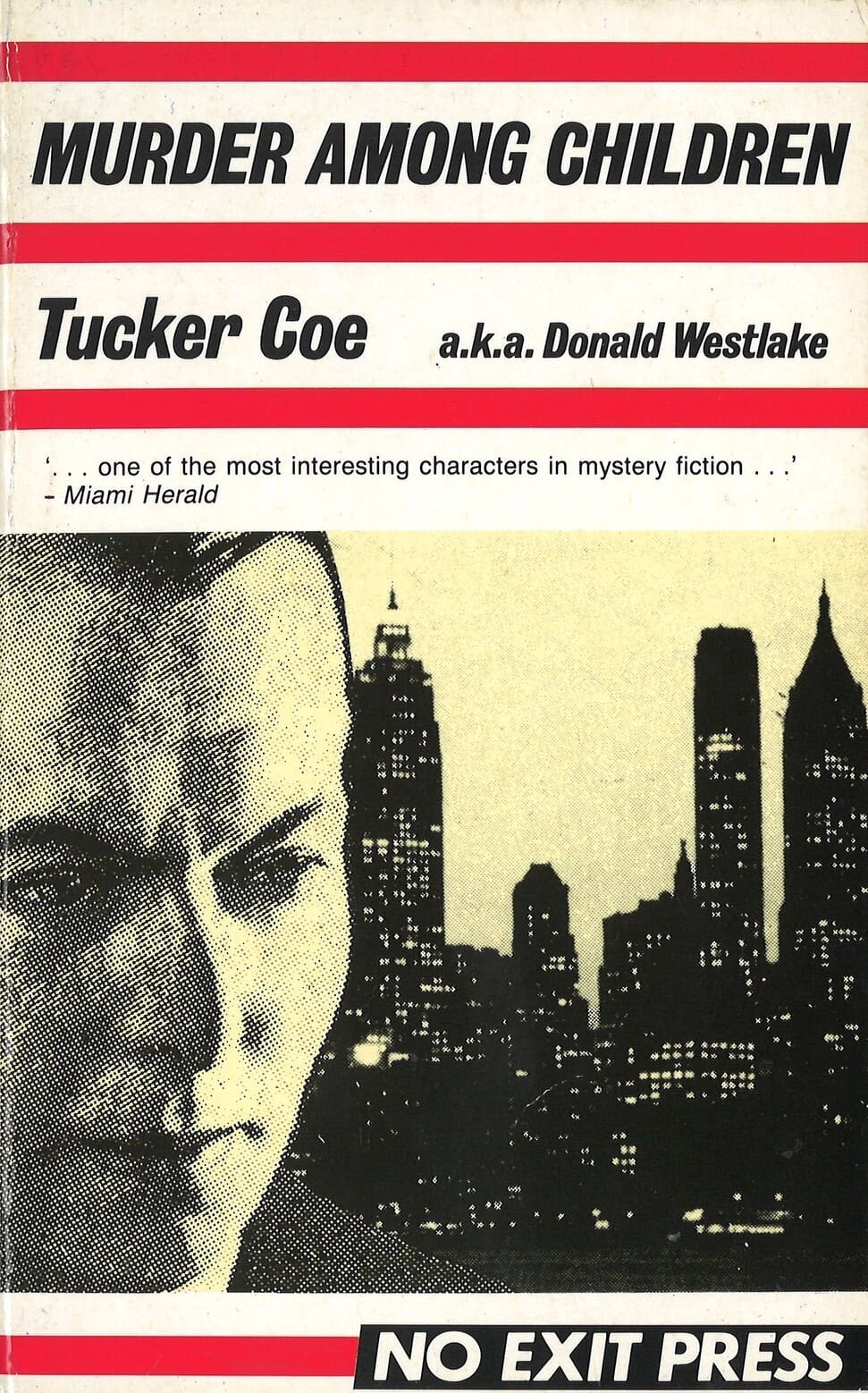
Would sir care for some crippling sadness with his impossible crime?
In the grand tradition of Golden Age types like Vernon Loder and Erle Stanley Gardner, Donald E. Westlake put out swathes of genre fiction under enough pseudonyms to populate an airliner. Perhaps best known these days for the Parker novels published under the name Richard Stark and the John Dortmunder novels written under his own name, it’s actually quite astonishing the range of crime fiction Westlake turned out, both in terms of styles covered and number of books.
Between 1966 and 1972, Westlake wrote five novels as Tucker Coe that featured disgraced ex-policeman Mitchell ‘Mitch’ Tobin. I’ll be honest, I had no idea that the Coe was a pseudonym of Westlake’s until I read about Murder Among Children (1967), the second Tobin novel, in Adey, which promised a “Death by stabbing in a locked room” as its impossible crime and so raised itself in my awareness. Jump forward several years and, after being gifted a copy, well, here we are.

Having been ejected from the NYPD in the sort of circumstances that are all the more heart-wrenching because he does not dispute or seek to dispute or justify them, Tobin is spending his days hiding from the world: trying to salvage his marriage while building a wall that represents — and it’s really not as corny as it sounds, Westlake was a genius for this sort of thing — his own slow rebuilding of his sense of self, all the more interesting because the reader is distinctly left with the feeling that neither project will be completed.
It is in this mindset that Tobin is approached by the youthful Robin Kennely, a second cousin, who has started a coffee shop in the city with a group of friends that includes her boyfriend, Terry Wilford. The shop, called Thing East, is being visited on a regular basis by a plainclothes policeman who seems, in an insinuating and faintly threatening way, to want something from the young people running it. No explicit mention of bribes has been made, but since the experience is making them all uncomfortable, Robin wants Mitch to look into it, and perhaps find a way to make it stop.
Reluctantly, Tobin is convinced to at least cast a passing glance over the situation, and so attends Thing East to discuss things further. Upon arrival, he meets another of the young coterie, George Padbury, who tells him that Robin and Terry are upstairs…only for Robin to appear in the doorway, covered in blood and bearing a bloody knife, just in time to mutter something incomprehensible and collapse at their feet. The police are called and in short order it is discovered that the murdered bodies of Terry and a prostitute are in an upper room…and only Robin seems to have had access to have killed them.
So not quite a “death by stabbing in a locked room”, more a sort of “the only person who could have done it isn’t believed to have done it” situation. And so Tobin begins to examine what possible explanation there could be for firstly the presence of a lady of the night in the sleeping quarters of a man who never had to pay for sex and secondly for the presence of only Robin and two dead bodies at the scene.
Down the stairs and into Thing East, that was the only way [the killer could have left]. And he hadn’t done it.
Several themes vie of prominence in Westlake’s story, not least the freedom and optimism shown by the young people running Thing East — the “children” of the title — when contrasted against Tobin’s own, understandably more jaded, perspective on life and living. Tobin, being so physically and emotionally cut off from both the people closest to him and the wider world at large, sees the hopefulness of the younger generation as something now beyond his acquisition, and this finds expression in part in the almost double-act partnership he forms with 20-something Hulmer Fass, the fourth member of the Thing East crew.
Watching him walk down the street, youthful, optimistic, humorous, bouncing on the balls of his feet, I found myself envying him in half a dozen different ways. I envied his youth, of course, and his optimism, and his humor, and I envied the absence of scars on his psyche that made the youth and optimism and humor possible. But beyond that I envied him for being young now, and black, and alive to the world in a way that I had not been for years, in a way that I perhaps had never been in my life.
Generational separation is another theme — Tobin’s own 14 year-old son is becoming increasingly distant (“There was a widening rift between my son and me, caused for the most part I knew by myself, but there was nothing I could do to mend it without opening myself, which I didn’t ever want to do.”), and the expected attitudes of the young generation towards drugs and free sex is of course put under the microscope (hey, it’s the 1960s…!), albeit briefly. See also Hulmer Fass’s wry comment about his being involved in starting up Thing East as “token integration” because “you’ve got to have a [black man involved in] whatever you start up”. The times, they are a-changin’.
Equally, as essentially a P.I. novel, you have Tobin running up against the police, made all the more uncomfortable by his embarrassment over losing his badge as well as his understanding that some of the language used to explain away certain actions would, when he was a cop, have meant that the person they were talking to — in this case Tobin himself — was under suspicion, or certainly being treated as if they soon could be.
The investigation, then, is limned with the sadness and self-reproach that marks out Tobin as something more than just another bland P.I. analogue, the seriousness rendering the various developments somewhat more grounded than they might be expected to be: it is, for one, devoid of the usual soubrettes that typically litter this style of fiction. It’s difficult to work in a sultry femme fatale, after all, when your protagonist is mooching around reflecting on how he’s been “drained of blood and life and existence”. And this lends a realist air that really helps matters — see the reflection on addicts and their use of drugs in chapter 19:
“Many addicts [kill themselves], you know. The purpose of the narcotic is to create a wall against despair, and the day despair breaches that wall the addict no longer has anywhere to hide.”
A few era-appropriate gems twinkle in this grim-sounding gloom — “credit in bars is illegal in New York”, who knew? — and it’s really not as morose as I might be making it sound: Westlake has a genius for rendering this milieu realistic and rooted in human emotion in a way that’s too honest to every feel maudlin. Honestly, my main takeaway from this was that it’s been far too long since I last picked up any Westlake, so rest assured that I’m going to try and find a way to correct that in future without skewing too far from this blog’s purpose.
The impossibility is…fine. The workings are nothing new, and Westlake does well to play fair to an extent by drawing your eye to the one key aspect of the whole thing, but it also relies on the murderer getting away with it on account of a psychological reaction there would be no way to anticipate, and so you can’t help but wonder what the plan would have been had that incredibly unlikely event not happened.
Murder Among Children comes recommended for the aching realism of its protagonist and the hints that, by degrees, the salvation he seems so keen to deny himself might actually be within reach. I don’t know whether I’ll read more of the Tobin books, but I can’t deny that I’ll think of him from time to time and wonder how his story turned out. I’m putting half a foot over the line into the sort of fiction that doesn’t ordinarily appeal to me — were it not for that impossibility, this would likely have never passed before my eyes, no matter how high a regard I have for Westlake — and the shortfalls in plotting confirmed my suspicions about why I generally avoid this era of this style of fiction. But the characters here are delightful to behold in their natural environment, so maybe, just maybe, a return might be on the cards.
More Westlake at some point, though, whatever name it ends up being under. That I can guarantee.
 The Invisible Event
Really glad you enjoyed it. And there is a progression in Tobin’s character across the five volumes that is worth tracking.
LikeLike
I hve read Westlake books that I loved, and Westlake books that I threw across the room in despair. Hard to tell in advance which this would be…
No star rating?
LikeLike
Yes, as with anyone who produces a lot there’s going to be a bunch of guff in there, but when he’s good he’s very good.
Star ratings on Thursday when I restrict myself to 1,000 words. Weekends are a chance to go on a bit more…!
LikeLike