
The last time I read a book by Richard Austin Freeman, my House of Stratus edition told me it was a collection of short stories only for it to turn out to be a novel. So it’s fitting that my next encounter with Dr. John Thorndyke should reverse the situation and what is pitched on the back cover as a novel turn out to be a collection of short stories.
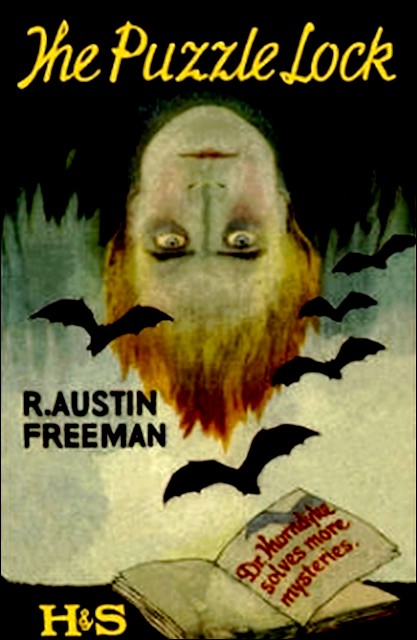
The Puzzle Lock [ss] (1925), then, comprises nine tales told by three different narrators from Thorndyke’s past, and seemed notable to me from the off for the truly bizarre cover it received on first publication — see left. The upside-down head and bats a-circling puts one rather in mind of something in the sensationalist fiction vein, and it’s difficult to reconcile the image with the stories of rigorous, scientific detection that the book could be expected to contain. I make this the thirteenth Thorndyke published, however, so perhaps by this point the character was famous and popular enough that it mattered not what you put on the front of the book. I’m just glad my reissue didn’t have that cover, is all I’m saying, and I would have loved to be in the meeting which resulted in that image being chosen to represent the book.
But, well, I digress. What of the stories themselves…?

First up, ‘The Puzzle Lock’ (1925) which starts with a lovely inverted Holmesian motif — spotting Inspector Badger in a lousy disguise, trailing some clearly suspicious men — and then evolves into the disappearance of those two suspects just as one of them is indicated as a member of a gang of thieves. It is the eponymous lock that Freeman wishes to explore here, containing 15 dials and “40 million changes” (which can’t be right, as that would mean a maximum of four letters per dial…), and the means by which he hides the code is…well, it’s very Thorndykian, even if it takes a leap or two to get us there.
The story is really more of a romp than a serious scientific investigation, but then Freeman’s short fiction often turns out like this. The moment everything goes wrong is quite telling, because it feels like a pleasing attempt to add some fallibility to the Great Detective in a way that was never quite successfully achieved elsewhere. Somehow when Thorndyke fails it only seems to increase his esteem, whereas the likes of Martin Hewitt just seem…de-esteemed, for want of a better word.
Another vanishing, this time of a wealthy man who has made a new will and might, therefore, have been dispatched by one of the legatees who did less well under it, concerns us in ‘The Green Check Jacket’ (1925). It’s nice to have Christopher Jervis, our Watson, express no surprise at the lightning-quick proclamations of his resident genius detective (“If he had then and there purchased a Trotman’s anchor, a shark-hook and a set of International code signals, I should have been prepared to accept the proceeding without comment…”) but the effect is somewhat ruined by Thorndyke having a lot of information Jervis, and so the reader, does not.
Still, the story is pretty weak sauce anyway, with Thorndyke required to explain away the abject stupidity of the central plot:
“The scheme was ingenious enough, but the execution was contemptible. He has left traces at every turn… He has acted on the assumption that the world contains no one but fools. But that is a fool’s assumption.”
I also wonder how threatening a man can seem when his appearance reminds Jervis “of a certain species of lemur that I once saw”…surely, one of the more bizarre comparisons in Golden Age detective fiction.
‘The Seal of Nebuchadnezzar’ (1925) is narrated by Robert Anstey, who got involved with Thorndyke in The Cat’s Eye (1923). This tale of footprints telling an interesting story feels like Freeman working out an idea that he cannot quite work into something bigger: it’s entertaining, reliant on that peculiarly obsessive attention to detail that makes Thorndyke so dangerous — indeed, it is difficult to disagree with the closing sentiment that “Thorndyke was either gifted with a sixth sense which enabled him to smell out evidence or was in league with some familiar demon who did it for him”. The fact that Freeman also discards as mere trifles the sort of fascinating esoterica — here, the eponymous seal — that which might provide a MacGuffin for several less accomplished writers is merely the seasoning on this delightful concoction.
Bat update: still none.
‘Phyllis Annesley’s Peril’, a.k.a. ‘Double Vision’ (1922) concerns the body of Mrs. Lucy Bland, found beneath the floorboards of a house owned by Phyllis Annesley. Miss Annesley and Mr. Leonard Bland were “admittedly on affectionate terms, though there is no suggestion of improper relations between them”, and the vanishing of Mrs. Bland would, it seems, clear the way for them to marry. Additionally, two unimpeachable witnesses each saw, through convenient holes in the shutters over the windows, the two engaged in hiding a large item under the floorboards around the time that Mrs. Bland disappeared.
That Thorndyke takes the defence tells you something is up — Jervis is wise to this, where Watson would be agog — and the eventual explanation here is somewhat ingenious, easily enough to fill a novel. One wonders if it finds itself employed in the shorter form because the necessarily complex description might get rather tedious if drawn out. Instead, it is compacted and so, in a way, feels somehow more ingenious, and as such the story hits even harder. Clever, clever stuff, and ingeniously relayed; given the difficulties this presents as a text-based narrative, the utilisation of illustrations is simply perfect.
Neither title is good, by the way. The first ignores that Leonard Bland is also on trial for murder. The second is just shit.
‘A Sower of Pestilence’ (1925) also has a bad title, but mainly because it gives away what’s going on, and it would be far better to discover this alongside Thorndyke and Jervis. When an unusual donation to a cats’ home — I kid you not: “St. Francis Home of Rest for aged, invalid and destitute cats…where these deserving animals are enabled to convert the autumn of their troubled lives into a sort of Indian summer of comfort and repose.”– puts Thorndyke’s newest hobby to the test, it results in some good wry humour…
“[I]f I find a man trying to set fire to a bank, I don’t immediately infer that his customary occupation is exhibiting performing rats in a back street of Bethnal Green.”
…a chance for Jervis to show some intelligence, and some characteristically uncommon detection. Remove the plot strand about the incendiary device at the bank and this would be in contention for among the best non-inverted Thorndyke shorts. Bonus points, too, for extra Nathaniel Polton, easily my favourite secondary character in fiction.
A borderline-impossible poisoning forms the basis of ‘Rex v. Burnaby’ (1924), narrated by Humphrey Jardine, who featured in A Silent Witness (1914). The story is most is notable for how well Freeman writes about the sensations of the court when legal action rears its head:
The mingling of squalor and tragedy, of frivolity and dread solemnity — the grave magistrate on the bench, the stolid policemen, the busy, preoccupied lawyers, and the gibbering crowd of spectators, greedy for sensation, with eager eyes riveted on the figure in the dock — offered such a medley of contrasts as I hope never to look upon again.
The solution is not hard to anticipate, relying as it does on the sort of colourless medical principle that I imagined all Freeman’s stories would utilise before I read him. Possibly it would have been astounding if written 20 years earlier, but here it just feels a little limp. Superbly relayed, but time has wearied it a little.
Anstey is back for ‘A Mystery of the Sand-Hills’ (1924), which demonstrates a clever awareness of forensics like like of which I’m sure many modern readers would be surprised to learn existed a century ago. The easy-going way Thorndyke explains away the perceptiveness of his insights marks out the wonderful evolution of the Genius Detective that he represents, and, as a complete aside, this tale made me realise how much I enjoy detection based in, on, and around beaches: see ‘The Man with the Nailed Shoes’ (1909) in John Thorndyke’s Cases (1909), sections of by Mystery at Lynden Sands (1928) by J.J. Connington, and many more besides.
That upside down face and those bats are finally explained in ‘The Apparition of Burling Court’ (1923), a tale of alternate-generational madness that starts with luminous bats flaying round a room and ends with the sufferer drowning themselves in a cave as outlined in a convenient family history laid down o this very topic. Thorndyke, ever the rationalist, is a reassuring presence in the face of such fanciful notions…
“Legal inheritance and physiological inheritance do not follow the same lines. If his mother’s sister married a lunatic, he might inherit that lunatic’s property, but he could not inherit his insanity.”
…dismissing the ‘history’ part of this easily enough and then turning his attention to saving the life of the latest victim. It’s speedy stuff, enlivened by the sort of joyous trappings that make Freeman so readable for me…
“It is a case for the smoker’s companion,” said [Thorndyke], producing from his pocket an instrument that went by that name, but which looked suspiciously like a lock-pick.
…but this, for all its readability, is minor stuff. Would make an interesting inclusion in, say, a Ghosts from the Library collection, but obviously it doesn’t fit the bill for those as it’s been reprinted very recently indeed. Good to have that cover off my mind, though.
To the annals of Jardine again, and a matter of survivorship in ‘The Mysterious Visitor’ (1924). These stories have felt increasingly like the early Holmes tales in that there’s only really one person who can be guilty and, yup, they inevitably turn out to be, but the rigorous detection Thorndyke brings to bear on the problems makes them feel more achieved or accomplished or…something. I won’t claim that this will live long in the memory, but it’s quick and enjoyable, and if you’ve made it this far you won’t have much to complain about here. Faint praise, but there you go.
Is it worth picking a top five list from a collection of only nine stories? Well, just in case:
- ‘A Sower of Pestilence’ (1925)
- ‘A Mystery of the Sand-Hills’ (1924)
- ‘Phyllis Annesley’s Peril’, a.k.a. ‘Double Vision’ (1922)
- ‘Rex v. Burnaby’ (1924)
- ‘The Mysterious Visitor’ (1924)
This is, all told, a minor brick in the wall of Freeman and Thorndyke’s parallel careers, and lacks, if we’re being honest, anything that anyone other than the completist needs to read. This collection will not convert anyone to the Thorndykian cause, and sometimes excess detection might fairly be accused of counter-balancing shortness of plot development.
For fans, though, the unshowy rigour that will have made the good doctor a favourite will prove very enjoyable. I’m always heartened by the lack of senseless alarmism in Freeman’s writing, and his ability to find some sparkle of intelligence in even the most unpromising situations (“There wasn’t much mahogany furniture before 1720…”) feels like a godsend for how he shows the application of human intelligence to the problems our esteemed medical jurist keeps finding himself up against.
A minor brick, then, but nevertheless one which can be put to interesting use by the proper mind. You should read at least 10 other Freemans before this, but the epicure who is then moved to investigate The Puzzle Lock will certainly find something to enjoy.
~
R. Austin Freeman on The Invisible Event:
The Red Thumb Mark (1907)
John Thorndyke’s Cases, a.k.a. Dr. Thorndyke’s Cases [ss] (1909)
The Eye of Osiris, a.k.a. The Vanishing Man (1911)
The Mystery of 31 New Inn (1912)
The Singing Bone, a.k.a. The Adventures of Dr. Thorndyke [ss] (1912)
A Silent Witness (1914)
The Great Portrait Mystery [ss] (1918)
Helen Vardon’s Confession (1922)
The Cat’s Eye (1923)
Dr. Thorndyke’s Casebook, a.k.a. The Blue Scarab [ss] (1923)
The Mystery of Angelina Frood (1924)
The Shadow of the Wolf (1925)
The Puzzle Lock [ss] (1925)
The D’Arblay Mystery (1926)
The Magic Casket [ss] (1927)
A Certain Dr. Thorndyke (1927)
As a Thief in the Night (1928)
Mr. Pottermack’s Oversight (1930)
Pontifex, Son and Thorndyke (1931)
When Rogues Fall Out, a.k.a. Dr. Thorndyke’s Discovery (1932)
Dr. Thorndyke Intervenes (1933)
 The Invisible Event
re : your confusion over the number of possible combinations of the puzzle lock. The original states ‘forty billion changes’ not million. Possibly an error in the House Of Stratus edition?
LikeLike
Ah, thank-you!
Interesting that there’s an error. I’m guessing Freeman is using old billions here, in that case, since the fifteenth root of 40,000,000,000,000 is 8 and a circular dial could be easily divided into eight segments. Weird it’s not the usual 10 digit dial, but I suppose I could be accused of over-thinking this…
LikeLike