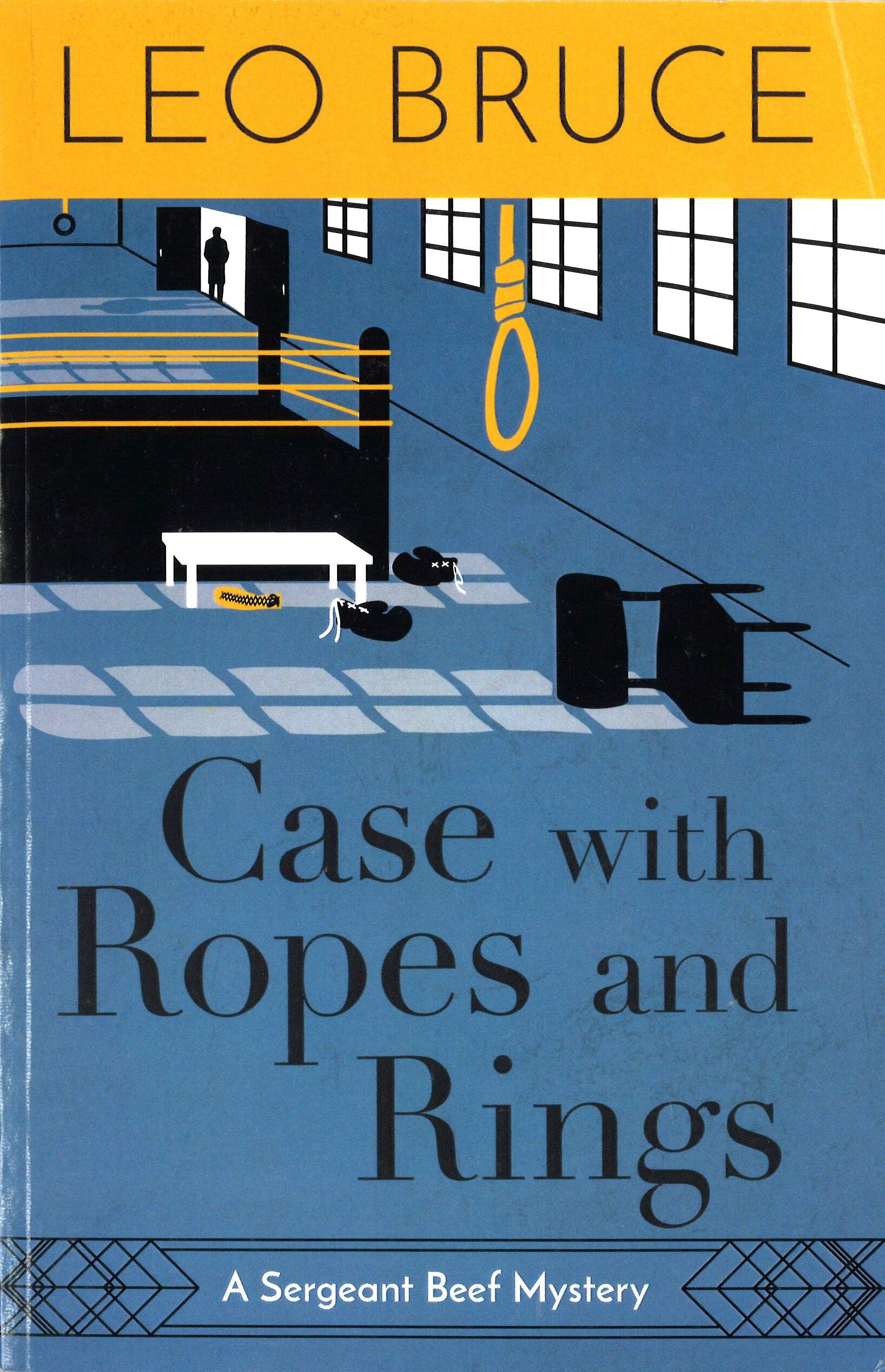


Following the revelation at the end of my recent review of Case for Three Detectives (1936) by Leo Bruce that I had not read three of sometime-Sergeant William Beef’s later cases, a friend has staged an intervention and leant me Case with Ropes and Rings (1940), Neck and Neck (1951), and Cold Blood (1952). So let’s mop these three up, and then I can turn my eye upon rereading the earlier titles which have not yet made it onto The Invisible Event. Today, the death by hanging of a popular boy at Penshurt public school raises Beef’s suspicion of murder and, figuring that the boy’s wealthy father might be remuneratively grateful, Beef and his chronicler Lionel Townsend descend on Penshurt and begin to investigate.
Half the fun of this series is the relationship between the pompous Townsend and the simple, earthy Beef, with the former permanently evincing the doubt which it is “my professional duty to maintain during all Beef’s investigations”. Here, the stakes feel somewhat upped, as Townsend is, of course, the product of a public school, and he sees no way that Beef’s unpolished manner will be able to hide amidst the social finery on display. Thankfully, the position as school porter has become temporarily available, and much is wrung from Beef’s relaxed attitude — ringing bells late, indulging in the crude bar-room game of darts with students, arranging for an unofficial school holiday — and Townsend’s consequent conniptions.
Bruce is also a keen farceur of detective fiction tropes, and has fun with more than a few here, like when Townsend suggests that Lord Edenbridge, father of the deceased, might not welcome an approach to investigate the death since he has, after all, just lost a son in tragic circumstances:
“Tragic circumstances,” [Beef] began sententiously, “have never been sufficient to put off an investigator. They love tragic circumstances, the whole lot of them. Haven’t you ever noticed in detective novels what a good time everybody has with a few tragic circumstances?”
Additionally, perhaps in admission of the fact that the plot largely consists of Beef and Townsend talking to a lot of people, there’s the lament at about the halfway stage that “all these interviews [are] awfully bad for the book. People get sick of reading how you cross-examine this or that person. They want some action.” Equally, when Townsend finds — with the sort of elephantine inappropriateness that really does appear to be his speciality — an attractive woman to lust after, Beef reminds him that “This isn’t a love story… It’s a detective novel. I never like to see the two mixed up. None of the best of ’em ever did it. We’ll stick to crime.”
It’s true that Case with Ropes and Rings lacks the complex shenanigans of many of its ilk, but there’s something pleasing about the simplicity of its design, especially in the way Bruce overturns your expectations so easily in the final stretch. The clues are sparse, sure, but they’re also undeniably there for you to trip over — the auditory one is particularly good, even if the, er, written one doesn’t convince me for a moment. I got especially caught up in the depiction of the school, such as the efforts to console the pupils following the apparent suicide stopping at playing the ‘Dead March’ in assembly and hoping that everything will just sort itself out.
It’s worth being aware, too, that Bruce has a deplorable tendency to spoil his own books, mentioning here by name the guilty party in a couple of his earlier titles — perhaps under the presumption that everyone was always going to read everything he wrote…never considering that certain titles might go out of print(!). He did the same thing in Case with Four Clowns (1939), spoiling the infinitely superior Case with No Conclusion (1939) on the very first page, so some caution is advised. There’s no way around it except to a) leave a long gap between books, or b) do as the man clearly expects and read them all in order. Or, hey, maybe he really does disdain the form, as one boy expresses late on:
“You’re both nosing round after someone to pin a crime on, aren’t you? God, how that sort of thing bores me! All these fearful women writers and people like you, working out dreary crimes for half-wits to read about. Doesn’t it strike you as degrading?”
Whatever Bruce’s views on this aspect of his career, Case with Ropes and Rings is an enjoyable time, filled with well-sketched minor characters, clever interpretations of simple evidence, and plenty to amuse both the neophyte and the ragged old armchair detective alike. It’s not surprising that he left Beef and Townsend alone for seven years after this, since it almost seems that there is no convention he hadn’t attacked in the genre, but the acuity with which most of this is observed bodes well for those later cases. Here’s to seeing how the good Sergeant’s career plays out.
~
The Sergeant Beef novels by Leo Bruce:
- Case for Three Detectives (1936)
- Case without a Corpse (1937)
- Case with No Conclusion (1939)
- Case with Four Clowns (1939)
- Case with Ropes and Rings (1940)
- Case for Sergeant Beef (1947)
- Neck and Neck (1951)
- Cold Blood (1952)
 The Invisible Event
“But Ropes & Rings was extremely poor…” – J. J., November 2017.
LikeLike
I remember starting this several years ago and giving up on it, which is the only possible basis for so confidently-stated an opinion. Where did I make this faux pas? And how on earth did you remember it?! 😆
LikeLike
I looked at your not-a-review of Case with Four Clowns.
LikeLike
Oh, well. That completely jiggers my memory of the chronology of events, then.
LikeLike
I am glad you have been able to get a hold of more Sergeant Beef mysteries. I remember enjoying this one. The solution predates with a variation, a famous psychological crime novel from the early 1950s.
LikeLike
It does! I didn’t want to hint at this in the review, but it’s interesting nonetheless.
LikeLike
I always wonder what exactly led all these different GAD authors to spoil their earlier books in later ones. The culprit-name mega-dumps in Dumb Witness and Seeing Is Believing come to mind, on top of the many examples from Bruce you’ve listed…
LikeLike
It is vexing, but at least they’re spoiling their own books. Authors who spoil the books of others have a special circle of Hell reserved just for them, in which every book they read has the final chapter missing.
LikeLiked by 1 person