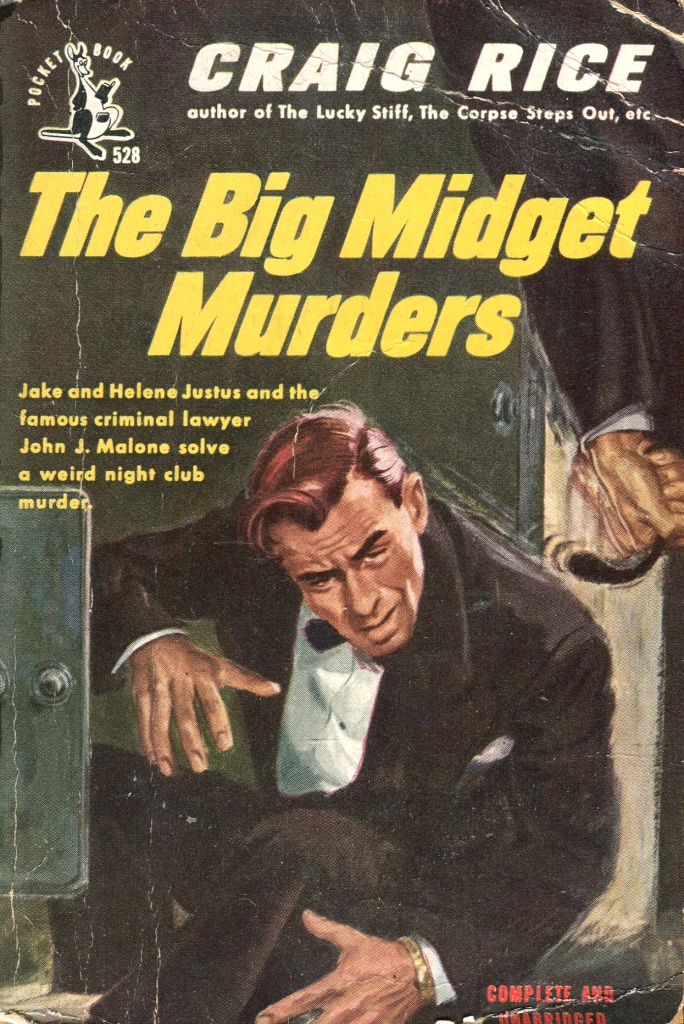


Though Jay Otto is “less than three feet high…his proportions were almost exactly the same as those of a full-sized man; his head was not too large for his body; his arms and legs were proportionately the right length”. The man is also a gifted mime, proving quite the hit at the opening night of Jake Justus’s new nightclub, the Casino. Which means it’s a blow for Jay and Jake alike when this “big midget” is found hanged in the wardrobe in his dressing room from a rope made of eleven mismatched stockings. And it’s even more of a blow for Jake, his wife Helene, and their lawyer friend John J. Malone when Jay’s body vanishes after they hide it to protect the reputation of the night spot.
The Big Midget Murders (1942), the sixth title in the series to feature Helene, Jake, and Malone from the pen of Georgiana Ann Randolph Graig under her Craig Rice nom de plume, is perhaps the most accomplished yet. The high energy nature of proceedings keeps things rocketing along, with practically every chapter ending on a cliffhanger that propels you forward, each new twist and development feeling genuinely compelling as the suspects become ever-more embroiled in each other’s lives. And yet Rice is never just throwing in cheap developments to hold your interest while ramping up your confusion; the plotting is a whirligig, but also a bravura performance when it comes to keeping strands entwined but clear.
Best of all, it’s grounded in superb character work that manages to fit positively acres of subtlety into the minutest spaces: see striptease artist Angela Doll’s response when Malone assures her that he found Otto’s mockery of her routine unfunny, the surprising moral streak in gambling czar and mobster Max Hook when he discovers the criminal scheme various characters are trapped in, or the heartbreaking hopelessness of faded showgirl Ruth Rawlson when she’s pressed on why she drinks so much. It takes skill to mix people up into a convincing puzzle plot, but it takes real class to make them actually feel like people while doing so.
Perhaps the two biggest achievements are the characters of Jay Otto and Ruth Rawlson. The first, flaunting the potential eggshell-stepping nature of his physical being, really is one of the most unutterable bastards and deserving corpses in classic detective fiction, and the second is a habitual fabricator who hides behind her faded feminine charms whenever she’s pushed on her lies…and yet, despite this running a high risk of palling, she emerges as perhaps the most sympathetic and exquisitely-limned person Rice might ever put on the page (and, yes, that includes Archie Carstairs). You know these people, you know how they’d behave in any given situation, and you’ve had time enough to learn about them without the plot ever sputtering to a stop to do lumpy and bland-tasting ‘character work’, too.
The core cast is also superb, of course, especially frustrated homicide detective Daniel von Flanagan — the moment Malone et al. burst into his office to demand the release of wrongly-arrested Allswell McJackson is a delight. Additionally, Malone’s keen moral fardels brings a sense of gravitas to proceedings, belying the supposed comical nature of Rice’s work where people simply drink and do drunken things. These books have become less and less screwball as the series progresses, powered instead by something more like human frailty — no-one will claim that Jake behaves admirably when hiding Otto’s body, but the motives are clear; you believe someone would do that. As a result, the relationship between the core trio has become more admirable as these books progress; after all they’ve been through, why wouldn’t it? Rice talks at the start of chapter 10 about how Malone “love[s] Jake and Helene so dearly” and, yeah, you can see that. It might be the best friendship in the Golden Age, and sort of makes my chest hurt when I think about it.
Only two flaws mar this. The first — absolutely not Rice’s fault — is that Adey listed it as an impossible crime and that erudite expert should have known far, far better. The second is that the motive comes out of nowhere…or, well, even if you intuit the motive, there’s nothing to link the motive to the eventual guilty party, and after the brilliance of what preceded this reveal it fell a little flat for me. There are still plenty of delights, not least the author footnote in the penultimate chapter which shows the book looking slightly beyond the Golden Age’s usual fixations; it’s just a shame that for the second book in this series in a row one of the key stitches is dropped when it matters most.
Man, I’m so completely in love with Craig Rice’s work, and a little frustrated that it’s so difficult to track down the majority of her stuff in paperback. She really does deserve better; the twining of plot and character done this brilliantly in the genre should be on show for as many people as possible to see. For my tastes, you are legitimately missing out if you haven’t read her yet.
~
Craig Rice on The Invisible Event
Featuring Helene Brand, Jake Justus, and John J. Malone:
Eight Faces at Three, a.k.a. Death at Three (1939)
The Corpse Steps Out (1940)
The Wrong Murder (1940)
The Right Murder (1941)
Trial by Fury (1941)
The Big Midget Murders (1942)
Having Wonderful Crime (1943)
Featuring Melville Fairr [a.p.a. by Michael Venning]:
The Man Who Slept All Day (1942)
Featuring Bingo Riggs and Handsome Kusak:
The Sunday Pigeon Murders (1942)
Standalone:
Yesterday’s Murder, a.k.a. Telefair (1942)
To Catch a Thief (1943)
Home Sweet Homicide (1944)
 The Invisible Event
I am really pleased to hear that this one was a good one. I’ve not read this one yet, so nice to know I have one to look forward to.
LikeLike