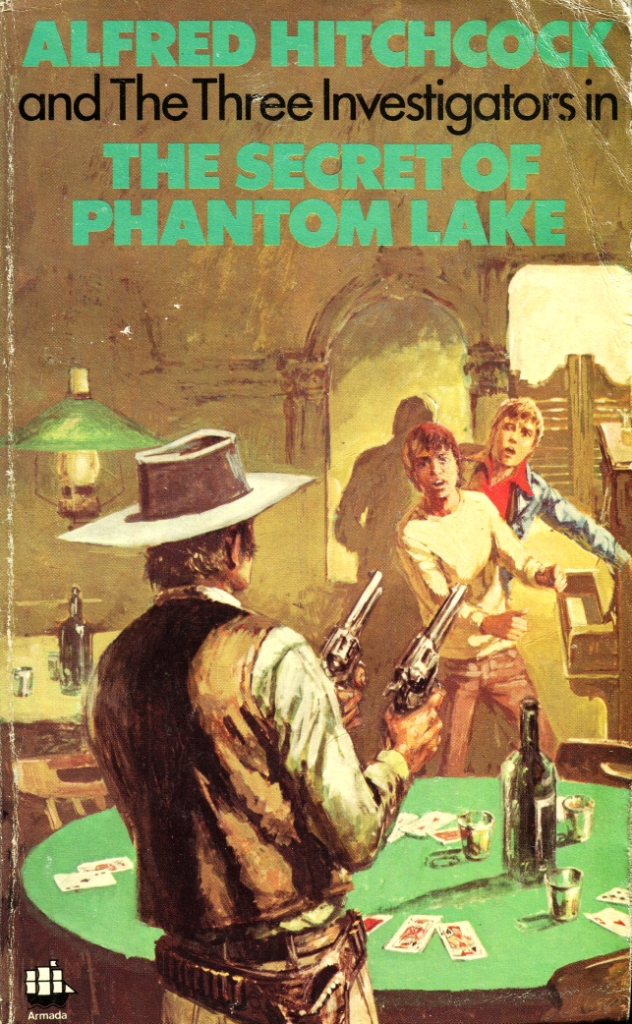
Pirates! Sunken ships! Mysterious treasure! A race to unscramble a message from beyond the grave! I promise you that The Secret of Phantom Lake (1973) by William Arden, the nineteenth title in the Three Investigators series, contains all these things. So why the hell is there a cowboy on the front cover?
It’s both a strength and a weakness of The Three Investigators series that the essential jumping-off point could be exactly the same from book to book: Titus Jones can buy a load of junk from someone for his scrapyard, and one item in that hoard can be valuable to an individual for unusual reasons…adventure results. P.I. novels start with a client walking through the office door, Perry Mason kicks off almost every case by observing some strange behaviour — these tropes exist because they give shape to the conventions we come to expect within the genre.
But it’s a weakness in the case of The Secret of Phantom Lake because the first half is, honestly, hard to distinguish from a great many titles that have preceded it in this series. The junk is purchased, someone wants to possess a chest contained within the bundle, the boys are followed by someone in a car, then it turns out that someone is trying to break in or steal something…it’s all been done before, and makes you appreciate why so many of the earlier titles shook things up with different settings or unusual mysteries, even when they turn out to be pretty terrible otherwise.
It put me in mind of the later Daniel Craig James Bond films: ticking off the chestnuts — young boy who helps the central trio, adult who appears he can’t be trusted, adult who appears just a little bit too helpful and will turn out to be the surprise villain in the final stretch — simply because they feel expected rather than because they add anything to the story.

The plot — concerning a journal left behind by a man who has been (quite savagely) murdered, which may or may not (it does) provide the clues necessary to find an old and very valuable treasure — is pretty boilerplate, too, with even the brief cowboy adventure depicted on the cover doing little to improve proceedings. It’s not like the 1970s were an especially rich time for Westerns, either, so this can hardly be put down to trying to cash in on what was hot in popular culture and represents instead just a weird, left-field turn for three chapters that is never spoken of again.
Still, the second half does improve: some good reasoning helps establish the complexity of the puzzle — the reason why Angus Gunn wouldn’t have just buried his treasure when he knew that men were coming to kill him for it is solid reasoning, neatly applied — and the difficulties in investigating what is essentially a cold case are realistically encountered and dealt with. One of my favourite examples of this is the boys going to the offices of the Santa Barbara Sun-Press newspaper for an article, only to be told that the newspaper’s morgue was destroyed in an earthquake and a fire and that their next best hope is an ex-reporter who used to keep his own paper morgue at home. There’s no need for this added step, but it makes the world feel lived-in, and heightens the difficulty in a way that works.
Pleasingly, too, there’s a sense of each step adding some new knowledge that will eventually make the answer to the riddle clear.
“I know something else, too… You said this case was maybe like a jigsaw puzzle — all the pieces go together to make the answer.”
And, yeah, in fairness it does require every step along the road to get to the answer, even if it some of the leaps they make are a little, er, intuitive at times. Also, how many of the target audience for this would have known what Arden was on about when he writes of “Poe’s purloined letter”? What? “Chesterton’s postman” too mainstream for you, Bill?
And, in fairness to Arden, he writes well when he gives himself the opportunity to do so: the visit to the fog-shrouded island populated by trees bent by the wind into nightmare phantom shapes is creepily effective, and goes to show how much scope there is in this series to do something interesting while also sticking close to the tropes and expectations which made it popular.
All told, The Secret of Phantom Lake is going to be nobody’s favourite Three Investigators book — cue sixteen people in the comments refuting this — and breaks the strong run that the series had maintained for the three preceding titles, returning us to the tepid middle ground of The Secret of the Crooked Cat (1970)…perhaps not uncoincidentally another Arden title that played safe with trappings when it should have been finding a way to extend the scale and scope of the boys’ adventures. The reputations of Jupiter Jones, Pete Crenshaw, and Bob Andrews will suffer none because of this book, but anyone looking to encounter the boys on their strongest form can definitely look elsewhere.
~
The hub of Three Investigators reviews can be found here.


I think you, as avid reader and a writer, read differently and the ordinary reader, who read for fun, mostly, read to have fun. So ordinary reader doesn’t care much if the story is reasonably new to his not so attentive mind, and the narrative not so confusing as to the solution. So, I would say, no matter the story old or new, the ordinary reader expect a good time. Even the bookworms, who could understand a bit about the plus and minus of a story that seemed a little too familiar, won’t mind if it is a fun read
LikeLike
Yes, I completely agree — the average reader picking this up won’t have the difficulties I did, because the familiar aspects are what they’re looking for.
I’ve already started planning to review less next year because it would be lovely to read something and not have to think about it more deeply than intended. So thank-you for reinforcing my decision!
LikeLiked by 1 person
I doubt that will work, I’m not doing any reviews at all and still can’t help noticing and thinking about these issues. Less reading and a steady diet of social media and TV might help though.
Referencing Poe rather than Chesterton makes perfect sense considering when this written and the target audience. Poe was at least still being read and taught at school back then, so there’s a good chance that readers might know the story. At least they’d know the name and should’ve no problems finding the story if curious enough about it.
LikeLiked by 1 person
I’d imagine it’s almost impossible to read a book and not think about it, but I’m planning on finally getting to a lot of stuff outside of the genre, which there’s no interest in me writing about on here, so I’m hoping I’ll be able to just read it, mull it, and more on like a normal person.
If that doesn’t work, I guess I’ll set up a TikTok account 🙂
Good point about Poe, too. I tend to forget that he’s taught and discussed in American schools. To most people in this country the name conjures up a red, seven-foot, baby faced rodent thing with a circle attached to the top of its head.
LikeLiked by 1 person
I agree that this is one of the more forgettable 3I titles; the fog-shrouded phantom trees is what sticks the most in the memory. On the next book, The Mystery of Monster Mountain, I have the impression that it is one of the more controversial “love it or hate it” ones among the fans. Personally I think it is one of the strongest titles, but I look forward to seeing your take on it.
LikeLike
Huh, now you’ve got me curious — what could possibly be controversial about a T3I title? I look forward to this with increased eagerness…
LikeLike
I used to read The Three Investigators a lot growing up, but can’t remember this one, though I’m pretty sure I’ve read almost all in the series. Well, maybe it’s time to re-visit my childhood favorites! 🙂
LikeLike
It’s been fun encountering these as an adult for the first time; no doubt revisiting childhood nostalgia would add to the enjoyment greatly. So I hope you get to — and enjoy — them soon 🙂
LikeLike
Oh, you have BARELY scratched the surface of the controversial T3I titles, Jim! Two you’ve yet to read had to be withdrawn and hastily re-written / translated in Germany. Monster Mountain is a real polarizer, so I look forward to seeing which side of the fence you fall.
BTW, your spot-on review (IMHO) has sparked some lively debate over here:
https://www.facebook.com/groups/threeinvestigatorsbooks/
LikeLike
Who knew there was so much controversy attached to a series of essentially fun juvenile mysteries? Not me! I look forward to being educated in due course.
And of course there’s a T3I Facebook page — how fabulous! Thanks for posting the review, lovely for it to be able to find an interested audience.
LikeLiked by 1 person