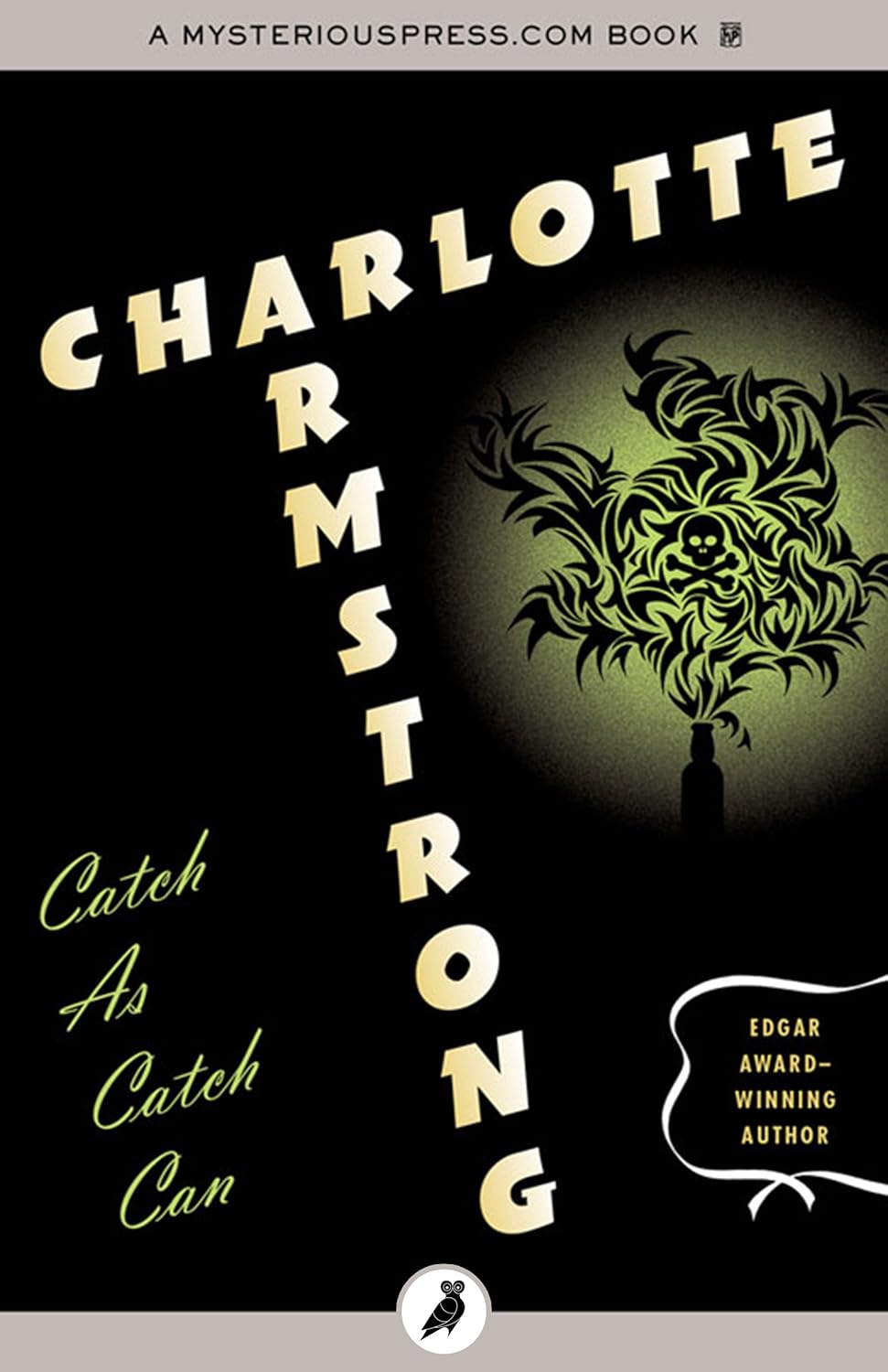


When Dee Allison’s itinerant uncle Jonas Breen pulls one of his sudden appearing acts and then promptly dies, leaving the overwhelming majority of his fortune to his newly-on-the-scene 18 year-old daughter Laila, the problems sown in the family are only just beginning. When the unworldly Laila runs away from home, unaware that she has eaten poisoned food which has already killed their housekeeper, Dee and her fiancée Andy Talbot are in a race against time to find the young woman before she, too, succumbs. And with some elements of the family possibly happier if Laila were dead, since that would solve their own financial woes, well, then you have a plot on the boil.
If the opening pages to set up this situation in Catch-As-Catch Can (1953) by Charlotte Armstrong are a trifle awkward, the way the plot soon reduces to a sort of inverse Cornell Woolrich nightmare — Dee and Andy know who they’re looking for but not where to look, while others plot, sometimes unknowingly, to obscure Laila’s location through nothing more than self-interest — proved very agreeable to this Woolrich fan. Armstrong gets good copy out of minor characters encountered on the run, like elderly spinster Estelle Fleming and cab driver Vince Procter, while those in Laila’s life already often have their own undercurrents of dislike and mistrust to inform their own cross-purposes actions.
Perhaps the greatest horror of the lot is Pearl Dean, whose presence in proceedings is left intentionally somewhat uncertain — she came over with Jonas Breen and might have known Laila’s mother, but is clearly a kook of some sort (“…[she] had seceded from the common experience of western man, and was, instead, a healer on some mystical basis invented by herself…”). Her insistence on self-renewal and New Age interest in the healing effect of the sun mark her out as an anti-realist of the worst sort, who is all the more frustrating a character because of how acutely Armstrong captures her hippyish mores. And then there’s Clive Breen, Laila’s other cousin, who is simply a misguided fool out for everything he can get and who might be a more sympathetic presence if he were a little more aware of the fact. Neither are especially awful people, but they’re certainly as vexing a pair of antagonists as I’ve encountered in a long time.
It’s probably just as well that the ‘bad guys’ are so unlikeable, because the ostensible heroes are a bland lot: Dee is simply a Girl Scout with nothing more than a yearning to always Do What’s Right, Andy is one of those generically Aggressive Young Men who became popular in fiction in the 1950s and is apparently so swoonsome that no fewer than two of the female characters are in love with him, and Laila is a bland, pliant, clueless presence with zero agency who is simply shuttled from one unlikely event to another. Other works by Armstrong have covered some miles in making her protagonists at least psychologically interesting, but she does fumble the ball a little here. The minor characters — like footless mute Mrs. Gilman — are by far the more interesting, and it’s their presence that helps dilute the frustration of having to read so much about our core trio.
Plot-wise, that Woolrich comparison is a little generous, since Armstrong has to wrench her characters through some highly unlikely narrative volte faces in order to extend the tension, and you really feel the lack of artistry in some of it. Woolrich was a master at making the contortions feel…if not natural then at least inevitable; Armstrong’s strength is character rather than event (the six pages she takes to describe a car crash are agony for all the wrong reasons), and so her dependence on events to draw the situation out does start to pall at times. There can, though, be no denying that, when on firm ground, Armstrong writes magnificently:
But the notion shuddered into her head that Pearl Dean might know and arrogantly dismiss as modern nonsense the whole situation. Her heart curled in fright. Oh, it was true! Laila was wandering, not only in the maze that the city physically was, but the maze of the minds of the people…the criss-cross of ignorance and knowledge, the conflicts of opinion and personal objectives. People’s loyalties and their limitations, the fits and starts of their motivations. This was the kind of haystack the needle was lost in.
Alas, it is Event rather than Character that drives the final stages, and the last third is drawn out and difficult to engage with. Indeed, the central thrust of the plot is abandoned with about 30 pages left because Armstrong can find no way to sustain it, and so we get a sort of mini-suspense sequence which feels familiar to me even after such a small sample of the woman’s work. Experiences like this make me slightly hesitant to jump two-footed into Armstrong’s oeuvre — she will be for me, I feel, an author with a curl in the middle of her forehead — but I have no doubt that other excellent examples of the craft will have come from her…I just need to find them.
~
See also
Kate @ Cross-Examining Crime: Despite being the focus of the book, Laila is not a heroine figure. She has no agency and her ultimate fate is not really due to her own actions. She embodies passivity and naivety to an intense degree. I think this means you can feel sorry for her, especially when she realises the mess she is in, but she is not someone you warm to. Consequently, I found it difficult to understand how she garners so much affections from others.
 The Invisible Event
Sorry to hear that this one didn’t work out for you. I enjoyed the unusual type of plot we get here and how it is almost an accidental crime or a crime of opportunity which is perpetuated.
LikeLike
Yes, the accidental nature of the situation does make a pleasing difference, you’re right — it lends things an almost thrillerish air. I just felt there needed to be a little more plot to go around…though Armstrong’s writing is frequently so enjoyable on a sentence-by-sentence level that it’s always a pleasure to read what she’s writing, even if it is coming up short in some other regard.
LikeLike