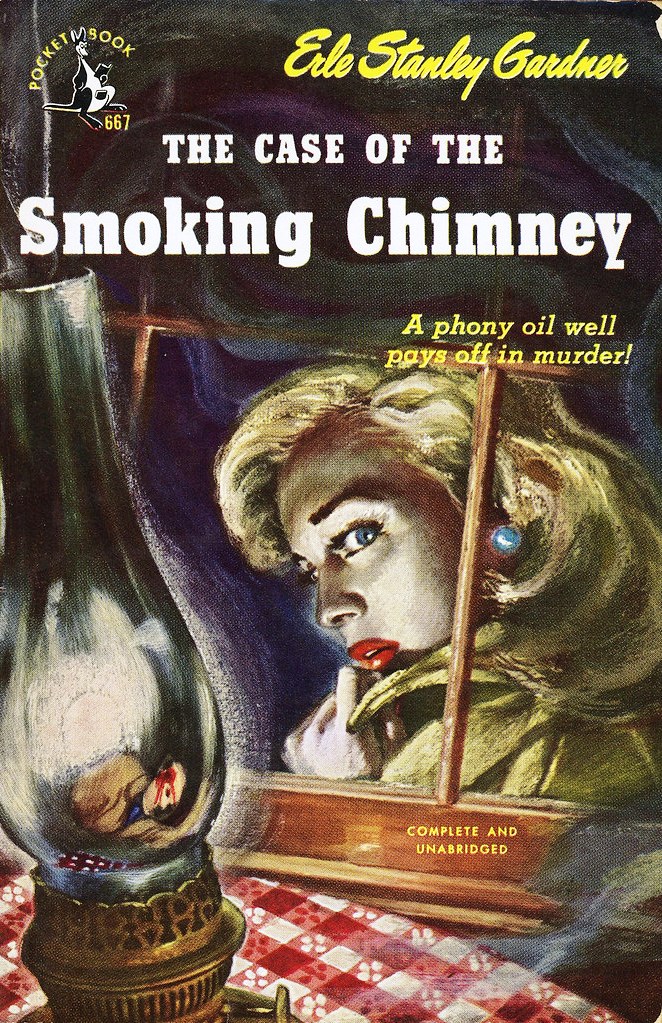


While you’ve hopefully been enjoying the regular reviews on The Invisible Event, I’ve been sweating bullets over the fact that I hit a seeming unpassable patch of reader’s block and haven’t read anything for nearly a month. Then Brad suggested that some Erle Stanley Gardner might help me out as it has done recently for him and, well, here we are. Mistakenly believing The Case of the Smoking Chimney (1943) to be the first of Gardner’s two novels featuring the disreputable Gramps Wiggins I picked it up and spent a very happy day in its pages, and while it reaffirmed much of what I like about Gardner’s writing the book also bears many of the man’s flaws.
Where Gardner’s typical M.O. is to open with an eye-catching event that ties his protagonists to some unusual crime, here he abandons that and gives us plenty of time to learn of the various people who surround millionaire businessman Ralph G. Pressman, most of who have a good reason for wanting him dead. Be it infidelity on the part of his much younger wife, financial malfeasance on the part of his accountant, or discontent with his most recent business venture from the landowner there affected, the opening pages make it clear that many lives would be simplified by the removal of Ralph G. Pressman.
Thus, when D.A. Frank Duryea is told that Jack Reedley, who owns a tiny scratch of the land Pressman is interested in buying, has been found shot in his spartan cabin, and rumours begin to circulate that Reedley might actually have been Pressman in disguise, trying to get an inside line on the business he was trying to push through, there’s already a long line of people who may well have gone to that cabin and pulled the trigger for reasons of their own. And Duryea’s job is further complicated by the arrival of his wife’s grandfather, Gramps Wiggins, just as these events begin to unfold — not least because old Wiggins takes it upon himself to interview various suspects and thus inveigle his way into the investigation.
Gardner has always excelled in tiny character touches — see Sophie Pressman’s icy condescension towards her husband’s secretary, or the cosy scene of familiarity and comfort which introduced the Duryea menage to the reader — and his settings are well-limned…
The room was as filled with silence as a cemetery. The books on the shelves seemed as resentful of a living intruder as tombstones in the moonlight. The room was partially darkened by drawn curtains, heavy with the gloom of its silence.
…but the clarity of his characters and places only goes to highlight how sparse his plotting feels in this volume from his library. Gardner rarely played fair, very few American mystery writers did in the traditional sense, but the way Gramps Wiggins pulls the solution out here (the significance of the eponymous chimney seems too obscure to be any use to me…and relies on an oversight of medical evidence that seems gigantically unlikely and is never actually explained) is divination at its finest — and contains at least one startling oversight (a left-handed man would hold the gun in his left hand, after all…). Duryea may lament his job as “a lot of things you have to run down in a regular, methodical manner”, but we see so little of it here compared to the work done in so many of Gardner’s other books that it feels more like lip service because he only had a weekend to dictate this one.
The few light touches which set this against the background of the Second World War are appreciated, but the loose nature of the plotting feels like an attempt to distinguish Gramps Wiggins from the likes of Perry Mason and Doug Selby. And, in fact, the clear similarities this shares with the Selby novels — people gunning for the young D.A., newspapers declaring their political affiliation, local crime-solving being tied up with the protagonist’s personal life — perhaps highlights why there was never a third Gramps Wiggins novel. Aside from him being a bit of a firebranded old cuss there’s very little to distinguish him — he lacks, for one thing, the moral rightness of your typical Gardner hero — and it’s easy to see why Gardner passed this universe over in his future writing.
ESG is always readable, and I’m yet to truly regret any time spent in his presence, but in the final analysis this is forgettable and easily passed over. I’m not entirely sure that it cured my reader’s block — there may be a few gaps on The Invisible Event in the coming weeks and months as I fail to make my own deadlines — but it proved mighty easy to read at a time when almost everything else was confounding me. Faint praise, perhaps, but anything more would feel disingenuous.
~
See also
TomCat @ Beneath the Stains of Time: [T]he character interaction between Gramp Wiggins, Frank Duryea and Mildred that’s at the heart of the investigation. A character-dynamic vaguely recalling Craig Rice’s John J. Malone, Jake Justus and Helene Brand, but the relationships here are, of course, a little bit different. … A good example of this is when Duryea, while looking over the body, discovers Gramp Wiggins has his face pressed against the window, like a creepy hobo, to see what was happening inside the cabin. Gramp Wiggins also managed to worm his way inside Duryea’s office and question some of the witnesses.
Noah @ Noah’s Archives: Without putting too fine a point on it, this is a minor novel by a great writer who is better known (and justifiably so) for his other creations…make no mistake, this book is pretty much only about the plot. None of the characters are all that believable; they do the things that they need to do to preserve the mystery. I still don’t know quite why Eva Raymond does what she does; she has to in order to keep the plot moving, but what little we know about her tells us that she wouldn’t have done it. She’s a minor character who rings quite false (and who could easily have been combined with Jane the secretary). Not Gardner’s best characterization by a long shot.
 The Invisible Event
I found a nifty little paperback copy of this recently. I even paid more than I usually do for used ESG. For some reason, I bought it was a Perry Mason book, and with the multiple stacks of PM, Doug Selby and Cool & Lam here to read, based on your review I might not get to this one for a long while. But I know what you mean: even second-tier ESG is ESG, the literary equivalent of comfort food! (And ESG contains no MSG!)
LikeLike
This was actually marketed as a Mason novel by at least one publisher — probably going on probabilities, given that it was from Gardner and the title sounds like a Mason novel. Moderately amusing to think people would have picked it up and then been confounded when Perry failed to put in an appearance.
LikeLike
Killer cover, too bad it doesn’t seem worth going out of the way for.
LikeLike
I wonder if the first book, The Case of the Turning Tide, is better. ESG obviously saw something in that to make him want to write a second, and then abandoned the characters after this second visit…so maybe head there first?
LikeLike
Only thing I remember about this one is the murder at the cabin and that I reviewed it at some point in the past. So, once again, we’re in dangerous agreement. Handy, isn’t it, to have a backlog of reviews all planned out? It has helped me over rough patch, or two, without it being noticed.
LikeLike
I’ve appreciated all the reading I was able to do over the summer, as it’s helped keep the blog ticking over while further reading has been problematic…but now, well, now I’ve got very little lines up, so we’ll have to see what gaps appear.
As to this book and our agreement — in honesty, it’s difficult to find too much to dislike about this, so I don’t think we need worry. Hopefully we’ll find something more enticing to take opposite sides on before too long…like my review coming this Saturday, say…
LikeLike