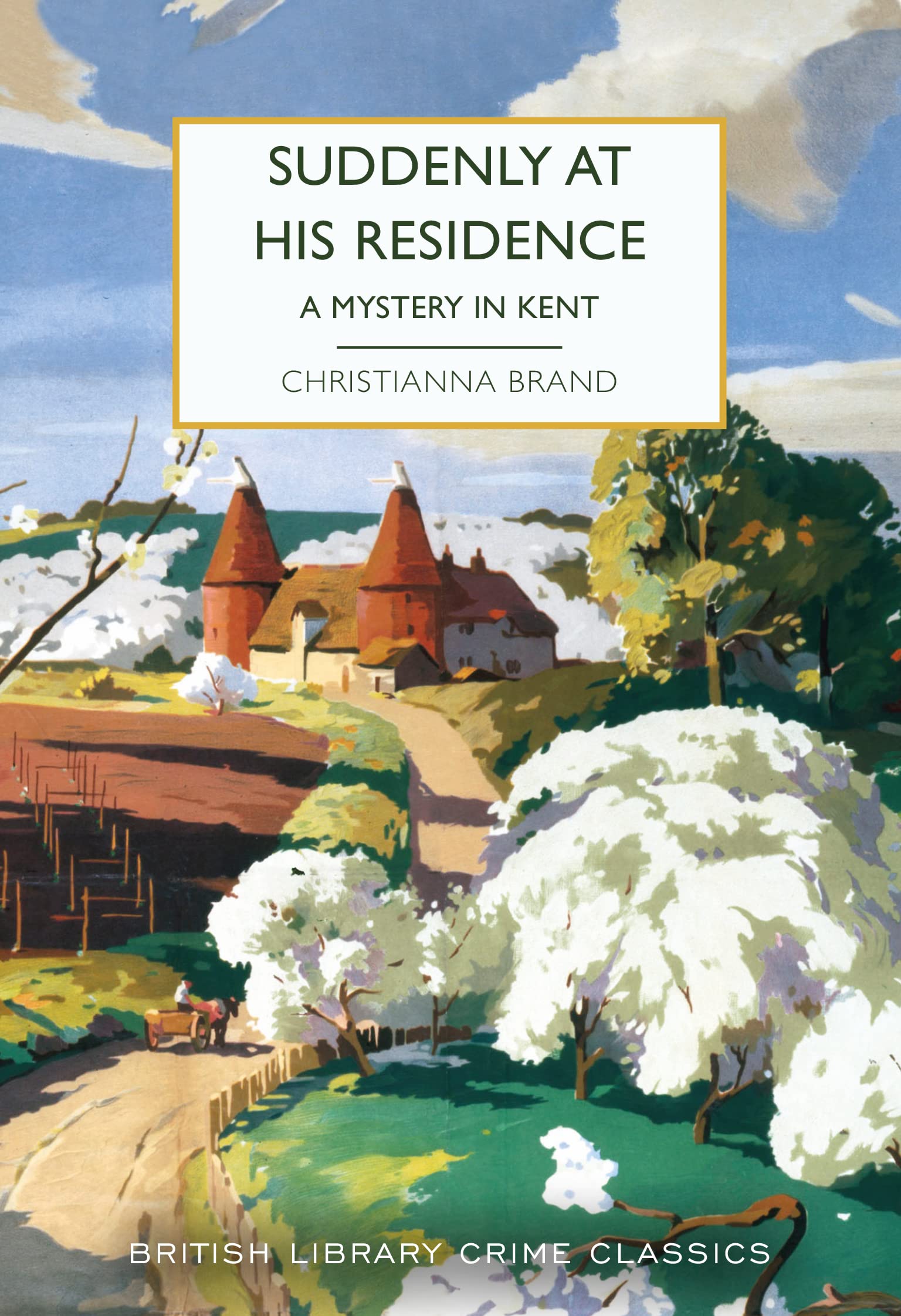

Good heavens, after this second reading of Christianna Brand’s Suddenly at His Residence, a.k.a. The Crooked Wreath (1946) do I have plenty of Thoughts. Indeed, I have so many Thoughts that I’m deliberately writing about it on a Thursday so that my self-imposed 1,000 word limit stops me going on for about four times that length, to the enjoyment of no-one. So: Sir Richard March, tiring of the attitudes of his grandchildren, threatens to rewrite his will, retires to the lodge in the grounds of Swanswater Manor for this express purpose…and is discovered dead the following morning. Having been visited by various people throughout the previous evening, who actually poisoned him?
The first thing I took away from this is just how phenomenally well-written it is, with Brand evincing more than her usual skill when limning the March family and their relationships — aided, no doubt, by a placement of adjectives which lift the whole thing on almost every page. Even little moments of nothing are somehow made more joyous and complete by the perfect descriptor thrown in so casually that it almost hurts to read:
That evening they sat on the terrace looking down to the river and away from the lodges, tenderly nursing their sunburn and all very silent after the rather hysterical unease of the day. … Bella fed biscuits to her dog, a small white whiskery animal called Bobbin which sat up with a rocklike steadiness, holding its mouth wide open to receive the fragments which, from a really astonishing distance, she threw to it.
She also prevents the frivolousness of the younger generation which irritates Sir Richard so much from being such an issue for the reader, with fabulous writing about grief, casual asides about the horror of the wartime experience, and reflections upon what is meant by the word “England” brushing up against the reality of the war which continues to rage. And yet, the March family come with plenty of flaws: none of then bother to learn the name of the ‘woman who does’ for them at the Manor, calling variously a “hag” and “The Turtle”, and the following diatribe from gardener’s wife Mr. Brough, following the accusation of her husband, is another piece of pitch perfect condemnation:
“Let the servants suffer! Don’t dream of punishing the rich or suspecting the rich, or saying a word that might hurt the precious feelings of the rich — not if you can find a servant to suffer in their place!”
There are also the difficulties within the family itself — Philip is having an affair with his cousin Claire, and has to negotiate leaving his wife Ellen and their young baby — and the way this feeds into the behaviour and attitude of the March grandchildren as things fall out becomes increasingly interesting, as does the love that lawyer Stephen Garde harbours for eldest grandchild, and presumed heir, Peta. And the moment when Sir Richard’s second wife Bella resoundingly refutes the idea that she would commit murder in order to acquire Swanswater for herself remains one of the great stand-up-and-cheer moments of classic detective fiction.
Indeed, there’s so much going on here that you could write a whole review before you even got to the criminous plot, and the expert way Brand waves false and true solutions at you from the very early stages (you’re actually told before the halfway point how the apparently impossible murder of Sir Richard was achieved…). And so while the criminal aspect does sort of take a back seat at times, we do at least have the terrier-like presence of Inspector Cockrill on the scene to worry away at the suspects in the most shamefaced manner imaginable.
And while, miserably, the family eased their tortured nerves, in accusation and argument, wrangling unceasingly among themselves, siding now with one and now with another, irritable, dejected, over-excited, ashamed, Inspector Cockrill prowled, ever watchful, through the house and grounds. Now and again he put a sharp question; now and again he stood unblushingly outside a door to listen; now and again he appeared among a group of them, stirring up with a sort of mischievous joy those easily ignited fires…
I can fault this only in that we’re never told how Cockrill comes to realise the answer of Sir Richard’s death, which is a very slight disappointment on the back of the sheer perfection of an ending which manages to take an impossible situation for the family and the crime alike and turn it into the most consummately fitting dénouement perhaps ever put on the page.
This was the second book by Brand I ever read, and I had good impressions of it from all those years ago, but revisiting it with a better appreciation of her oeuvre, and of the genre in general, makes me realise how magnificently special Suddenly at His Residence is. Brand would be out-sold and out-reputationed by many of her peers, but the excellent work done by the British Library in negotiating rights and picking such strong titles to reprint will hopefully give her the reappraisal she is due. My thanks to them for all the work that has gone into these, and for the review copy that has enabled me to find so much to celebrate in this book in particular. Hopefully more are on the way…a second reading of Tour de Force (1955) feels about due, hein?
~
See also
Martin @ Window Through Time: The purist would argue that there are more holes in the plot than in a colander and while that is true and there is an element of impossibility to the explanation of the way both impossible murders were committed, Brand manages to divert the reader’s attention with a tour de force of some not inconsiderable brio and humour.
Nick @ The Grandest Game in the World: Brand usually turned out creditable work; she does not here. She populates the clichéd country house with a large family whose vocabulary is liberally peppered with ‘Dear’ or ‘Darling!,’ a condiment this reader finds offensive to his palate. The patriarch is murdered on the eve of changing his will—a thoroughly clichéd situation… What irritates most is the twee and over-sentimental tone, always very arch, except when it degenerates into simply blatant melodrama.
 The Invisible Event
Your intro left room for doubt as to whether you had loved this or hated it, and I amused myself by wondering for a few seconds how many stars it would get – I was not expecting the full five at all! I love Brand’s style of writing, and her cheery characters, so manage to get over my annoyance about her snobbishness and the Mary Sue-ness of the female heroines.
AS you don’t go into the whole question of whether a weapon could be concealed in a skimpy bathing suit, I will take the liberty of adding a link to my review https://clothesinbooks.blogspot.com/2016/06/dress-down-sunday-room-for-weapon.html
where we go big on that possibly rather niche aspect.
Re-reading my own entry, I remembered the splendid gardener’s wife, whom you also feature, and her mourning her husband ‘Poor old Brough – scum that he was, I wish he’d been alive to see this day.’ For a time ‘scum that he was’ entered our family language, and clearly should be revived.
LikeLike
Yes, for all the in-book discussion about how the murder weapon could have been carried, it’s pretty glossed over when you get to the actual solution, eh? I missed that!
LikeLike
Glad you liked this upon re-read. It is interesting that many bloggers for whom I have tremendous respect offer differing opinions on this book.
I recognise its imperfections (e.g., mawkish dialogue, I am not sure that either impossible crime would have worked, it drags a bit after the second murder, etc.), but this still holds a special place with me. This is the first Brand I ever read after seeing Martin Edwards include it in his “The Story of Classic Crime in 100 books”. Having two impossible crimes was irresistible plus I enjoy Brand’s prose and her ability to make me care about her characters.
LikeLike
This was the first Brand I enjoyed — Green for Danger left me pretty cold (now resolved, with rereading the BLCC reissue), but this one I at leas appreciated the cleverness of, and had an enjoyable time watching the various threads fall out. A second look, knowing what the answer is, certainly enabled me to appreciate the above-mentioned qualities; a third look in due course could be even more positive…
LikeLike
Yeah, I was pretty shocked by the negative reviews expressed in the quotes from other bloggers. It’s a brilliant novel – surely in the top 20 of the Golden Age. Part of me wants to declare it to be Brand’s best, but then I’m torn by the brilliance of Green for Danger, Fog of Doubt, and Death of Jezebel. Tour de Force too, and even Cat and Mouse. Gah, they’re all so good! Time to go read the final page of The Rose in Darkness one more time…
LikeLike
I wish I liked Fog of Doubt more. Perhaps I broke it for myself in doing a chapter-by-chapter Spoiler Warning post for it, but, man, that book was frustrating. Still, it’s due to be reissued by the BL next year, so maybe it’s due a reappraisal.
This one, though, really is a gem, and the republication of Brand in general in recent years is a magnificent occurrence. Plus we got a bunch of Carr and Crofts at the same time, and James Ronald is being republished…what a time to be alive!
LikeLike
That is good news about James Ronald. I thought his family refused to allow re-publication because he had an unsavoury past. Do you know which titles will be re-issued?
LikeLike
Details here — excitingly, it’s Volume 1, so who knows what other delights await us?!
LikeLike
Thank you. I didn’t know James Ronald wrote short stories. I am looking forward to those.
LikeLike
I reread this one (first time in English) earlier this year and your experience, realizing just how magnificently special it is, pretty much mirrors my experience the second time around. Suddenly at His Residence always divided opinions, some love it while others hate it, but a second appraisal firmly placed me in the camp of the former. I can only imagine the people who disliked it hoped to find another London Particular, but instead got, what look liked, cheap melodrama and a vulgar family row with accusations of murder flying back and forth. And that’s really the only thing you can hold against the book. Brand has written better as it’s not even her third or fourth best mystery novel! So glad you enjoyed it!
Although we should be a little careful when vehemently agreeing during these troublesome times. We don’t want to accidentally peel away another one of those apocalyptic seals by agreeing a certain number of times over a certain period of time.
LikeLike
Ha, don’t worry, we’ll fall out over something in the coming weeks. The seals are safe for now.
LikeLike
I just listened to the BLCC audiobook, having never actually read this one before. I was about to doze off when “the bomb” dropped, and suddenly I sat up in bed wide awake and gasping. How could I help loving a book that would do that? I don’t care about plot holes or treacly dialogue; it is magnificent!
LikeLike
It’s a magnificently clever ending: gutsy, exciting, and cleverly allowing everyone to get exactly what they want. Pure genius, I’m so glad you enjoyed it.
LikeLike