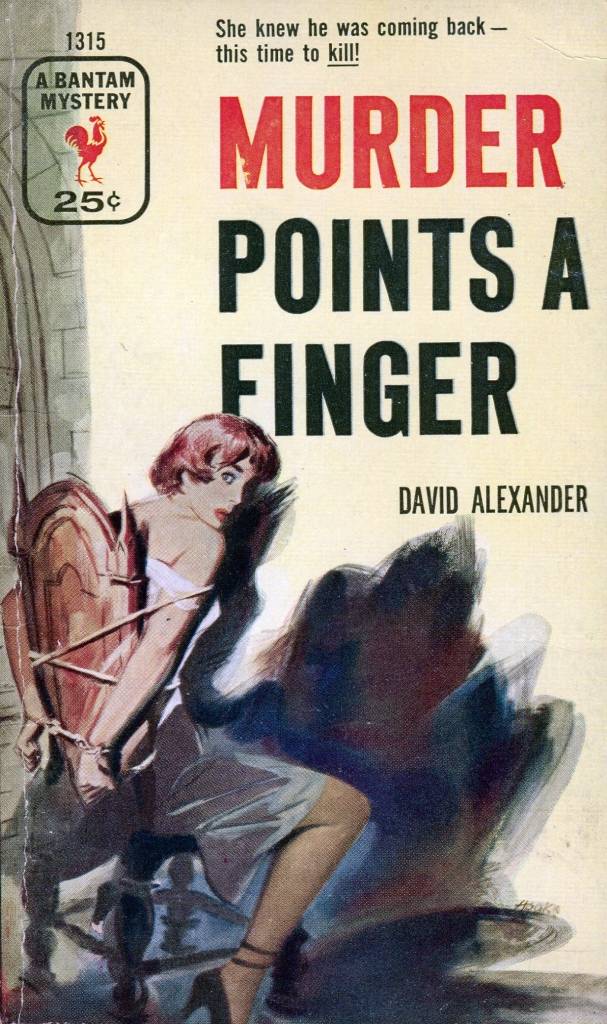
It was probably TomCat’s review of Murder Points a Finger (1953) by David Alexander which first put the book on my radar, but chances of finding it were slim and I’d forgotten any details by the time I did, much to my surprise, run a copy to earth last year.
I’d liken the experience of reading this to that of eating a trifle using a salt spoon: it’s rich, many-layered, and keeps up an impressive rate of changing focus to capture the attention, but, lord, at times it really does feel like you’re making infinitesimal progress. The book is 166 pages long, and at times I honestly felt like it was never going to end. There’s a sort of loosely-rolling suspense vibe to the whole edifice, and the novel is full of incident, but Alexander’s style so dense that wading through this really did feel like a chore at times; I would read for hours, or so it felt, and have only covered about six pages.
Of the plot, know this: retired New York policeman and expert on fingerprint evidence Philip Linton is shot in his home by a man he knows but whose identity is obscured from the reader, and in his dying moments selects nine cards which demonstrate facets of fingerprint evidence and leaves them in a clearly deliberate order on the floor. He also leaves an indication that these nine cards are a message for his friend, the retired theatre actor and puzzle enthusiast J. Dabney ‘Dab’ Ashton, who is then brought in by the police in an attempt to give some meaning to events.

Soon after Linton’s body discovered, another revelation hits hard: Linton’s granddaughter and only surviving relative, Patricia, has been abducted, having spent the evening with her beau, young policeman Allan Walters, who had proposed to her that evening and was then forced to leave her temporarily when their car ran out of petrol. Walters returned to the car to find Pat missing, and is now ready to tear the town apart looking for her. And, to complicate matters for Dab, the police are certain they’ve interpreted the dying message and are gunning for Linton’s nine-fingered stepson Abner Ellison, a young man Dab loves like the son he never had.
So, can Dab find the correct interpretation of Linton’s message and save the life of young Abner, with every cop in New York convinced that the young man is a killer of one of their own? A task complicated by Abner’s apparent criminal connections, as well as his being scorned by Patricia for Walters in the small matter of love. It is clearly going to be a long night…
As a plot, this clearly shares some DNA with the Golden Age’s love of esoteric puzzles, albeit the more realistic bent of the 1950s crime novel is felt in Inspector Sansone pouring scorn on the amateur detective’s eagerness to involve themselves and immediately make things complicated:
“Never do it the easy way. Never accept the obvious truth. Blame it on the butler’s illegitimate son who’s disguised as the prime minister. Never blame is on the guy who’s caught with a smoking gun in his hand.”
Indeed, Dab will put himself through the wringer when it comes to his ability to solve the puzzle and save the life of a man he doesn’t believe is guilty, going from the upbeat waxing of his moustache in a moment of childlike glee to wallowing in self-loathing in the most violent terms when the reality of the situation hits:
He thought at last he saw himself for what he was. A futile old man. A posturing mimic. A man who had never lived or faced life’s problems in any real sense. Instead he had led the life of characters who existed only on a playwright’s paper. He had no wife, no children of his own, and he would never have them now.

You’ll deduce from these brief quotes that Alexander writes well, but when everything is seen through these heavy glasses it really does make for hard going. Each chapter grinds on, littered with wonderful phrases — “The therapy of hope had worked a miracle with him.” — and the occasional archaic turn of phrase to set you back on your heels (“Any tosspots among the suspects?” did, for a few moments, have the Englishman in me in stitches), but I also won’t deny that things move ever-forward, and as we alternate views between Dab and Abner (with an occasional check-in on Pat locked away, with which Alexander does very little and yet still feels like he’s working hard) things do grind on in their inexorable way. Alexander also writes well about the damaged Abner, who has returned from the war carrying around a great deal of what would now be called PTSD, and gives the novel its heart as everyone else struggle with the desire to either shoot him on sight or uncover the evidence which finds him innocent.
Pleasingly, the dying message is actually pretty clever, and Alexander even works in a couple of false solution to show the peril of trying to interpret evidence at face value — and it’s slightly frustrating that the pun-based and best of these is withheld from the reader for such a long time, because it’s very clever. And the final solution is dropped clean in the middle of a chapter with a complete lack of fanfare which…I dunno…might highlight the very problem this book has: for all its incident, it feels structured along different lines from what we’d expect of a murder mystery, with revelations ground out in the middle of chapters and weird points of inconsequence picked as dramatic end points. The whole things needs a good edit, and then it might be a forgotten gem. As it is, it’s merely forgotten.
Having experienced some of the ridiculous flights the dying message has been taken to — I didn’t say that author’s name, you thought of it all on your own — I’m delighted to see such a clever utilisation of the principle here, in what feels like a transitional novel which both celebrates the intellectual puzzle and admits that pure intellect alone won’t cut it any more. There’s a tendency among GAD fans to believe that the puzzle novel simply got cut dead in its prime, but works like this show that a huge fondness for it remained beyond the period typically considered the Golden Age, and that the slow progress on in the genre didn’t simply abandon the building blocks of what came before at the gate of a new vanguard. A lingering fascination remains, even if the genre seems keen to move on, and for that alone this is worth a look. Just don’t expect to find a copy any time soon.
 The Invisible Event
I assume there’s a good reason why the victim was able to construct such an elaborate dying message, but couldn’t simply write the killer’s name in blood.
LikeLike
Nope!
LikeLike