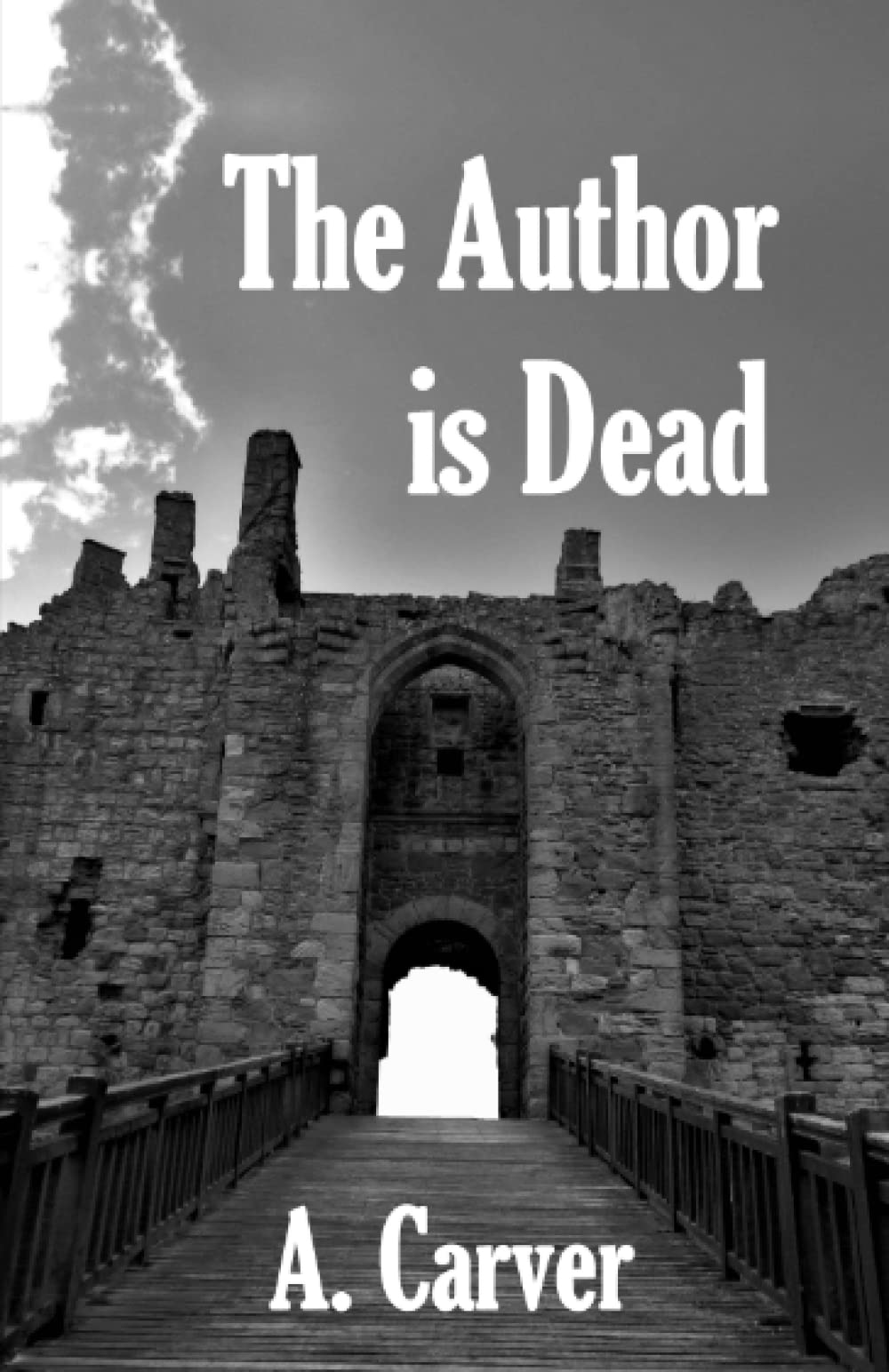
Excepting a couple of books by James Scott Byrnside, who graduated magna cum laude from the University of Self-Publishing, the last time I pursued these Adventures was October 2020. So, grizzled and too old for this shit, I am summoned out of retirement by The Author is Dead (2022) by A. Carver.
Six fans of the mystery author Adam Carver are given the opportunity of a lifetime: an invitation to Carver’s Rest, the famed, secluded house of their idol, for reasons that positively burgeon with potential — this might be a publicity stunt to drum up interest in another volume in his hugely successful Castles in the Sky tetralogy, a “quartet of young adult mystery thrillers set in gothic times and within eerie castles where baffling murders occurred with probability-defying frequency”. And so Alex Corby arrives at 10pm as her invitation requests…only to find that the others arrived at 10am and she has missed out on a day with Carver. And then she discovers Carver’s dead body in her room — a body which vanishes before she is able to summon anyone to come and see it.
From here, events progress at an impressive lick, with baffling deaths and unusual occurrences littering the pages as the body count rises and Alex finds herself appointed Watson to another guest’s detective. Can any sense be made of the murders? Why is a volume of Castles in the Sky left at each crime scene? And who’s next?

As a busy narrative with plenty of confounding events piling up, stirring a mystery that only gets deeper and more complex at each new development, The Author is Dead is very successful. But it’s also something more, taking in commentary on the genre as the mystery fans find themselves in a situation that would be both a dream and a nightmare to encounter — after all, they’re being asked to solve a series of impossible crimes, playing the Grandest Game in the World in an isolated setting, potentially pitting their brains against one of the best to have ever set foot in the genre. Who wouldn’t jostle their way to the front of the queue? But, like, people are dying.
[T]he last glance of [the victim’s] petrified face before it was hidden away reminded Alex of just what was at stake. She couldn’t begrudge Yva her evident brilliance, of course; that was childish. This wasn’t about who could get to the truth first. This was about getting to the truth at all, before somebody else died horribly.
What begins to unfold, then, is more than just a straightforward mystery, with each of the participants trying to force their way into contention as the sleuth in the affair, with the expected results. Personally, I found some of this a little wearying at times, especially when the theorising reaches a point of spinning potential solutions that are so incredibly unlikely that it’s pure navel-gazing to even suggest them. I mean, it’s part of the fun, and I won’t begrudge A. Carver the right to enjoy themselves, but sometimes less is more.
The characters involved, all summoned because of their dedication to Carver’s online fandom, are a realistically prickly bunch, with Yva — despite two attempts at explanation in the book, I still don’t know how to pronounce that — eager to emerge victorious and treating events far more like an attempt to grandstand than as the set of potentially horrifying crimes they might be. I don’t like Yva, but I don’t think you’re supposed to: she’s grandiose, fond of over-dramatising everything, and handwaves away any objections or serious opposition to her theories…and that’s probably how we’d all be if this role was foisted upon us. Her over-dramatic pacing and pausing are straight out of the detective cliché handbook, and such childishness in the face of the monstrous unknown is an endearingly clueless aspect of her behaviour.
Indeed, you get a good sense of most of the characters here, except Alex — which is a bit of a shame, since Alex is the protagonist. Thank the good lord, A. Carver has the sense to follow everything as if looking over Alex’s shoulder (if I have to read another “I’m just going to tell this chapter from character X’s perspective” novel I’m going to scream — pick a point of view and stick with it, authors!), but besides a few insecurities about her suitability for the role there’s not much to her. The reason she’s picked for the role as Detective’s Assistant did make me laugh, though, and is one of the better sly asides in the whole affair. Adding to this, a series of author-insert addresses to the audience give this a meta air that is quite good fun (someone who understands the Knox Decalogue! Nirvana!) and the commentary on cheap tricks and cheats used in the genre is refreshed at regular intervals, effectively cutting off those alleyways as solutions within the narrative:
“Accomplices are a cheap device to make things easy for the author,” Cornelia growled, with sudden ire. “Of course the killer can get away with anything if they have a sufficient number of people willing to lie for them!”
A. Carver has clearly read a lot of mystery fiction and seen just about every trope going. And the crimes themselves reflect this: stabbings on the wrong side of virgin snow, bludgeonings in rooms taped up from the inside…each scene is pleasingly creative, gleefully macabre, inventively impossible, and as each crime is uncovered the list of suspects gets shorter and the stakes get higher, and a few instances of genuinely great writing shine through:
Of the five living people in the room, four had faced the murdered dead before; in Alex’s case, twice. It would be wrong to say they were unmoved — that they did not feel fear of the murderer, pity for the victim, anger at the injustice of it — but if their reactions were muted by comparison, it was because they had been prepared. They had seen worse.
But, well, can it all be made to make sense? And the answer is…almost.
The busy-ness of the plot works well, with the short timeframe and the repeated disclosures woven clearly into a concise pattern. If I come away dissatisfied with anything, it’s partly that I don’t get a sense of why the murders needed to be impossible crimes, and that a lot of the detection borders on the Moment of Insightful Genius rather than any true reasoning. I can well believe that our author is a big, big fan of Gosho Aoyama’s Case Closed, because many of the revelations are achieved that way: ‘Oh! Now I see it!’ rather than as the result of a process — the speculation dismisses a lot of false options, but does nothing to establish the one true one in each case.
I also feel that things get a little handwavey with details about how the locked and sealedness of the solarium, the final crime scene, is achieved — this is where the Case Closed comparison really sings out to me, because I can see it being played out in a series of panels that make everything clear, but I’ve no idea why it would occur to our detectives that that was the method used. It’s a minor gripe, and not enough to spoil the cleverness of the pattern that emerges, but as a fan of detection I love it when my detectives actually detect rather than just know, particularly where mechanical means are concerned. Indeed, this why I feel decidedly cool on the topic of Case Closed, though that’s a topic for another time.
Overall, however, The Author is Dead shows keen insight about the impossible crime novel and detective fiction in general, and casts an interesting light on the role of the sleuth and how they affect the conduct of people within a case. And, look, every novel has a few minor gripes, and there will have been countless traditionally published novels put out this year that would warrant far harsher criticism than is due here. Another win for the self-publishing crowd; let’s hope A. Carver returns with a doubtless even stronger second effort before too long.
 The Invisible Event
I agree The Author is Dead has its imperfections and somewhat rough around the edges leaving plenty room for improvement, but, on a whole, it’s an impressive first stab at the detective story bursting with promise for the future. This is the quality you can get by building on your genre’s rich, storied history instead of tearing it down.
Interesting you compared The Author is Dead to Case Closed, because I was reminded of The Kindaichi Case Files. But suppose you can put that down to the general influence of the Japanese mystery on Carver. Anyway, I hope that second novel will be published in the not too distant future.
LikeLike
Yes, having someone appreciate the history of the genre before embarking on a novel in that genre really does seem terribly sensible, doesn’t it? But then, we nerds are always going to feel like that, I suppose — we take it seriously, so everyone else should, too.
Man, sometimes I wish I could just get in line with the masses and delight in the work of Ann Cleeves. Life would be so much simpler.
LikeLike
I momentarily misread your parenthetical sentences about the Knox Decalogue… but now I’m imagining Kurt Cobain singing those ten rules to the tune of “All Apologies”.
This is a book I’ve been interested in reading for awhile. Glad to hear it holds up!
LikeLike
I’m surprised there’s not been more written about this one, given that it’s been out for a while. But I guess it’s a crowded marketplace, and there’s an inevitable caution where self-published books are concerned — a caution I feel almost uniquely well-placed to advise, given how much SP dreck I’ve read. This one, though, is a good example of what can be done if you’re willing to be intelligent and respectful about the genre. Something could be learned from this.
LikeLiked by 1 person
This was a fun enough book. Not many have 4 impossible murders. Have you heard anything from the author? I couldn’t find any info about the guy. Nothing on twitter/amazon/goodreads/blogs/etc. He’s such an unknown. Others like JS Byrnside have blogs at least or are on goodreads.
LikeLike
I know nothing about the author at all, even whether they should be referred to as “the guy”…!
LikeLike
It could even be a man and woman writing and plotting together. After all, Eve was carved from Adam’s rib. 😉
LikeLike
Or three kids stacked in a trenchcoat…
LikeLike
I just finished this one and wow, I enjoyed it. As a locked-room enthusiast, reading this felt like being a child who likes sweets being locked in a candy store overnight. It is not perfect (but then what book other than perhaps And Then There Were None is), but it was fun.
While having read classic GAD, the shin honkaku is style is new to me and clearly this is a hybrid love letter to both. But I came away with admiration for the author’s creativity and chuckled a few times along the way, including:
Great-aunt Cornelia’s withering reaction to being compared to Miss Marple or Jessica Fletcher by one of the other characters.
The book reminded me of the 1985 comedy film, Clue, where wild accusations are hurled around including my favourite: “…so I prepared a back-up theory. She activated the gates using a self-destroying machine, which burned up or melted. I am not obligated to describe this machine!”.
I also have the second book in the series, “The Christmas Miracle Crimes” so look forward to reading that one soon.
LikeLike
It’s a remarkably confident debut, isn’t it? I’m excited to see how the follow-up fares, as well as what else we get from Carver. He and Byrnside might yet bring some reputability to SP impossible crime fiction…
LikeLike
This was great fun, so many thanks for the review as I wouldn’t have heard about it otherwise.
LikeLike