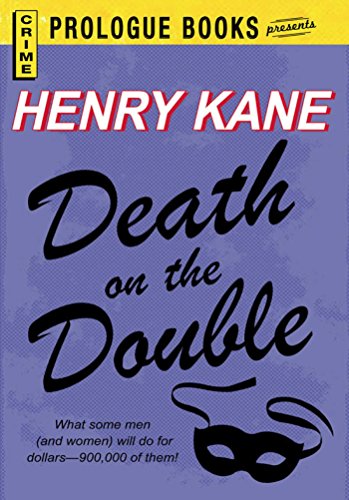
I often find myself in possession books with no idea why I bought them — there was a good reason at the time, or a recommendation from a reliable source, but damned if I can remember it now. And thus, with my motivation to read them forgotten, they linger on my TBR making me feel guilty…so for Tuesdays this month I’m again plucking four from obscurity and hoping for the best.
First up, Death on the Double (1957) by Henry Kane, which I bought because the book by Kane I was looking for — going by the magnificent title of Too French and Too Deadly (1955), even if I once again can’t remember why I wanted it — was very, very hard to find, and I stumbled across this after learning (again, I don’t know where) that it had some impossible crime shenanigans at its core. Beyond that, I honestly knew nothing, and so it’s with something of a sigh of relief that I tell you that I had a really good time with this. Well, with two-thirds of it.
Allow me to explain.

Death on the Double isn’t actually a novel, being instead comprised of two novellas, the first of which, Watch the Jools, is twice the length of the second, Beautiful Day. Now you might be all “Well, of course it’s two novellas, Jim, it’s called Death on the Double,” but nobody asked you. Given that they’re titled on my Kindle table of contents Death One: Watch the Jools and Death Two: Beautiful Day, it wouldn’t be unreasonable to expect the first part to be about one murder before a second death deepens things considerably…but, no. When things started to wrap up with alarming speed as I hit the 64% mark I realised my error, but I’d been expecting a full book before that. So, fair warning, etc.
Watch the Jools introduced me — though not the reading public at large, that occurring a decade before this in Martinis and Murder (1947) — to private eye Peter Chambers, who swiftly establishes himself as the archetypal, wisecracking P.I. of yore as he suffers through a New York heatwave:
It was muggy and sweaty and hotter than a cooch-grinder wriggling through an audition for a rhythm show in Vegas.
Chambers is summoned by Robby Tamville — senior partner of Tamville and Hart, Investment Brokers — to his office with the sort of magnificent, hardboiled shorthand that Kane will trade in heavily, and since “a call from Tamville represented business, and my business of late had been of the peanuts variety”, Chambers obeys the summons with alacrity. It seems that Tamville is selling a valuable ring at a costume party he’s holding the following day, and wants Chambers there as security for his investment to ensure nothing goes awry (“[I]t’s a damned small object, and damned small objects can disappear.”). Chambers agrees, and is then summoned by Jonathan Hart, the firm’s other partner, for business of his own.
Hart — accessed via his secretary Jessica Rollins, who gives our P.I. and author both a chance to get leery about the female form, as is de rigueur for the genre in this era — wants Chambers to track down his wife Delores, who walked out on him two weeks ago. A simple enough proposition, but for the small matter of Hart having a cardiac arrest later in the day and Chambers, while searching the man’s office, interrupting a rival P.I. partnership who knock him unconscious and scram before he can start asking questions.
You know exactly what you’re getting with this book: being knocked out is a mere bagatelle, tough guys exchange tough dialogue, society types are all wimps who need a real man like Chambers around to ensure their plans go ahead without a hiccup, and all the women a beautiful, free, and very easy. It should pall pretty quickly, but two things not only save it, they elevate it beyond its base, pulpy, lazy roots. First, Kane has a fine eye for the jaded, absurdist similes which follow so easily on the coattails of this tone of fiction. Say…
He had tiny grey eyes that peered meekly from beneath a heavy ledge of forehead, a good-natured whiskey-rasped voice, a slight lisp, and large square teeth that hung out like the bosom of a bent-over debutante.
…or…
A vein in his forehead stuck out like an urchin’s tongue behind his Mama’s back.
…or…
[The room contained] a red rug that was thicker than a Hungarian accent.
Second, Kane’s plotting is delightful, with each new encounter spinning off into a new thread so that seen from a distance the overall pattern represents not so much a Venn diagram as a circus performer impossibly gyrating as rings around him spin in incredible directions. The developments are fun — Hart’s death has nothing to do with his ailing ticker, and it’s here that the impossible element comes in — and the way the eventual solution rolls around shows that Kane has been cannily adding to his house of cards with each new ring in the plot (yes, that’s a mixed metaphor; I don’t care).
Also not without interest is the semi-impossible vanishing of the valuable “jools” Chambers has been tasked with guarding, and while neither of these elements is resolved with anything like rigour — the solution here is the kind of thing Agatha Christie, Christianna Brand, and J.J. Connington would dismiss as a false interpretation almost immediately — it’s pleasing to see Kane at least trying to do more than have tough guys quip at each other and take beatings like they don’t count, especially given those pulp roots. Equally, the fact that a homosexual character, at a time when homosexuality was still a crime, is treated with the in-on-the-joke disdain he is — rather than being turned into an easy, lazy punchline — feels sort of significant, if only because the revelation is very insignificantly brushed past as the nothing it should be.
The sexual politics are, of course, somewhat out of kilter for modern sensibilities, but everything else about Watch the Jools is great, even if Chambers is a facsimile of so many tough guy P.I.s from the genre’s youth. He has a conscience, he gets on well with a policeman (Detective Sergeant Ernest Falkner: “a college graduate, a career man [with] none of the old-fashioned hatred for the private operator.”), he can hand out a beating as well as take one, and women swoon whenever he walks into a room…reading Kane, you realise that Robert B. Parker’s Spenser was perhaps less of a leap forward than his many fans would have you believe (Spenser just cooked and read books; I never got why everyone went so nuts for this).
There’s even a lovely moment towards the end where Chambers realises the vapid crowd he’s ended up running with:
“Doesn’t anybody care,” I said, “that a guy just died?”
“Nobody seems to,” she said. “Everybody’s high, at least, a little high. Perhaps none of them were really his friends. For myself, I hardly knew him.”
Nothing’s done with it, but that Kane takes a moment to point this out goes a long way with me, and adds another point in the plus column for this snappy, fast-moving, inventive, and hugely enjoyable slice of cliche that’s somehow wrapped beautifully and made to look more valuable than genre historians might like to let you think it is.
And then, for the final third of the volume, we have Beautiful Day.
Let’s be clear, Beautiful Day is not bad…it’s just not Watch the Jools. We have “in the classic tradition” a beautiful woman coming to Chambers’ office to threaten him at gunpoint and, consequently, Chambers walking in on a dead body just as the police arrive and find him holding the gun which shot it. Again, Kane finds something to say about what should by now be a form of storytelling well and truly put out to pasture…
“This deal of mixing a private eye in a murder frame is so old, I’ll be ashamed to mention it in my memoirs, the critics will have my head.”
…but there’s less zing here, despite the same excellent standard of wisecrackery (“Guilt was scribbled on him like the devil had written it on his forehead.”). There’s about a third of the plot of the previous tale, but this takes up half the space, leading to a lot of repetition — almost scene for scene at one point — and the answer when it comes is (again) never actually proved and so Chambers survives because he’s the protagonist rather than any in-universe reason. I was hoping that the apparent simplicity of this would be a misdirection, that some clever conceit would be pulled out at the last moment, but…no. The dames are hot, the police are cool, the wisecracks come thick and fast, and it’s all much emptier because of how damn great the first story was.
I don’t doubt that I enjoyed this because it was so out of my usual way, and I can believe that too much time in Chambers’ company might prove galling, but I came away from Watch the Jools especially with that same crackling energy that people seem to have when they talk about Dashiell Hammett’s Continental Op stories: there’s something invigorating about Chambers’ spirit, his indomitable will, especially when mixed with the human moments that keep him on the ground among mere mortals. In the final instance, I’m still interested in Too French and Too Deadly, but at least this time I know why: because Kane has shown me something here that, on balance, I’d love to see again.
And that’s rather superb, isn’t it?
 The Invisible Event
I have an important question, though rather a niche one.
Does the costume party happen, is it featured much?
I have a small grudge collection of books where costume/fancy dress is trailed early on, but doesn’t happen (a Wentworth, a Marsh). Like, as if murders are reason enough to cancel a party.
Such events are one of my favourite things to illustrate on the blog, so you see where I’m placed. I mean, the first one sounds good, but am I about to be disappointed?
I feel about this much as you may do about alleged locked rooms that aren’t, unfair cluing, and misdescription of impossible crimes.
Please inform at your leisure.
LikeLike
There is most assuredly a costume party, with plenty of elaborate — and, in the case of women, skimpy — costumes. Have at it!
LikeLike
If Moira is looking for a costume party murder mystery with very odd costumes I suggest she track down a copy of The Murder of Stephen Kester by Harriette Ashbrook. Fun mystery. Lots of oddball costumes, one of them almost scandalously leaves the detective Spike Tracy in the altogether when his loincloth slips down. At one time it was available in digital format. Doesn’t look like it’s out there anymore. Odd. But copies of the US or UK 1930s hardcover do tend to pop up every now and then.
Henry Kane is hilarious, I think. I’ve read only A Corpse at Christmas and I quote practically a third of that short novel in my review back in 2017.
LikeLiked by 1 person
Thank-you, John — of course you have an obscure example to tempt us with; wonderful to have you back!
Kane is funny, and I’ve been lucky enough to find Too French and Too Deadly since reading this one, so he will definitely be on the blog again in future. I’m really looking forward to it.
LikeLike
Harriette Ashbrook’s The Murder of Stephen Kester is a good suggestion and Christopher Bush’s Dancing Death is another, but, if you want another really obscure one, try Ralph Trevor’s The Ace of Clubs Murder.
LikeLike