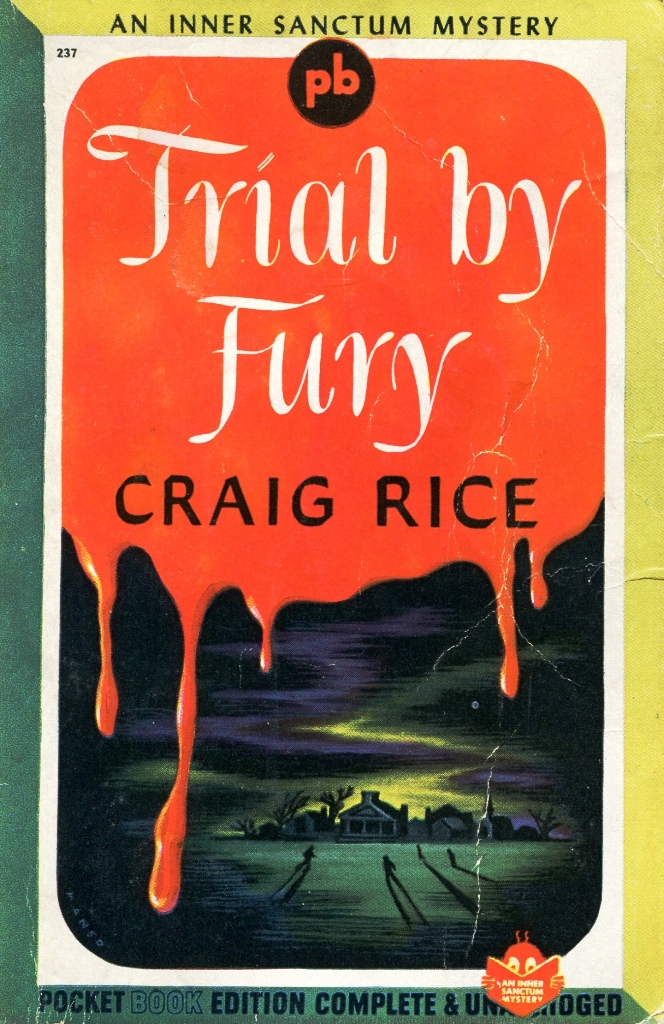


“This is the sort of thing we came to the country to get away from,” Jake Justus laments when, being given a tour of the Jackson County Courthouse in Wisconsin, the dead body of ex-Senator Gerald L. Peveley rolls down an emergency stairwell and lands at his feet. And with the D.A. insisting that “nobody here could have murdered him [because] we all know each other” it’s only a matter of time before Jake finds himself arrested and his wife Helene must enlist the services of Chicago-based lawyer John J. Malone, who has joined the Justuses on four previous murder investigations, to dig them out of trouble…a task that will only get harder as the murders in the town multiply.
Regular readers of The Invisible Event — hello, both of you — will already know that I’m a huge fan of Craig Rice’s writing. However, this fifth book in her excellent series featuring Malone and the Justsues had the extra curiosity factor of being included on the Haycraft-Queen Cornerstones List, all the more intriguing because no-one ever seems to talk about it (or, indeed, Rice in general). And I can certainly understand Fred Dannay’s interest in this book now, its setting anticipating the Wrightsville milieu he was about to explore for several novels starting with Calamity Town (1942) — “[a] little town like this is all currents and cross-currents…motives are bound to pile up, probably suitable for half a dozen murders”.
Rice explores and exploits the setting well, giving us a suitably imbricated mishmash of lives, frustrated desires, business affairs, and local politics which can be at times a little hard to keep straight but feeds the atmosphere perfectly. And the notion that “there’s something deadly and poisonous going on here in Jackson” is overlaid effortlessly — it would be easily-established enough by the murders which start cropping up on a regular basis, but Rice folds these murders into the fabric of the town, most notably in an extended sequence where Helene wanders the streets at night, culminating in a striking moment of silent horror and suspense.
The potentiality for murder was like a germ that everybody, including all healthy persons, harbored but that never developed unless certain conditions arose. It could happen in any one of these little houses.
It works, too, because the denizens of Jackson are given time to breathe: from Henry Peveley who lost his money in the crash of 1929 and so remains befuddled and trapped in that year in his mind, to the coquettish Cora Belle Fromm who is dismissed by Jake (and Rice) so savagely that I recoiled from the page, via District Attorney Jerry Luckstone, engaged to one woman but in love with another, the range of human life is there before you so that even in the crowd scenes little snapshots of life reach out and grip you (“Someone said something about first aid and having been a Boy Scout counsellor…”). And the Justuses and Malone at the centre of things carry this life with them — see Helene at her most magnificent making an off-colour remark that will doubtless be redacted if this ever gets republished, or lighting a cigarette on the third try in a moment of vulnerability, or see the late scene in which our lawyer-sleuth is reminded of his wartime experiences.
Plot-wise the murders present much which is interesting, not least the variety of methods adopted, although relinquish now any hope that the shooting of Senator Peveley has any sort of impossible element despite the gun apparently vanishing (“You couldn’t have carried a tune out of that courthouse without one of the deputies stopping you.”) because the resolution of this is so uninspired you wonder why Rice bothered with it. There is, though, a pleasingly casual piece of forensic detection straight out of R. Austin Freeman and a wonderfully atmospheric climactic chase through an asylum (following the payoff to possibly the best joke Rice has ever told) to enrich things. There’s a surprising absence of booze in this one, too, perhaps reflecting the confidence Rice has in the plot she’s mapped out, with the only drinking scenes arguably being central to different intentions (and giving rise to excellent comedic writing at the start of chapter 19). You could play a drinking game, though, by taking a sip every time Helene is described as looking pale, and you’ll be sozzled in no time.
I can fault this only in the rather crucial area of the guilty party: not that their actions don’t make sense or the motive proves insufficient, but rather in how Malone fastens on that person as the culprit. Even a line somewhere — especially concerning the capabilities required for the second murder — would resolve this easily, but it falls a little flat when you’re only going to get the guilty party by guessing, since that appears to be what our detective has done. It’s a minor point, but coming so close to the end it leaves a very slight air of disappointment which lingers once the book is closed; go in prepared for that, however, and you’ll doubtless have an excellent time.
~
Craig Rice on The Invisible Event
Featuring Helene Brand, Jake Justus, and John J. Malone:
Eight Faces at Three, a.k.a. Death at Three (1939)
The Corpse Steps Out (1940)
The Wrong Murder (1940)
The Right Murder (1941)
Trial by Fury (1941)
The Big Midget Murders (1942)
Having Wonderful Crime (1943)
Featuring Melville Fairr [a.p.a. by Michael Venning]:
The Man Who Slept All Day (1942)
Featuring Bingo Riggs and Handsome Kusak:
The Sunday Pigeon Murders (1942)
Standalone:
Yesterday’s Murder, a.k.a. Telefair (1942)
Home Sweet Homicide (1944)
 The Invisible Event
Ir’s not entirely true that no one talks about Rice or this particular Rice book, as I have reviewed this one, along with several others. Not reviewed any since April, but that is more through lack of easy availability. Glad you enjoyed this book though. It is one of the strongest in this series.
LikeLike
Yeah, but you and I are cool — if there’s any chance of Rice being reprinted, as the six books I’ve read to date convince me she should be, it’ll need normal people who aren’t obsessed with this genre to at least have an inkling of who she is…and in that regard no-one’s really talking about her. Which is, I’m aware, a catch-22 situation, but something about the absurdist nature of this assertion appeals to me in light of Rice’s own semi-absurdist take on the genre.
I mean, she’s never going to be Christie famous, but I think she’s better than, say, Gladys Mitchell, who is almost entirely in print thanks to Vintage and who probably only one in forty people on the street might have heard of. And it’s not because of the Diana Rigg-starring The Mrs. Bradley Mysteries that Mitchell’s in print…if televisual adaptation had any correlation with availability, Erle Stanley Gardner would loom down at use from every bookshelf in the land 🙂
But I must stop before this hobby horse rears to life and runs away with things. You already know everything I’m going to say.
LikeLike
I wonder if it is the fact that Rice’s work is screwball comic crime stories which puts people off – they assume poor plotting or something tasteless that won’t work. Based on books by Rice and Tilton I have concluded that actually it takes a lot of work and skill to write a really good screwball comic crime tale as you have to keep a really tight control of the plot strands. But at their best they both do this remarkably well.
Dare I say this but is Mitchell’s work perceived as more traditionally plotted or structured? Perhaps by hanging on to the coat tails of the Queens of Crime she managed to become well known – that and the fact that she lived in to the 1980s, whilst Rice died in the 1950s – the fact she was around longer and able to interact with Silver Age crime writers/readers probably meant she stuck in people’s heads better.
LikeLike
You make an excellent point about Mitchell’s overlap with the Silver Age; I always felt that her inclusion as a Queen of Crime came of the back of her being availabloe rather than the other way round — no-one’s going to perpetrate that narrative if they’re unable to read her, after all — but I guess we’ll never know exactly how that whole shebang came about.
And, yes, screwball mysteries are more than likely to be view askance; hell, I avoided Rice for years myself for that exact reason (and I avoided Crofts because people said he was boring — man, I pick bad times to follow the crowd…!). It’s a shame, because I think Rice offers something that very few, if any, of the readily-reprinted authors from the Golden Age do: only really Edmund Crispin comes close, and he’s more farce than screwball.
Ah, well, we can but wait and hope…
LikeLike
I’m fortunate that all of the John J. Malone books are available on Kindle in America. They are listed at $7.99 but often go on sale for $1.99 so I’ve picked up several, including this one. I’ve also purchased the AMC edition of Home Sweet Homicide as I do want a few of those covers on my shelves.
LikeLike
You are indeed very lucky; I keep hoping the AMC will reprint more of her, but as time goes by and more authors emerge from the wonderful imprint it seems that Rice has her shot and is now to be cast aside. Dammit!
Not that I should complain, I guess, because it was the AMC edition of HSH which got me reading her in the first place, and I will maintain that book’s masterpiece status until my dying day.
LikeLiked by 1 person
On the flip side, there are currently 60(!) Kindle editions of Gladys Mitchell available for only $1.49 or $1.99 (publisher Thomas & Mercer) but my two experiences of Mitchell in The Saltmarsh Murders and Speedy Death have not made me all that eager to try more.
LikeLike
I’ve loved Trial by Fury ever since I read it in the early 70s. Rice’s books were very hard to come by at that time and the only one I could find was in French, entitled Malone Quitte Chicago. My reading French was much better then. I always wondered what they did with the bloodhound.
LikeLike
Oh, does the bloodhound not feature again? Man, that’s a shame…though perhaps not entirely unexpected.
LikeLike