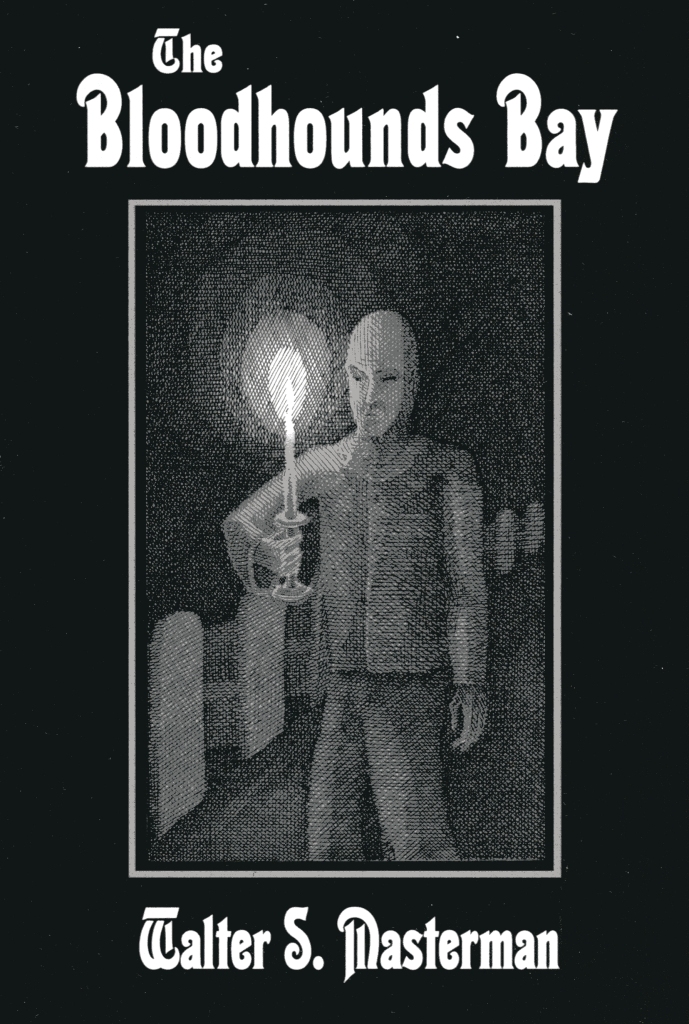


Jack Reid, posing for the last few weeks as a holidaying artist, breaks into Severinge Abbey one night with the intent of relieving its chapel of its more valuable contents, only to half-witness in the darkness the murder of Lord Henry Severinge by an unknown hand. Feigning ignorance, Reid returns to the Abbey the next day to find that the body has disappeared, and suggests that they use the bloodhounds of the Severinge’s neighbour Colonel Graham to track down the missing man. When the body is discovered in an Ellery Queenian hiding place, the small matter of who could plan such a diabolical crime, and to what end, comes into question.
Intending to read the Walter S. Masterman titles I possess chronologically, I should be reviewing The Rose of Death (1934) today. A mix-up with publication dates resulted in The Bloodhounds Bay (1936) coming to the top of my TBR instead and, well, I have to say that little do I regret the error, since this is easily the strongest Masterman title I’ve read to date. The plot develops cleanly and clearly — a miracle in light of Masterman’s sprawling Victorian tendencies — the atmosphere is superb, the humour enjoyably subtle, and it contains both a well-hidden culprit and easily the best moment of pure suspense outside the pages of Cornell Woolrich.
The case of Severinge’s murder is taken up not by Masterman’s usual Scotland Yard man Arthur Sinclair, but instead by young whipper-snapper Richard Selden, whose youth may count against him in the eyes of the locals, but (with the deduction about the candlestick, say) he establishes himself quickly in the reader’s affections as someone who is capable of clever insight rather than jumping at shadows and easy explanations. That Selden enlists Jack Reid’s help, and that Reid then goes and falls in love with governess Sylvia Lawrence, is of course setting up conflict for later on, but even this is handled smoothly, intelligently, and — in the case of Sylvia — with something approaching real skill in the communication of how simple trust can prove so binding.
What’s most impressive is how confident this feels, as if Masterman is finally adopting the Golden Age ways he has spurned for so long. That means that the book feels like it was written in 1906 rather than 1870, but it’s still leaps and bounds on from his earlier work, with some wonderful character beats:
Colonel Graham was a man to whom action was the breath of life. He struck the lightning, and sometimes like that potent force, he struck the wrong people; but there was nothing indecisive in his methods.
The text positively bristles with wonderful moments, like a servant smoothly entering the room “as though pulled by a string”, relatives who gather for the funeral and learn they are not in Severinge’s will drifting away “like people who have lost their money on a horse”, or the various hidden caches from Reid’s earlier burglaries “[laying] hidden for years, maturing like good wine”. Equally, Masterman does well with contrasts — detailing the terror of Reid re-entering the sinister Abbey to speak to Sylvia, only for the scene to turn into “Romeo and Juliet business” that he “enjoy[s] like a schoolboy in an apple orchard”. See also the way in which the respect conferred on Reid by others dragged into the crime throws the life he has led to that point into stark relief, giving insight to man and his actions even as he grows on from them.
Masterman also juggles suspicion well: one minute Ian Colindale, manager of the Severinge estate, is completely beyond reproach and the next he’s cast in a new light with startling ease; rinse and repeat this for the likes of the Severinge’s butler James, for Colonel Graham and his roving bloodhounds, for Lady Hilda Severinge…hell, even for the young Severinge twins Joan and Marian, who are singularly unfazed by their father’s violent demise in the manner so recognisable in young children. True, Masterman doesn’t play fair, relies on a sizeable coincidence, drops a bunch of information on you in the final chapter explanation, and resorts to a conceit he’d use again almost verbatim in a later book…but I loved it all, even if I do have to take a star off as a result of that final tumble of olde style info-dumping.
Previously, I’ve wrapped up recommendations of Masterman titles in various swaddling layers of conditions, but you can go into this with your mind free of such weighty concerns: he manages place, people, and plot very well indeed, and I’m delighted to have my patience in reading him rewarded in this way. The only advice I’d offer is to avoid my mistake of confusing bloodhounds and basset hounds, which rendered certain suspense sequences almost comical, but other than that…dive in. This could turn out to be the best thing he’s ever written, so don’t get too excited about him just yet, but rest assured that I shall continue to explore and report back at intervals.
~
One thing that does puzzle me is whether there’s an apostrophe missing from the title. The bloodhounds do bay on several occasions, and so as it appears here — and on the first edition cover — makes sense, but equally calling it The Bloodhounds’ Bay, a.k.a. The Baying of the Bloodhounds sort of feels more appropriate. Though, in all honesty, the bloodhounds and their baying is such a minor part of things that I don’t know why it’s the title at all. Looking over Masterman’s titles, I’d be inclined to go with something dripping in atmosphere like The Death Crypt or similar, but instead I’m here pondering punctuation. Life is strange.
~
Walter S. Masterman on The Invisible Event
Featuring Chief Inspector Arthur Sinclair:
The Wrong Letter (1926)
The Curse of the Reckaviles, a.k.a. The Crime of the Reckaviles (1927)
The Mystery of Fifty-Two (1931)
The Nameless Crime (1932)
The Baddington Horror (1934)
The Rose of Death (1934)
Death Turns Traitor (1935)
The Avenger Strikes (1936)
The Wrong Verdict (1937)
The Secret of the Downs (1939)
Back from the Grave (1940)
Featuring Inspector Richard Selden:
The Bloodhounds Bay (1936)
The Border Line (1937)
Standalone:
The Perjured Alibi (1935)
 The Invisible Event
I always enjoy a Masterman review. Glad you enjoyed it.
Too bad the story didn’t take place by the sea, or you’d have another interpretation of the title.
LikeLike
And if there was a brown and black horse in it, there’d be even more confusion…
LikeLiked by 1 person