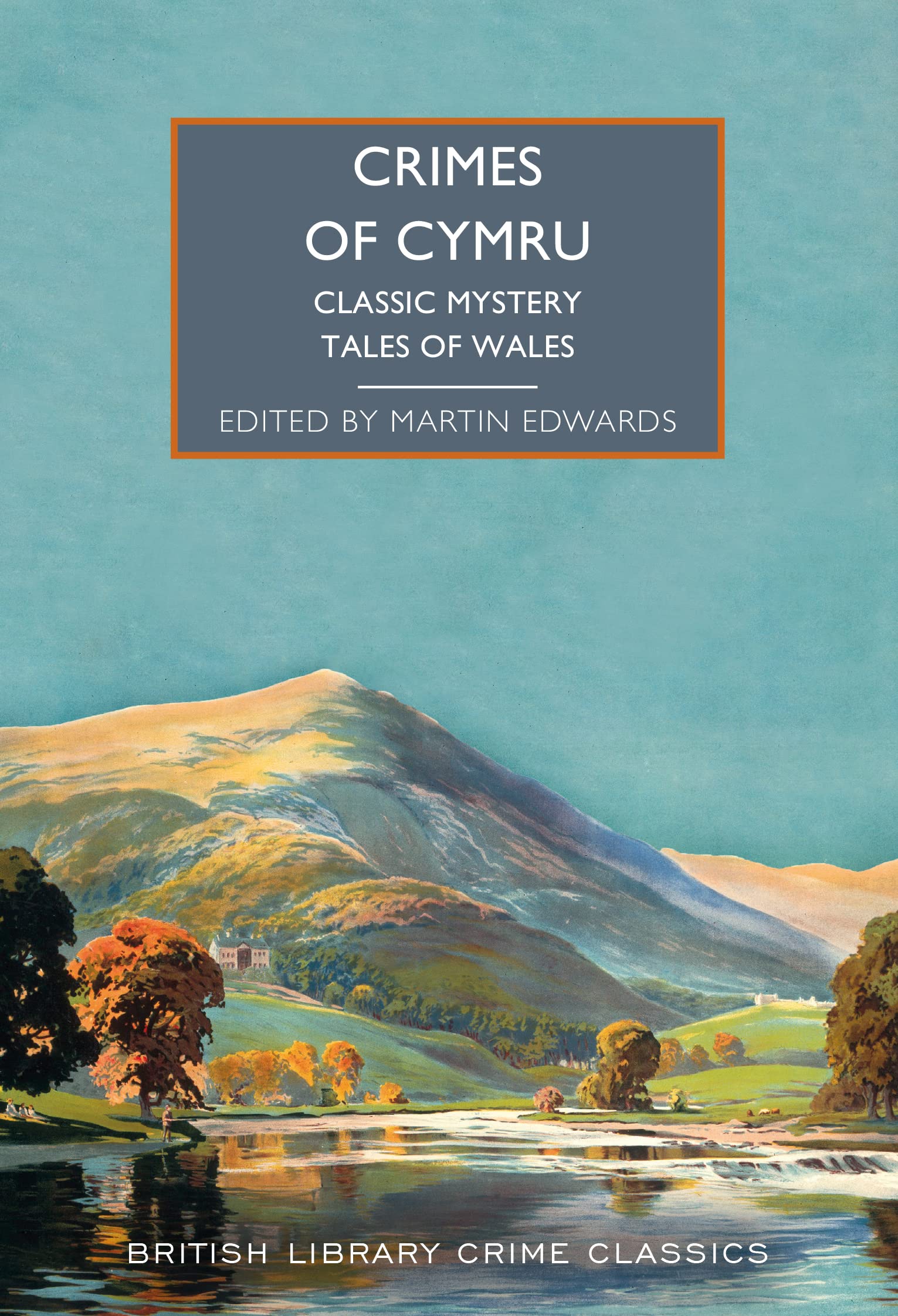
Another themed collection of crime and mystery stories from the British Library, Crimes of Cymru (2023) sees Martin Edwards’ exemplary genre knowledge tasked with selecting tales with Welsh settings or origin.
Edwards’ typically authoritative and highly readable introduction makes clear the difficulties involved in such a task: while many fine writers have issued from Wales, and while the land itself seems ripe for mysterious tales and skulduggery, a relative dearth of criminous endeavour has ever been focussed on the country. Still I’m encouraged by the mention of, among others, Virgil Markham in those pages, and if the BL ever decides to republish any of his work I’ll be at the front of the queue. However, for now, on with the current collection.

We being, as always in these British Library collections, with the oldest story, ‘The Murder in Judd Lane’ (1909) by Frank Howel Evans in which one-time French detective M. Jules Poiret — antecedent to both Hercules Popeau and Hercule Poirot, now retied on the grounds of his ever-increasing girth — is moved to investigate when a body is found in the eponymous cul-de-sac. Poiret’s methods might not sound unfamiliar…
He was not the detective of fiction who went about with a microscope, and an insatiable thirst for out-of-the-way clues. He simply sat in his office in his big armchair, and put his almost superhuman intelligence to work, for in that gross body and behind that fat, florid face there was a brain which cultivated trifles and made them bloom into accepted facts.
…but he’s mainly made to look good through a combination of pre-existing connections in the underworld and the frank idiocy of the professional police. Still, Welshman Evans does well not to disregard the Gallic temperament in the final stages, and there’s an amusing time to be had here even if recent experience has taught me that I’m generally more interested in the rogues and scoundrels of this era.
Drop everything right now and read ‘Water Running Out’ (1927) by Ethel Lina White. This savage, hilarious tale charts, via his birthday party, the compromised existence of thirtysomething Harvey, who supports his elderly, horrible live-in aunt after the rest of the family has abandoned her (“She was selfish and venomous. She was an organism that absorbed everything. She seemed a fungoid growth, which preyed on matter in order to add to its bulk.”). Not only is White’s eye for telling detail magnificently focussed (“Annie had become engaged to Harvey, when she was eighteen. Now, she was thirty-four.”), her layering of opinion, flashback, and important detail is masterful; who knew she had it in her?
It’s a shame this doesn’t quite work from a plotting perspective, but the sheer delightful, Anthony Berkeley-esque tone and playful semi-inverted structure of it all makes up for such slight infelicities. The BL have just republished White’s novel The Wheel Spins (1936), and this story alone just ramped up my interest in that by a factor of about twelve. Expect developments.
We put a toe over the line into medico-detection with Francis Brett Young’s ‘A Busman’s Holiday’ (1930), in which the holidaying Dr. Malcolm encounters a spinster from his younger days who suspects that her sister is being poisoned by her new husband.
It’s an odd story, because this corner of the genre had already, through the work of R. Austin Freeman, shown how completely ingenious it could be, and Young’s take is simplistic at best. It’s interesting in the treatment of the villain — though, there again it’s odd — but feels more like a passing curiosity than anything more. Well-written, and easy to enjoy, but you’ll scan the contents page afterwards and wonder why you can’t remember it.
I can’t challenge Edwards’ assertion that “an anthology of Welsh mysteries would surely be incomplete is it excluded [Arthur] Machen“, but his story ‘Change’ (1936) is one of folk horror and not crime, and so seems an odd inclusion in stark contrast with the contents of the previous collections in this range. And, look, it’s probably good at what it does, but — rather like the extra protein provided when a fly lands in your coffee — it’s not what I’m here for.
‘Error at Daybreak’ (1938) is one of Carter Dickson‘s stories from The Department of Queer Complaints (1940), but since that previous review is pretty vague let me add some thoughts here. This impossible stabbing of a man when no culprit is anywhere near him, and when “several miles of empty water behind him” make a shot fired from a rifle equally impossible, shows Dickson’s ability with superb bafflement and sinuous, subtle scene setting.
I didn’t remember the solution to this — that box of toy soldiers played a part, but I was jiggered if I could tell you how — and the answer is actually less interesting than the secondary plot launched after the death, which…well, spoilers, but it’s very clever and had eluded my memory. Excellent work from the BL in getting more Dickson (a.k.a. John Dickson Carr) in print — hopefully more of his novels and short stories will follow in the years ahead.
Maybe it’s the sheer amount of time it takes to get going, or maybe it’s the confusing way the various players are introduced via an opening conversation rather than in person when they need to enter proceedings — whatever the reason, I could not get on with ‘Murder in Church’ (1940) by G.D.H. and M. Cole. My limited experience of the Coles’ short stories suggests that they’re either long-winded and bland or to the point and entirely unmysterious. If any other collections have utilised them to better effect, I’d be interested to know.
‘Brother in the Barrow’ (1951) by Ianthe Jerrold is a short piece, and will be familiar to readers of Bodies from the Library 5 (2022) where it was published under the title ‘Skeleton in the Cupboard’. I read it again, because I remembered enjoying it, and I enjoyed it a second time, but due in part to its brevity I have nothing to add to my earlier thoughts.
Roald Dahl’s Tales of the Unexpected were, as for no doubt so many of us, a formative part of my reading life, and it’s lovely to see him included here with ‘The Way Up to Heaven’ (1954). Dahl has always been superb at sprinkling in that sniff of unease, and in detailing the suspected-but-never-proven torments Mr. Eugene Foster puts his wife through on account of her “almost pathological fear” of tardiness he’s writing at full strength.
You, of course, suspect the eventual outcome, as Mrs. Foster finally makes her six-week trip to Paris, but the sheer sinister calmness of the closing, revelatory stages is what really sets this apart. And, boy, this makes me want to revisit Dahl’s tales, the best of which — ‘Parson’s Pleasure’ (1958), etc. — are probably masterpieces.
‘Lucky Escape’ (1956) by Berkely Mather is another short one, and does well not to hang around or make mysteries where none should be falsely generated. A stern father, his put-upon daughter, a fishing trip, and a smitten young man — all the ingredients you need, mixed quickly, sprinkled with plenty of authentic jargon, and then paid off with only a sniff of motive and no mystery-making. It’s over too quickly to be able to come to too strong an opinion on it, but it’s also difficult to dislike on much the same grounds.
Sometimes a story’s strength lies in what it leaves unsaid, and in many ways ‘The Strong Room’ (1959) by Cledwyn Hughes illustrates this very well. Working late, a post-graduate student in a small town becomes convinced that the local bank is being robbed, and so heads out into the night to summon the police.
Where things go from here are best left to the reader to discover, but the easy tone and intelligent conduct of the small cast meshes well with the criminous element — at times you expect Hughes’ background to be in engineering rather than in Chemistry — and produces something that is both very slight but also rather affecting. As I say, it works best for all the things it doesn’t tell you, and many aspiring writers would do well to study the technique.
The shortest tale herein, ‘Mamba’ (1962) by Jack Griffith paints an effective picture in an impressively short time, as a man with a deep-seated fear of snakes drives home and…well, there’s not much more, so I should probably stop there. You get an impressive sense of personal history and, while there are questions that remain unanswered, this is the sort of crime writing where that works. Short and sweet.
‘The Chosen One’ (1966) by Rhys Davies is one of those gloomy, miserabilist, kitchen sink non-dramas that reminds me why I rarely read much between the Golden Age and the modern day. Essentially a dispute between a tenant and his elderly, acidulous landlady, this take 38 pages to do what would be far better covered in six, and I have to admit that I lost interest after 20 pages of repetition and molasses-paced developments and just skipped to the end to find that, yes, it’s still miserabilist and gloomy. Every collection has one duff story, and this is the sort of crime writing that I loathe.
I experienced the delightful oddness of ‘No More A-Maying’ (1974) by Christianna Brand recently, having read her Buffet for Unwelcome Guests (1983) collection last month. I’ll not repeat myself so soon after first encounter, so head to that review to read my thoughts (in short: it’s fine).
We finish with Michael Gilbert and ‘Y Mynyddoed Sanctiaidd’ (c. 1985), a crime story involving the eponymous mountain and a juvenile delinquent who, several years before, was encountered by the probation officer who is now telling his story to our narrator. This leads to some confusing framing, but Gilbert invests his thin narrative with a sense of sadness and frustrated ambition (“[H]e had those dark inward looking eyes that Welsh children sometimes have, and he seemed to be spending most of his time thinking about life and finding it hollow.”), and had the modern crime writer’s skill for making small actions count for a great deal.
I tend to round off reviews of short story collections with a top five — no idea why, you have to buy the whole book anyway — and here they’d be:
- ‘Error at Daybreak’ (1938) by Carter Dickson
- ‘Water Running Out’ (1927) by Ethel Lina White
- ‘The Strong Room’ (1959) by Cledwyn Hughes
- ‘The Way Up to Heaven’ (1954) by Roald Dahl
- ‘Brother in the Barrow’ (1951) by Ianthe Jerrold
I make this the nineteenth short story collection in the British Library Crime Classics series, and it speaks volumes about the high quality of stories from the Golden Age (and surrounds) that so many strong examples of the form can still be found to fill out such an endeavour. We always expect the standard to vacillate, and you’ll doubtless love some of the ones I’ve been dismissive about — that’s the joy of individual opinion — but we’ll agree that there’s plenty here to arrest the interest of the GAD fan, and no doubt many more collections will follow. My thanks to all involved in making this happen, and to the BL for the review copy.
~
British Library Crime Classics anthologies on the Invisible Event, edited by Martin Edwards
Capital Crimes: London Mysteries (2015)
Silent Nights: Christmas Mysteries (2015)
Crimson Snow: Winter Mysteries (2016)
Continental Crimes (2017)
Foreign Bodies (2017)
The Long Arm of the Law (2017)
Deep Waters: Mysteries on the Waves (2019)
Settling Scores: Sporting Mysteries (2020)
Guilty Creatures: A Menagerie of Mysteries (2021)
Murder by the Book: Mysteries for Bibliophiles (2021)
Final Acts: Theatrical Mysteries (2022)
Crimes of Cymru: Classic Mystery Tales of Wales (2023)
Who Killed Father Christmas? and Other Seasonal Mysteries (2023)
Lessons in Crime: Academic Mysteries (2024)
Cyanide in the Sun and Other Stories of Summertime Crime (2025)
As If by Magic: Locked Room Mysteries and Other Miraculous Crimes (2025)
 The Invisible Event
If it is any comfort, the short stories from these collections are finding their way into single audiobook releases rather than readings of the whole collections, so your top 5 may be invaluable to those who consume their crime fiction that way!
LikeLike
Ah, interesting, I was unaware of that. I shall continue to pick top fives, then — thank-you 🙂
LikeLike
This anthology is getting positive reviews and I hope to get to it one day. The Way up to Heaven by Dahl is unforgettable. So many years after reading it, I still remember that lift. Have you read Ethel Lina White’s Some Must Watch? That to me is the best of her read so far. A few months ago, I read the Coles’ ss collection Wilson and Some Others, Here’s my review of it: https://ahotcupofpleasureagain.wordpress.com/2023/04/12/1940-club-wilson-and-others-by-g-d-h-and-margaret-cole/
LikeLike
I read on Ethel Lina White — I want to say Fear Stalks the Village — and it was…pretty meh, to be honest. So I’m definitely on the lookout for recommendations.
Thanks for the link to your Coles review, too. Interesting that you find them more successful without the series character of Wilson. I shall remain sceptical about their work going forward…
LikeLike
I didn’t enjoy Fear Stalks the Village too but love Some Must Watch.
LikeLike
Good to know, thank-you. I’ll keep an eye out for SMW.
LikeLike
This looks like one to put on the wish list. I’m also appreciating the 19 short story collections and the 200+ obscure yet read-worthy tales this series has exposed to the masses. Knock one off a week and that’s a lot of reading, even if they don’t all hit. And that’s how I like to approach my short stories.
I was looking for a Christianna Brand story to be mentioned, as several novels – Cat and Mouse and A Ring of Roses – are set in Wales and are unforgettable. Both stories feature memorable settings and unexpected twists – Cat and Mouse in particular whipping my head back and forth over the last several chapters like no other book that I can remember.
LikeLike
Edwards has done a great job — like Tony Medawar in the Bodies from the Library collections — of mixing famous names with unjustly-forgotten obscure lights. Nothing will convince me that the Machen story should be in here, but the Selwyn Hughes is very good, as are others highlighted above.
And, yes, how lucky we are at present to stand a good chance of some Brand being included in this sort of endeavour, eh? Unthinkable even a few short years ago, and now almost accepted as a matter of course.
LikeLike