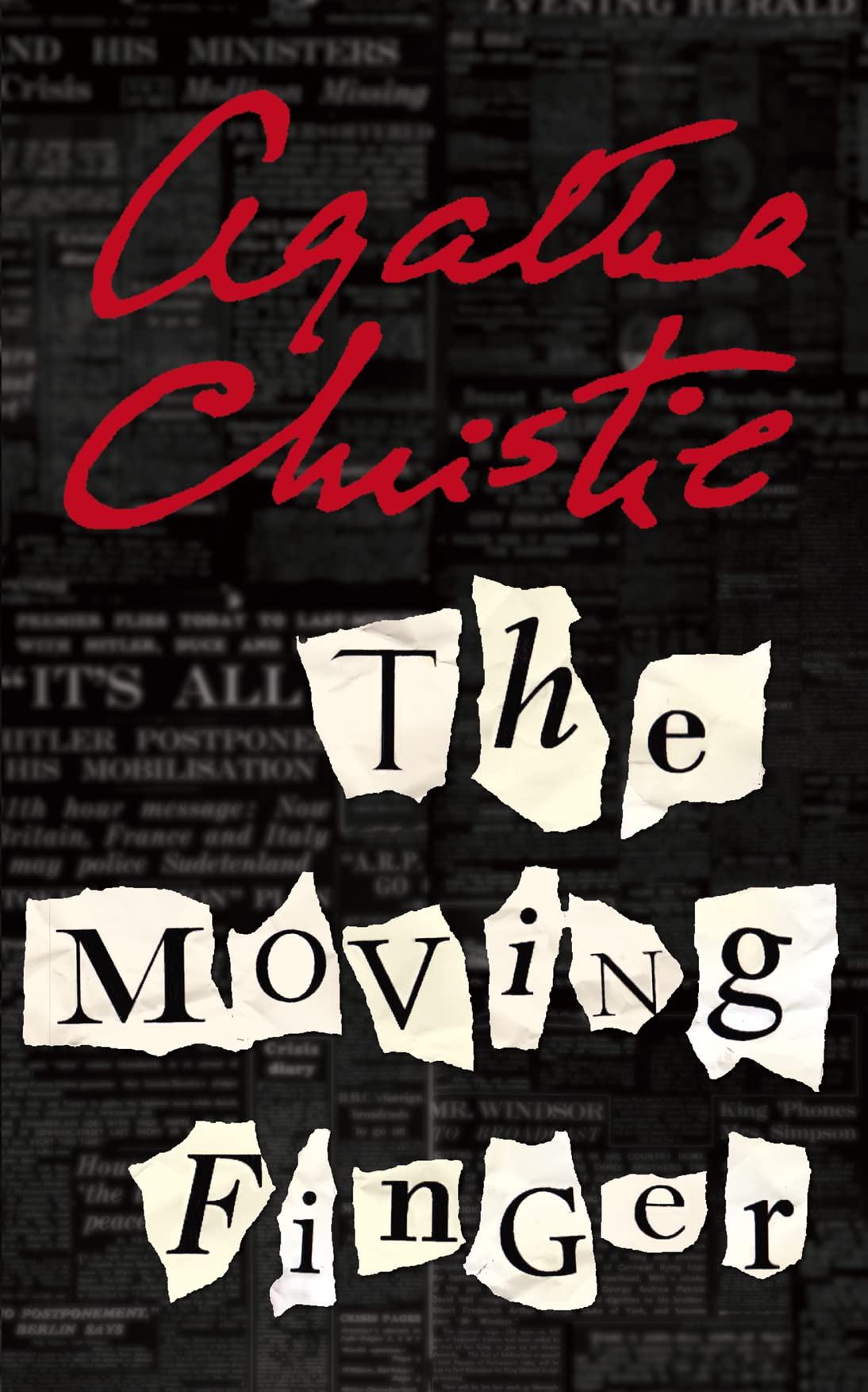


I had intended to review Behind the Crimson Blind (1952) by Carter Dickson this week, but the opening chapters of that puzzled my will and so I’ve taken the coward’s way out and opted to reread what I remembered as a stone-cold classic: village poison pen tale The Moving Finger (1942) by Agatha Christie. My recollection was that this both made the threat of nasty letters actually seem like something to fear and provided a superb reveal of its guilty party through one of the best pieces of negative evidence in the genre…and, in these regards, it stood up. It also fell down in a couple of others, but we’ll get to that. Headline: this is a great example of what the Golden Age did so well, and comes highly recommended.
Following a flying accident — despite the wartime date, there’s no implication that there’s any conflict involved and this seems to be just a side effect of being idle and rich — Jerry Burton moves with his sister Joanna to the quiet country town of Lymstock, “the most innocent sleepy harmless little bit of England you can imagine”, intending to do nothing more than recuperate (“Dogs are wise. They crawl away into a quiet corner and lick their wounds and do not rejoin the world until they are whole once more.”). Unfortunately, they soon discover that there is a serpent in Eden, as vicious anonymous letters are being directed at all and sundry with no discernible purpose. But how serious can such a problem be?
Christie does a wonderful job sketching in the life of Lymstock, a setting which proves tinder to the flame of the accusations being so haphazardly cast about:
“I’m afraid…of the effect [of the letters] upon the slow, suspicious, uneducated mind. If they see a thing written, they believe it’s true. All sorts of complications may arise.”
It’s this fear, especially the native fear of being mixed up with the police, which Christie mines so well. Most of the allegations are entirely baseless, but that one person might see a grain of truth in such hogwash causes people to clam up, to fester in their own fears, and, in one case, to commit suicide when an accusation of infidelity is directed their way. Upon which action, the threat starts to take on a very sinister aspect indeed.
This works so well because the dual strands of character and plot are so neatly intertwined. We’re given a cast of people who could easily be presenting a public face through which their true nature is allowed to peak in unguarded moments: young Megan Hunter admitting that she’s so very good at hating people, elderly Miss Emily Barton seeing the letters as God’s way of guiding the immoral towards a better life, vicar’s wife Mrs. Dane Calthrop speaking quite emotionally about the sheer unhappiness of the writer…Christie’s own moving finger does a wonderfully light job of pointing everywhere, always just ahead of the canny reader who thinks they’ve spotted a potential explanation for the missives.
There’s also, perhaps more terrifyingly, a surprising seam of the base intelligence behind most of the mistrust. That local witch Mrs. Cleat comes under suspicion is perhaps inevitable — and the explanation of how she has fed the flames of her outsider status is very clever — but then the way that suspicion simply drops from her is equally ingenious. Jerry’s observation that “we owe most of the achievements of genius to idleness” at first feels like a slightly pompous assertion, but one can also spot here the danger of simply adopting what we’re told without first considering it ourselves…a danger which has become increasingly prevalent as the Information Age gave unprecedented rise to the spread of uninformed opinion and unfounded accusations.
Don’t let this give the impression that the book is at all ponderous, however, since it contains some of Christie’s sleekest writing, not least in the person of Mrs. Dane Calthrop, whose tendency to cut to the heart of a matter sees her so very deeply feared in the village:
“Do tell me, why have you never married, Mr. Burton?”
“Shall we say,” I said, rallying, “that I have never met the right woman?”
“We can say so,” said Mrs. Dane Calthrop, “but it wouldn’t be a very good answer, because so many men have obviously married the wrong woman.”
It’s the thread of Jerry’s burgeoning romance which brings the first of two criticisms. While Christie is to be applauded for finding beauty where it waits rather than where it presents itself brazenly, Freud would have a field day about Jerry taking the woman he ends up falling for to the same people who make his sister’s clothes and cut his sister’s hair before admitting the attraction to himself. Perhaps this is more a product of its time, but I find it odd that a female author would lean into such cosmetic matters being important. The other issue I can raise is that, while the negative evidence remains superb, the reveal of our guilty party is disappointingly muted. It makes sense to me now that Miss Jane Marple parachutes in for a few late chapters with the insight to make sense of the mess — and, my god, how damn obvious it should have been — but the capture of that person is an oddly damp squib. But then, that seems to be the case sometimes with Christie — the culprit in A Murder is Announced (1950) is unmasked in a similarly ungratifying way, so while ingenious endings certainly fell in her wheelhouse the delivery of these shocks wasn’t always the author’s strong point.
These minor matters aside, The Moving Finger is a delight for its rich setting, superb cast of characters, atmosphere of dread and suspicion, and clever authorly brinksmanship as the reader does their best to get ahead of the game. Christie remains popular for the best reasons: her fiction is well-paced, her characters well-drawn, and her plots ingenious in the simplest of ways. On the slim chance you haven’t read this one yet, hop to it!
 The Invisible Event
“but I find it odd that a female author would lean into such cosmetic matters being important.”
I’d say is precisely a female author who would see such things as important. I can’t imagine it in a JDC book, for example. That is a recurring GAD theme, that men don’t pay conscious attention to female clothing and make-up, beyond noting how revealing the clothing is and whether they are wearing something unfeminine like trousers. Women do understand the importance of whether clothes flatter the body shape, etc.
LikeLike
Yes re-reading can be a lot of fun and it has been nice for me that my reading this year has leaned into it more than it has done in previous years. The Jerry/Megan romance is a bit problematic, with its Pygmalion bride (think I have remembered the right allusion). I wonder if Jerry took Megan to the places his sister used because he didn’t know where else to take her for women’s fashion and hairdressing. We tend to go with what we know or have heard of from others.
LikeLike
I can see Jerry believing that the shops Joanna patronized were the best, without it being too creepy. But I hope Megan really wanted the makeover, and Jerry wasn’t going to turn into some kind of control freak making her into his showpiece. It might give her some self-confidence, but not everyone has to be a fashion-plate. Would Columbo be a better detective if his clothes were GQ-worthy? I have the impression that Ariadne Oliver wasn’t terribly fashion-conscious either
LikeLike
Thank you, Johan! When people tell girls “Appearance doesn’t matter” they mean “Appearance matters more than anything else”.
LikeLike
I suppose I’m just surprised to find a 52 year-old Christie reinforcing this view; she would feel very differently a decade later in They Do It With Mirrors…
LikeLike
Is there any way I can browse through your blog from blog # 1 onwards ? This would ensure that I do not miss out on any of your blog. I have become a great fan of yours due to our common interests, and I wish you well. Regards and best wishes, Akh
LikeLike
Well, you can find the first post here and I guess scroll through them from there; only 1100 to read, so you’re getting your money’s worth… 🙂
LikeLike
Rumor has it that I’m very fond of Agatha Christie . . . but I would never claim she held enlightened views about her sex. Megan is a counterpoint to Joanna, and at the end of the story, the two women trade places: Joanna gives up the glamorous life to marry the country doctor, and Megan, transformed by Joanna’s couturier into a beauty, takes Joanna’s place by Jerry’s side. Nothing Freudian about it!! Joanna is the “real” London girl, while Megan is the fairy tale creature, part Cinderella (neglected by an unloving mother and stepfather) and part Ugly Duckling.
This comes out in 1943. The following year, in Towards Zero, Audrey Strange gives her heart to the man who likens her to “a bird struggling to escape” and tells her, “You’ll never escape now.” in 1948’s Taken at the Flood, Lynn Marchmont falls back in love with Rowley Cloade after he strikes her. I think the ickiness generally stops after this, but we don’t see much female empowerment replacing it. I think Christie saw herself mostly as a housewife who had a job that she loved. When Archie left her, she didn’t say, “He can’t handle my success!” No, she fell apart and then spent the rest of her life writing books about men killing their wives. (I made a list for a possible future post about murderous spouses. I found fifteen examples amongst the novels – there are oodles more in the short stories – and the husbands beat the wives 11 – 4!)
If there’s one point that keeps coming home to me in my yearlong re-read/analysis of the Miss Marple novels, it’s that when an author creates a sleuth whose methodology is almost completely psychological (a “psychology” that basically comes from anecdotal evidence rather than science) and almost never produces actual court-worthy proof, that author is going to have trouble with her endings. Think of Hercule Poirot sitting in the ship’s salon in Death on the Nile with a dozen pieces of evidence that he will use to explain his solution . . . or Ellery Queen in The French Powder Mystery staring down at two lipsticks, five keys, the onyx bookends, the jar of powder and brush, five books, a shaving set, two ashtrays (with stubs), a scarf, playing cards, blue memo paper, a blue hat, walking shoes, and a :38 Colt revolver before he speaks to the crowd for fifty pages!!!
Miss Marple can tell a good story, but when it comes to proof, it’s mostly about Mrs. Twitcher’s son Jonny who stole the begonias out of Miss Whitby’s garden to give to his girl or about what a lady carries with her on the street or how a servant girl dresses to take in the washing. There’s nothing that will convict, and so Christie has to devise all these “traps” that get pretty ridiculous. (The one you allude to in A Murder Is Announced is a real low point, but I like the humor in the finale of 4:50 to Paddington, a novel whose solution hangs on even less evidence than usual.)
Anyway, I love this book, and I’m glad you enjoyed it again, too.
LikeLiked by 1 person