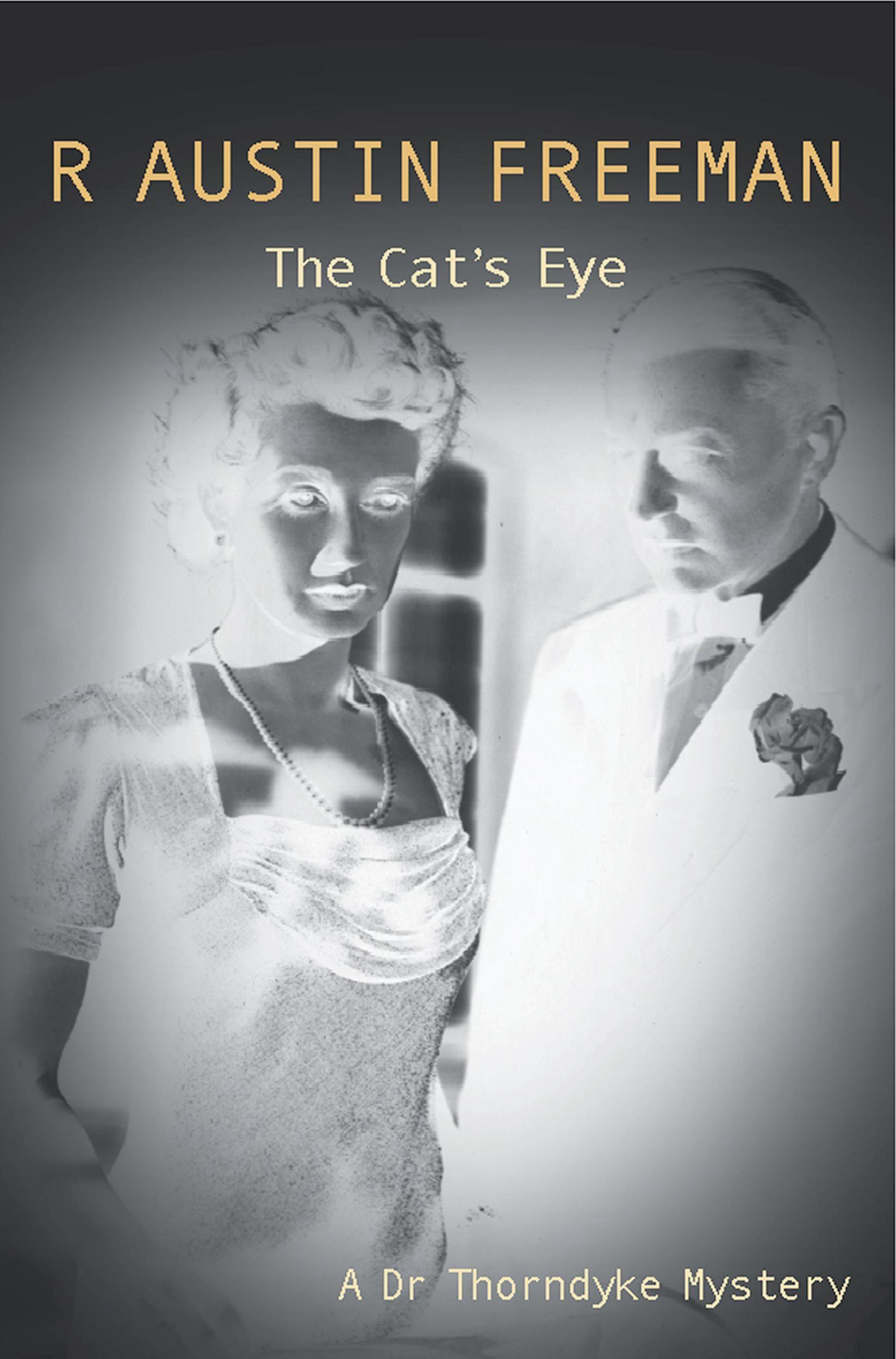


“Follow him! Don’t let him escape! He has just committed a dreadful murder!” — thus is Robert Anstey exhorted into chasing after a man he interrupts assaulting a woman on Hampstead Heath. Failing to catch his quarry, Anstey retraces his steps and discovers that Andrew Drayton, collector of knick-knacks, has indeed been shot dead in his home where Winifred Blake, the assaulted woman, had an appointment to meet him that evening. Even more curious, all Drayton’s acquisitions were well-known to be essentially valueless, so why have his gewgaws been ransacked, and what could he possibly have had amongst them that was worth killing for? Enter Dr. John Evelyn Thorndyke.
After the Slough of Despond represented by Helen Vardon’s Confession (1922), The Cat’s Eye (1923) finds R. Austin Freeman and his esteemed medical jurist back on slightly more familiar territory, with another mildly intriguing mystery that the average reader will have solved by the halfway stage without breaking a sweat. It’s true that the book is a long way from the very pinnacle of this series, but it’s also difficult to dislike — I seem to be saying that a lot these days — and, being Freeman, isn’t without points of interest.
For a start, some of the detection is very interesting: Inspector Badger may look over the scene and miss a few key points — the ease with which Thorndyke deduces he presence of an unexpected man is wonderful to behold — but the examination feels truthful, and the finer points raised by Thorndyke’s closer reading do him great credit (even if that handprint does seem a bit too magical to be true…!). Historical precepts, too, litter proceedings and enrich them: Thorndyke’s portable camera is a marvel, the College of Surgeons has an automatic lift (“[W]e stepped out of the lift he shook our hands heartily…pressed the button and soared aloft like a stage fairy.”), and while Freeman’s foreword is at pains to establish that the event in chapter 10 was not inspired by real life…well, Anthony Berkeley would feel no such compunction six years later.
A little like the interchangeable protagonists who get swept along on Henry Merrivale’s adventures in the novels by Carter Dickson, Anstey — lead counsel on the case detailed in The Red Thumb Mark (1907) — is a bit of bland and mainly there to react to Thorndyke and fall in love with Winifred Blake in Edwardian fashion. It’s interesting to note that that previous case appears to have had in-universe consequences, making juries and police alike wary of fingerprint evidence, but the belt and braces nature of Thorndyke’s investigations always sews things up much tighter anyway. I enjoy still the intelligent application of knowledge in these cases (“One mustn’t expect to apply a fact as soon as it is discovered…”) and if the telling is a little slow and the later events a little easy to predict, well, time spent with Thorndyke and Nathaniel Polton is never truly wasted.
“[I]f only there were a few thousand more Poltons — men who found their satisfaction in being useful and giving pleasure to their fellows — what a delightful place this world would be!”
Freeman also writes well, with a talent for gloomy scene-setting that is a delight after the meandering oddness of his preceding novel:
This was the old timber house, and as we crossed its deserted rooms and trod its uncarpeted oaken floors, our footsteps resounded with dismal echoes among the empty chambers and corridors, conveying a singular sense of remoteness and desolation. The gloomy old rooms with their dirt-encrusted casements, the massive beams in their ceilings, the blackened wainscoting, rich with carved ornament but shrouded with the dust and grime of years of neglect, the gouty-legged Elizabethan tables and ponderous oaken chairs and settles; all these dusty and forgotten appurtenances of a vanished generation of men seemed to have died with their long-departed human associates and to be silently awaiting their final decay and dissolution. It was an eerie place, dead and desolate as an Egyptian tomb.
Additionally, the events in the closing stages which cause Anstey to look upon Thorndyke and “[find] in his quiet, unconcerned manner something inhuman and repelling” are superbly handled with a deliberately light touch, using the essential human nature of the man as the double-edged sword it is in all of us. It’s not Dickens — though a few explicit references to that great man peek out now and then — but it’s more character than I think many would suspect lurks in these medico-detective pages.
There’s much else to talk about — the clever way the baffling riddle is resolved, the magnanimous attitude of the police to the professional criminal playing the game with them, the explanation of why arsenic is a “fool’s poison”, the pleasingly non-mawkish development of the romance ‘twixt our leads — but I’ll learn from this book and not linger over them. As a correcting step, The Cat’s Eye does much to reassert my faith in the direction that the Thorndyke stories are heading: at their best these are delightfully inventive stories of human ingenuity, and celebrate intelligence with a warm-heartedness that still soothes the spirit a century later. Better examples are available, but that in no way robs this of the merit it definitely has.
~
R. Austin Freeman on The Invisible Event:
The Red Thumb Mark (1907)
John Thorndyke’s Cases, a.k.a. Dr. Thorndyke’s Cases [ss] (1909)
The Eye of Osiris, a.k.a. The Vanishing Man (1911)
The Mystery of 31 New Inn (1912)
The Singing Bone, a.k.a. The Adventures of Dr. Thorndyke [ss] (1912)
A Silent Witness (1914)
The Great Portrait Mystery [ss] (1918)
Helen Vardon’s Confession (1922)
The Cat’s Eye (1923)
Dr. Thorndyke’s Casebook, a.k.a. The Blue Scarab [ss] (1923)
The Mystery of Angelina Frood (1924)
The Shadow of the Wolf (1925)
The Puzzle Lock [ss] (1925)
The D’Arblay Mystery (1926)
The Magic Casket [ss] (1927)
A Certain Dr. Thorndyke (1927)
As a Thief in the Night (1928)
Mr. Pottermack’s Oversight (1930)
Pontifex, Son and Thorndyke (1931)
When Rogues Fall Out, a.k.a. Dr. Thorndyke’s Discovery (1932)
Dr. Thorndyke Intervenes (1933)
 The Invisible Event
Whenever I think of Freeman I think of incredibly boring stories about people painstakingly dissecting alibis, which is grossly unfair as I’ve never read the man. I think it’s because of how Agatha Christie parodied him (via a pseudonymous character) in The Clocks, in the chapter where Poirot discusses crime writers.
LikeLike
I think you’re thinking of the wrong Freeman here. You’re probably talking about Freeman Willis Crofts, who is the dissector of alibis.
LikeLiked by 1 person
Ooooooooooh, you’re right, I am!
LikeLike
Well, the good news here is that you now have two excellent authors to discover — Crofts isn’t as dull as you’ve heard, and RAF’s novels are a wonderful, warm celebration of human ingenuity.
LikeLiked by 1 person