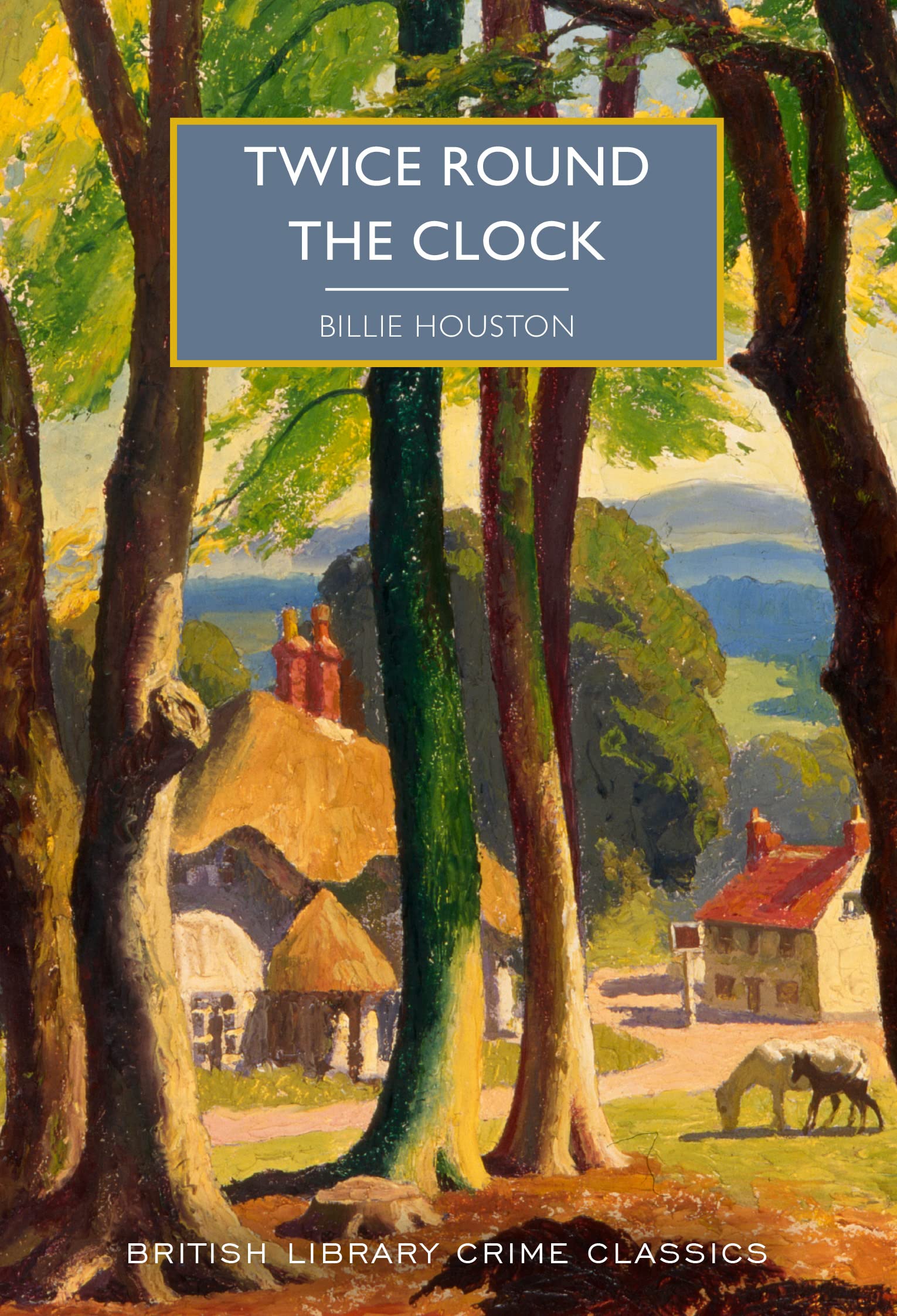


The core framing of Billie Houston’s sole crime novel Twice Round the Clock (1935) — a murdered man discovered in the opening scene, before we jump back in time twelve hours and see events that lead up to the murder, then the twelve hours that follow the discovery — is hardly new, but the book is written with a fresh eye, and such clear lines in its character and narrative that it’s difficult not to enjoy. Don’t come for the detection or clues, which are scanty, but those of you who enjoyed Death of Anton (1936) by Alan Melville, another British Library Crime Classic, will find this equally to your liking for its clear setting, distinct characters, and occasionally unusual ideas.
Seeking consent from world-renowned scientist Horace Manning to marry his daughter Helen, Anthony Fane is delighted when the old man agrees and invites the Fane ménage to his house for dinner that evening to celebrate. And yet all is not quite so simple as it seems, for Helen has lived in fear of her father her entire life, and Horace Manning has more than a few tricks up his sleeve when it comes to discomfiting those around him, including his personal staff:
[Mrs. Geraint] did not so much dislike Manning as hate him. Something about him made her very bones creep, and roused in her a hatred which was deep, instinctive, and almost violent.
And Manning is hardly unaware of this facet of his personality. Indeed, he might even be said to enjoy the effect he has on people, as evinced by the actions in chapter eight when, having invited his dinner guests up to his laboratory, he demonstrates his latest work by killing a kitten in front of them. Houston builds up to this well, with subtle hints that all has not been easy twixt Manning and Helen, and that he is viewed askance by most of those who know him even slightly well. And we know where this is going to head, since it is Manning who is found stabbed in the back in his study in the opening pages, and as the flashback progresses he gives everyone — to one degree or another — a reason for wishing him dead.
Easily one of the most successful elements of this book is the way Houston does not fall into a debut novelist’s trap of seeking to make mystery where none exists for the experienced reader. Time and again, some event will occur which a less confident hand would draw out to tedious effect, and yet Houston — perhaps informed by her reading in the genre — is often in quickly with the sinister (or obvious) interpretations: that everyone had a motive, that everyone had opportunity, that what might be seen as telling behaviour (the house is “crawling with confessions” at one stage) has a relatively simple explanation. In this regard, her narrative is very difficult to predict — at one point I became convinced that she was deploying a bit of canny misdirection (John Dickson Carr used it four years later…), and deploying it well…but then 20 pages later she tells you that the opportunity for misdirection existed and so…what to make of that? Especially when it’s done time after time with every character in turn.
Against Houston, however, is that it’s not until page 192 that it occurs to our ostensible sleuth Bill Brent, trapped in the house by a biblical downpour, to actually do some sleuthing…and even then he only uncovers one clue which means nothing until we’re told its significance in the denouement, and one that brings about another obviously false interpretation. This might be why the denouement is brought about by such odd means, since Houston has no clues to weave into a pattern, but I’d be lying if I said I didn’t enjoy the miniscule strangeness of events in the closing tranche of chapters — uncommon, and fraught with risk when it comes to upsetting the narrative, but it works even though it shouldn’t.
Throughout, the baker’s dozen of character remain easy to define even if they’re not all treated with the same care. Alongside young Anthony’s engagement there’s a love triangle which is decidedly complex and unmawkish and conducted on the sort of frustrating terms that you feel young, headstrong people would resort to…yet Helen gets one moment of character and then becomes a swooning non-presence for most of the rest of the book. Pick of the lot, though, is Anthony’s father, Sir Anthony Fane, who is the blustering baronet of yore writ large:
Having thus done his husbandly duty for some half-hour, he patted the prostrate lady firmly on her aching head, barked at her a gruff order to go to sleep immediately, and lighted a formidable cigar with which, the windows being shut on account of the storm, he proceeded to smoke her out.
It’s a bit of a shame that more isn’t done with Manning before his death, and that so much which makes the man interesting only comes out once our killer confesses. The scientist is a sort of dark twin to R. Austin Freeman’s Dr. John Thorndyke, and it feels that an opportunity to do more with his warped psychology has been passed up by making him little more than a figure of malice and cruelty. But, well, Golden Age victims are there to be despised and get knocked off, and he does both admirably. The final stages of the solution, though, and the reason for that four o’clock deadline, are quite wonderful, and were for this reader surprisingly affecting, making the impact of the preceding pages difficult to deny.
And so, Twice Round the Clock is another strong choice straight out of left-field for this series, and continues to diversify the imprint in a way that is immensely pleasing. My thanks to the British Library for the review copy, and I echo Martin Edwards’ sentiments in the introduction that it’s a shame Houston stopped her crime writing career after just this one book; ah, what might have been…
 The Invisible Event
I am very pleased to see that you got so much out of this as it is one of the titles I have been looking forward to most. I have yet to get around to cracking open my copy but I’m glad to read that it’s worth the time!
LikeLike
It’s definitely not a novel of detection, but as an interesting diversifying of this range — something the editors have always done well — it has a lot to recommend it. A very interesting find, kudos to whoever is responsible.
LikeLike