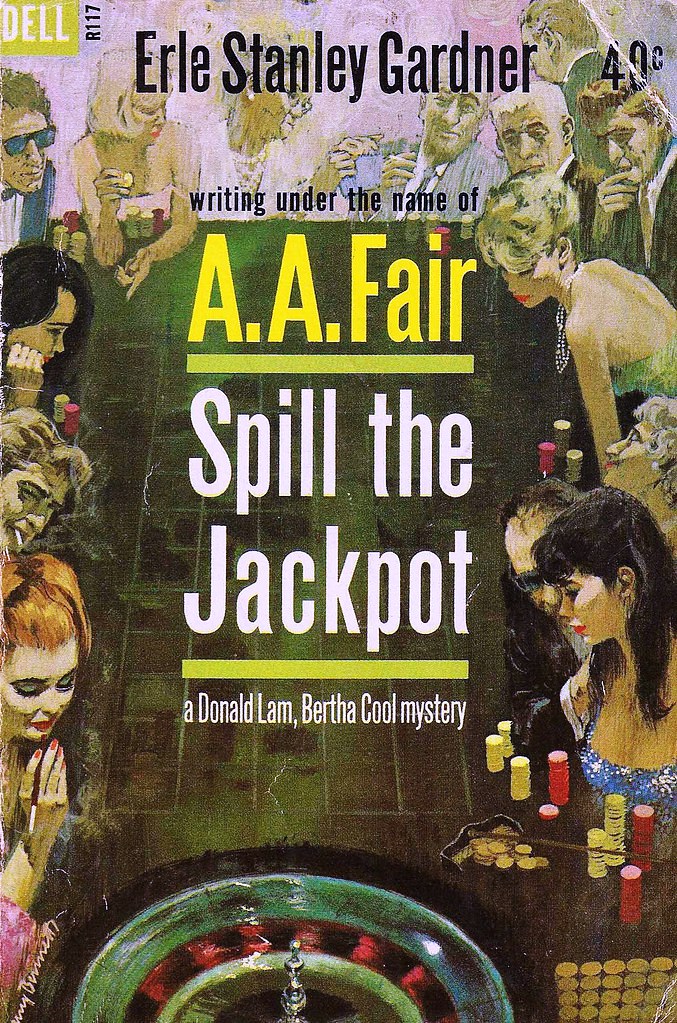


Two days before her wedding to Philip Whitewell, Corla Burke upped and disappeared from her place of work, leaving behind all her personal property: “she simply vanished into thin air, and hasn’t been heard from since”. Following a slender lead to Las Vegas, the groom-to-almost-was’s father Arthur hires the B. Cool Detective Agency to “find out what happened to Corla, why she disappeared, where she is now”…and so we’re off. And, of course, everything will go to plan for pint-sized investigator Donald Lam and he definitely won’t find himself pursued, beaten up, and accused of murder. No, wait — fry me for an oyster, that’s exactly what happens to him…good lord, however will he get out of this jam?
Spill the Jackpot (1941) is business as usual, then, for Cool and Lam, with Erle Stanley Gardner, under his A.A. Fair nom de plume, providing the expected combination of smart plotting, swift reversals, and canny acuity on the part of the insightful Donald. A few cosmetic changes aside — Bertha Cool, having recovered from a bout of pneumonia, is now 100lbs lighter and gets to experience life as something more than the bullish presence she’s been to date (“She was suddenly conscious of the fact that she was a woman. How that was going to affect her business judgment remained to be seen.”) — we’re in Gardner’s preferred, fast-moving territory, and everything progresses more or less as expected. And that’s no bad thing, when you can turn a plot in the space of a sentence as adroitly as Gardner can, or capture people and settings in startlingly few words in a manner that really deserves deeper examination:
[The chair] was comfortable. It was the only really comfortable chair in the room. The whole house was like that. Little economies paved the way for a splurge on one or two items that would count. The house didn’t have the stamp of poverty, but it bore unmistakable evidences of persons who wanted better things, and would make every sacrifice to possess one or two objects that would be symbols of what they wanted.
…say, or…
I looked forward along the train. There was a wind blowing. Smoke and steam from the locomotive were whipped back, and tossed about to dissolve into fragments. … Out beyond the station, I looked up at the sky. The stars were staring steadily down, close to me, unwinking and brilliant. It seemed there wasn’t an inch of the heavens that wasn’t blazing with pin points of light.
Early on, an explanation of the ways slot machines can be hijacked shows the man’s limitations as an author of purely technical prose, but this is more than made up for with lovely character beats, like the psychologist in Arthur Whitewell pandering to a hitherto unsuspected vain side of Bertha’s personality (“Donald, isn’t he the nicest man?”). You also get vignettes like casino boss Harvey Breckenridge giving “the impression of a man who didn’t smile often, and when he did, his thin, tight lips pressed secretively together as though willing to co-operate in the smile only on the condition the cause was kept a strict secret” and the delightful experience that is spending time with ex-prizefighter Louie Hazen, undoubtedly one of the great minor Gardner characters.
You also get to spend time with Helen Framley, latest in the long line of young women who fall for Donald’s charms, who comes across as decidedly more rounded than the role has any right being, with her heartbreaking admission of love for Donald (“If that’s the play, let’s just call this little party off now…”) among the most tender scenes ever put down in so propulsive a novel of plot and incident. Indeed, the section in which Donald appears to give up the detective life and heads out with Helen and Louie to learn how to fight and enjoy being with the woman he loves is…well, it’s simply lovely, and all the more affecting for how genuinely Gardner commits to it.
There is, however, a plot in back of all this, and it’s interesting to reflect how far we’ve strayed from the solution to the murder when it finally rears its head again towards the close — almost as if Gardner is enjoying stretching his muscles a little and offering a soupcon more than we might have expected given the series to date. And the solution here is a very good one, not too tied up with the trademark reversals that can leave you shaking your head a little trying to make sense of things, and while the final reversal on top of the revelation of the killer might be a little convenient it also — for once — ties into the plot surprisingly neatly, giving the whole edifice a discernable shape and ending on a note of pleasing melancholy that you just know would be dropped by the time the next book came clattering out of Gardner’s secretaries’ typewriters.
Spill the Jackpot — and this is my first time reading this particular title — is, then, a good example of what makes the Cool and Lam books so enjoyable: fast, unpredictable, full of great lines (“I wouldn’t trust any one of them as far as I could throw a bull by the tail up a forty-five-degree slope.”), and with a surprising amount of both moral fibre and heart. I don’t know if the pattern of ‘Every Even-Numbered Cool and Lam Title is a Good One’ will continue, but it’s being borne out at present…let’s see if Double or Quits (1941) can break that cycle in a month or two.
~
The Cool & Lam series by Erle Stanley Gardner writing as A.A. Fair:
1. The Bigger They Come, a.k.a. Lam to the Slaughter (1939)
2. Turn on the Heat (1940)
3. Gold Comes in Bricks (1940)
4. Spill the Jackpot (1941)
5. Double or Quits (1941)
6. Owls Don’t Blink (1942)
7. Bats Fly at Dusk (1942)
8. Cats Prowl at Night (1943)
9. Give ‘Em the Ax, a.k.a. An Axe to Grind (1944)
10. Crows Can’t Count (1946)
11. Fools Die on Friday (1947)
12. Bedrooms Have Windows (1949)
13. Top of the Heap (1952)
14. Some Women Won’t Wait (1953)
15. Beware the Curves (1956)
16. You Can Die Laughing (1957)
17. Some Slips Don’t Show (1957)
18. The Count of Nine (1958)
19. Pass the Gravy (1959)
20. Kept Women Can’t Quit (1960)
21. Bachelors Get Lonely (1961)
22. Shills Can’t Cash Chips, a.k.a. Stop at the Red Light (1961)
23. Try Anything Once (1962)
24. Fish or Cut Bait (1963)
25. Up for Grabs (1964)
26. Cut Thin to Win (1965)
27. Widows Wear Weeds (1966)
28. Traps Need Fresh Bait (1967)
29. All Grass Isn’t Green (1970)
30. The Knife Slipped (2016)
 The Invisible Event
Just got to this in my Cool and Lam read through- absolutely loved it! Louie Hazen is indeed a spectacular side character, and that whole latter part of the book with them and Helen going on a desert road trip as a weird throuple was far more charming than expected, and as “charming” is never a word I think I’ll use to describe an ESG plot that doesn’t seem like it should be saying much but actually it was. I was smiling the whole way through this one, not to mention the mystery had just the right amount of twist while also being more pleasantly straightforward than ESG generally is.
Now I need to order myself some Doug Selby books- never read any and saw that you’ve rated them pretty high.
LikeLike
Great to think that someone else is out there working through Bertha and Donald’s cases, too. They run together a little in my mind, not exactly being composed of the most distinct ingredients, but this one stands out a little more for that final desert trip and some of its antics.
This strays into the top half of the twelve I’ve read, certainly, but that’s about as far as I can go. A ranking of all 30 once I’ve finished them would be, I’m going to anticipate, impossible.
As for Doug Selby — yay 🙂 I love those books. Best experienced in order, and the first is the weakest, but, wow, does that series do some great things.
LikeLike
Yeah, honestly what I think I may have liked most about this one is how different it is from standard ESG fare- but in a way I still find enjoyable. Also, my guess is that the Bertha subplot (where the client is able to flatter her into falling for him) is very hit or miss with people but I thought it was pretty fun.
And good to know that Doug Selby starts slow- I already have the first one requested from the library so will make sure to get the second too!
LikeLike