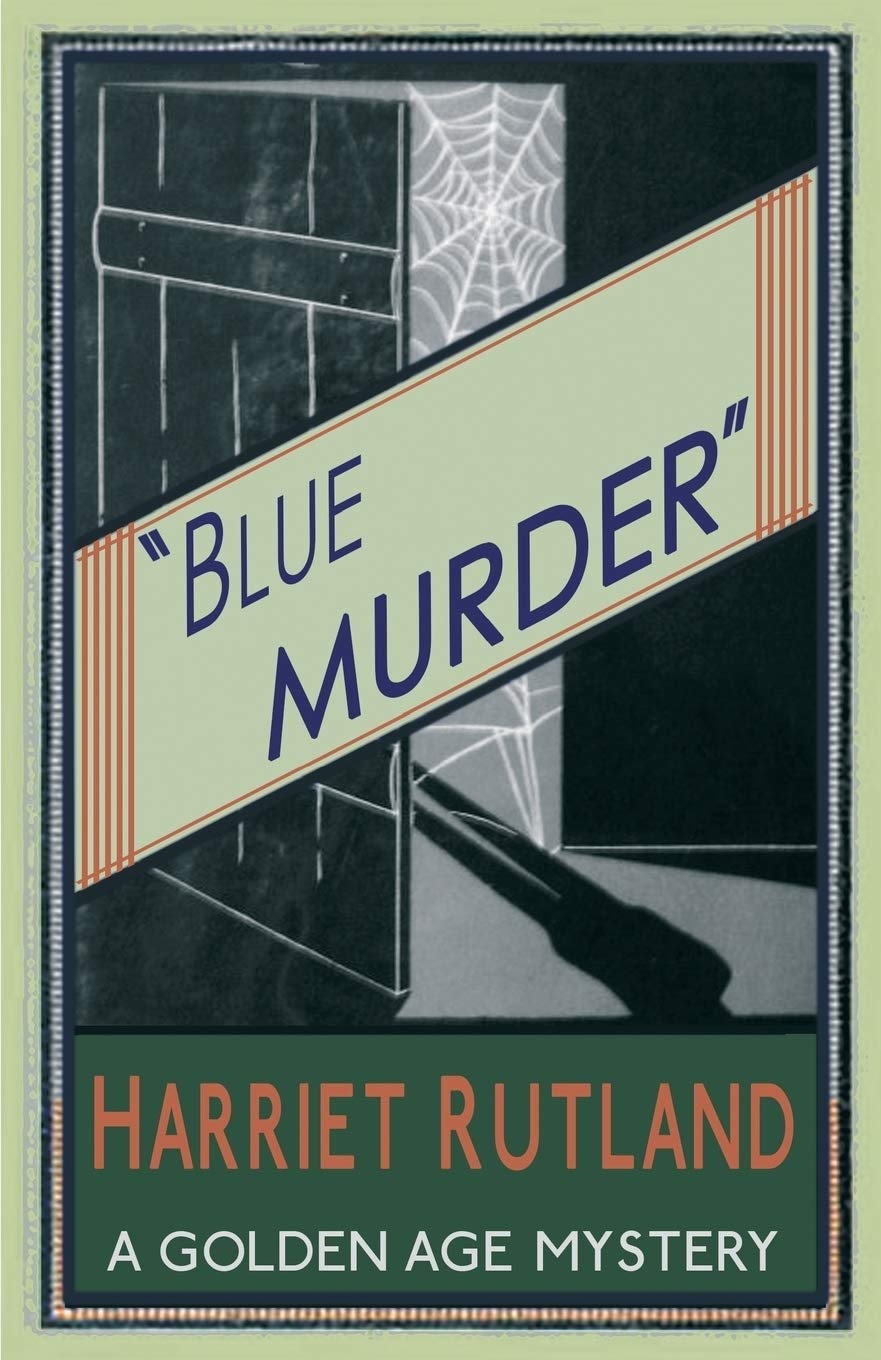


I read the first half of Blue Murder (1942), the third and final novel by Harriet Rutland, in a single gasp. It’s a fascinating opening, deliberately short on setting and description so as to emphasise the characters you’re going to be spending the book with, and it drew me like a moth to a flame, eager for the destruction to come. From the outset, when headteacher Mr. Hardstaffe learns that his affairs are being gossiped about by the village schoolchildren and calls them “little bastards!” for showing such disrespect, we’re clearly not in the genteel arm of GAD, and it’s only a matter of how savagely Rutland develops from here. And, as things progress, we seem to ring more than a few changes.
The Hardstaffes really are quite easy to dislike — whether we see them in action (hypochondriac Mrs. Hardstaffe’s insulation for the real world is gorgeously shown in her wittering about sugar rations early on), or learn about their less pleasant characteristics through others (Leda’s treatment of the housemaid Frieda, say). But, in fact, Rutland is also keen for everyone to have more than just one side to them: Superintendent Cheam is as charming at times as he is brusque at others (“It’s evidence I want, not a character study,” he snaps when told that while not actually seen committing an act, it would be “in character” for the person suspected) and the moral laxity of otherwise likeable characters on display would keep Mary Whitehouse busy for a month.
And so of course someone is going to get murdered, and of course we’re going to play around with the notion of detective fiction by having fading novelist Arthur Smith trying to cash in on the current popularity of murder mysteries by writing one and making the Hardstaffes characters in his book. In one amusing swipe at the peculiarities of amateur detectives we’re told that Arthur’s sleuth Noel Delare “made it a point of honour never to enter any room by means of the door”, and when the Oxford-educated Chief Inspector Driver from Scotland Yard appears on the scene we’re informed that he “had learned to curb the habit of flinging into the air a sudden quotation whose very aptness had only served to irritate his critics”. See? It’s that sort of GAD novel.
Rutland’s eye extends to the trenchant beyond merely the game-playing of GAD, however, to delightful effect:
This was war time, and you could not deal effectively with incendiary bombs, or stand by with a First Aid Party, in a gown which swirled around your ankles. There was, in fact little scope at all for femininity in Total War, which for the time being, and possibly for all time, had destroyed the slogan that Woman’s Place is in the Home.
See also Dr. Macalistair being next up to “face the bowling” in giving evidence at an inquest, or Superintendent Cheam trying to “frame his questions within the three-hundred-word vocabulary of a two-year-old child” when questioning Frieda whose first language is not English. And then, just as you expect you have a hold on things, Rutland darkens the palette subtly: Leda Hardstaffe’s refusal to allow German to be spoken in the house because it’s “unpatriotic”, Hardstaffe gazing at the youthful object of his affections “through the watering, bloodshot eyes of an old man”, or the melancholy reflections of the coroner at the inquest on the first victim. For all the wit on display (and, sure, not all of it lands — the dogs urinating on everything is…odd) there’s a fair amount of vinegar beneath the honey.
Naturally the Second World War looms both large and small throughout: Arnold Smith is fleeing the bombing of London, but Nether Naughton is so far removed from any action that the various drills everyone must attend take on a farcical aspect. Equally, the sheer exhaustion of living under restrictions is beginning to show — Hitler dismissed as a “little house-painter” in whom no-one has any real interest any more — and contrasts with Frieda’s experience of genuine horror and hardship as a German Jew, fleeing to a place of safety where she is belittled and abused by the people supposedly helping her. The casual anti-Semitism so jarringly on display in books of this era is something Rutland confronts quite fearlessly, from both sides, and while I’m not sure it’s entirely successful you have to acknowledge the attempt to genuinely raised some empathy for what should not be a sympathetic character.
But all this societal change on the page is also evident in the narrative developments that close out the book, and for me it falls frustratingly close to brilliant but for the fact that it sets up several question — they key, for one — that it never answers. The ending is possibly something quite new at the time, and the various pointers along the way towards that solution are undeniable…but then, equally, Rutland wishes that cake to also remain as evinced in a late chapter where a character’s name is withheld for the exact reason that it doesn’t matter who it is. However, as something that wishes to push detection more in the direction of crime fiction, this has much to recommend it to fans of both schools. It sprinkles delightful historical nuggets throughout — far from least of which is the generational war that sees younger people having options and exhibiting behaviour their elders find distasteful (a woman combing her hair in public? Egads!) as the expected roles and strata of society crumble even while the buildings remain standing — that shows very strongly the benefic results of that somewhat crabwise for of progress.
Sharp, unsparing, delightful, and clearly showing the genre’s ability to address real world issues while also managing its own subtle development. A shame my copy seems to be missing twenty chapters (immediately following Chapter XXXIX comes Chapter LX…) but, that aside, this was a delight. Shame Rutland didn’t write as many novels as Christopher Bush, eh?
~
See also
Kate @ CrossExaminingCrime: This may not be a novel filled with clues and is much more dependent on psychology and relationships, but I think this is Rutland’s strongest novel having a strong Frances Iles’ flavour. The writing style, the dialogue, the tone and dark sharp humour, along with the characters mesh together cohesively to provide an ending which cracks a punch.
Nick @ The Grandest Game in the World: Rutland focuses on the characters and on her blackly comic dissection of the class system and British insularity. Despite a couple of investigating policemen, there is very little clueing or deduction. The murderer will come as no surprise; but there’s an easy naturalness and inevitability to the revelation.
 The Invisible Event
Phew! And also kind of surprised. I was quite concerned you wouldn’t enjoy it. But I am glad you did. Just got to wait for Brad to catch up now. Think he has read the other two.
LikeLike
Same here. When I saw JJ was going to review this one, I expected another lukewarm, two or three star review, but maybe he’s finally coming around. Stranger things have happened this year.
DSP has revived many writers who should have been as prolific as Christopher Bush and Brian Flynn. Like Robin Forsythe, Ianthe Jerrold and Rutland. I would have welcomed more novels like the brilliant Bleeding Hooks and Blue Murder.
LikeLike
Like all the best Golden Age detective novels, even when you think you know exactly what’s coming I still have the potential to surprise 🙂
LikeLike
I read Bleeding Hooks pre-blog and don’t remember getting on with it as well as I did this – so there was always a risk this one might fall down for me, but with such a strong focus on the social milieu and ringing the changes in 1940s society, the pre- and post-war generations, and the changing face of the detective novel as a whole…well, how could I not thoroughly enjoy that?
LikeLike
You have to give Bleeding Hooks a second shot, because pre-blog Jim might have struggled as much with Blue Murder as with Bleeding Hooks. Even your taste must have somewhat matured and fine tuned over the years. ;D
It would be interesting to see what you make of Robin Forsythe. He can be a little verbose, like Punshon, but his intricate style of plotting is as distinctive as a fingerprint. You have to read more than one novel to catch the hook of his plotting technique, but what he did with it makes his novels standout and he still doesn’t get the appreciation he deserves. I recommend The Pleasure Cruise Mystery or The Spirit Murder Mystery. I also liked Murder on Paradise Island (Robinson Crusoe mixed with murder), but plot-wise, it’s a lightweight compared to his series novels. So there’s a remote chance you’ll love Forsythe.
LikeLike
There’s a moderate amount of truth in this, I cannot deny. Pre-blog Jim would not have enjoyed Freeman Wills Crofts, Anthony Rolls, Patricia McGerr, and, indeed, Blue Murder, so a re-examination of Bleeding Hooks may be on the cards…the question is when?
Forsythe I shall definitely check out, thanks for the nudge. I typically find that I get on better with verbose authors in print than ebook, so I’ll pick one of your suggestions carefully and run the terrifying risk of us agreeing for the third time in a calendar year. Maybe I better leave it until 2021, eh?
LikeLike
My main issue with Forsythe’s word is how verbose his sleuth is, who can just go on and on with his theorising. TSMM was the best though IMO and did not have this issue as strongly.
LikeLike
I thoroughly enjoyed Knock, Murderer, Knock and decided to parse out my Rutland. But Bleeding Hooks was harder to break into – I tried three times – so I put that aside and went straight to Blue Murder after Kate’s review. I agree with everything you say here. I think I liked the first one more, but this one is more important in terms of the transition of the genre at that all-important post-war time. I remember thinking the ending seemed . . . rushed? But it was an entertaining book and time well spent with a thoroughly unpleasant family.
TomCat, I promise you, I will get to Bleeding Hooks one of these days!!!
LikeLiked by 1 person
I read Bleeding Hooks pre-blog and didn’t love it — the setting is interesting, but the characters and plot are just sort of…there. And the expected things happen. And the reveal at the end is nowhere close to as daring as it thinks.
Not tried KMK yet, but now I’m torn — is it as accomplished as this, or is it the stumbling, voice-finding effort of BH? And, when that’s read…we’re done. No more Rutland. So I want to read it, because it could be another belter like this, but even if it is…then I have to go and find someone else to provide that sort of book.
Man, the trials of the GAD enthusiast, eh?
LikeLike
“TomCat, I promise you, I will get to Bleeding Hooks one of these days!!!”
You said the same about Nicholas Wilde’s Death Knell!!!
“I read Bleeding Hooks pre-blog and didn’t love it”
My disgust is immeasurable.
LikeLike
I’m confused — I did say the same about Death Knell and I reviewed it, like seven months ago. What have a missed?
LikeLike
Brad got himself a copy and promised to review it, but we’re still waiting for it.
LikeLike
Ah, yes, I forget that not all comments here are aimed at me; sorry, been a busy morning!
LikeLike
I felt KMK was the weakest of the 3. I managed to clock the killer quite early on – one of those annoying cases of just noticing one slight thing and everything falling into place.
LikeLike
So much to comment on here:
Regarding Blue Murder – I can’t compare it to Bleeding Hooks because I haven’t read the latter. All I can say is that it was easier for me to get into than the fishing book, and I enjoyed it thoroughly. However, if you’re looking for another game-changer, JJ, you probably won’t find it there. It’s just a good ol’ whodunnit set in a healing waters sort of hotel with some great characters. I did NOT pick up on the solution like Kate, but then she’s way more clever than me, having raised many goats and chickens, not to mention learning to read 1,000,000,000,000,000,000,000,000,000,000,000,003 words per minute.
Regarding TomCat: I don’t know whether to feel peeved that Mother told me to clean up my room or flattered that you even remembered my broken promise. I completely forgot about Death Knell, but I’ve taken it off the shelf and put it on the stack, whatever that means. Meanwhile, didn’t I RUSH to cover Jack Vance after you wrote about him?? Haven’t I done my duty with Harriette Ashbrook? You can’t believe what a massive TBR resides on my shelves today! Ands I’m not even going to mention how many books have remained unopened on my Kindle since 2016, including three Punshons, two by Annie Haynes, and evidently the wrong Robin Forsythe. (Evidently, JJ is correct about e-books, but maybe Who Killed Charmian Karslake? did a number on my head!)
This is the lot of the GAD fan: we go into a flurry over the latest releases and pick up a dozen titles for 99 cents each on Kindle or fight over the one overpriced copy available on eBay of something John Norris mentioned or stumble greedily out of the used bookstore with three Quentins, two McCloys, and a Gribble hidden behind a wrapping of plain brown paper, or joyfully unwrap the goods from our Secret Santa (sorry about that Derek Smith theatrical mystery from three years ago, JJ, I WILL get to it soon) . . . and then they all sit on a stack for years. And then, to add insult to injury, we moan about the house, complaining that we don’t have anything to read!!
I need a spanking, TomCat, there’s no denying it.
LikeLike
“You can’t believe what a massive TBR resides on my shelves today!”
That’s your excuse? Full shelves? My TBR pile has gained sentience and an attitude. Last week it asked me if I liked detective stories (sure) and threw Ellery Queen’s 101 Years’ Entertainment in my face. It then chuckled as it shoveled away.
LikeLiked by 1 person
I’ve been meaning to try Rutland for a while, given TomCat’s enthusiasm for her.
LikeLike
Pingback: Blue Murder by Harriet Rutland – Mysteries Ahoy!
I just read this and one really interesting thing was the sort of metatextual element of the main character being told he had to write a GAD novel because that’s what sells, only for him to end up in the kind of nearly clue-free (well, there are general clues, but they don’t narrow things down to the murderer particularly), more psychologically based book that the genre would more totally morph into post-war.
And while I agree that I’m not sure it was totally successful (whatever “success” in this case might be), this is probably the only GAD book I’ve read written during WWII that talks about what was going on with the Jews in Germany etc outside of vague platitudes, and it was really interesting. As far as the “less successful” elements, one wonders whether some of those were expected tropes from the publisher- I don’t know if you’ve read Victims or Villains by Malcolm Turnbull about the Jews of GAD fiction, but he makes the case that many writers with relatively neutral opinions about Jews used antisemitic tropes because they were expected of the genre, in the way that one might also write about Italian mafiosi or Russian mobsters, for example. But she was very clearly on the ball.
LikeLike
I’ve not read the Turnbull, but it sounds fascinating. I’d also suggest that the Jewish tropery wasn’t exclusive to this genre, however, and was more of a wider societal impression of the Jews that was perpetrated for reasons that I’m still sort of fascinated to read more about. Maybe the Turnbull is a good place to start.
The only other WW2-era GAD novel I can think of at present which makes any mention of the treatment of the Jews in Germany is Not to be Taken by Anthony Berkeley, in which the German cook proudly explains how she’s a Nazi and so doesn’t like “Chews”…but that’s small beer compared to what Rutland wrote about here.
LikeLike
I mean, obviously antisemitic sentiment existed in various forms for a long time, including in England in ways that tie into tropes, class, the role of the church, etc. The question is why it existed in the specific forms it did in UK GAD detective fiction, which I don’t think are necessarily OBVIOUSLY the same as those IRL. In inheritance plots, it’s natural you’ll end up with a moneylender, and if you had a moneylender he had to be Jewish because that was the trope. It built on itself, as tropes so often do. I wrote more about my historical understanding of some of this based on Turnbull (and my frustrations with some of the book’s limitations) here.
I was going to say that Jewish tropes are not used in the same way at all in American mystery fiction of that era, but actually, and I’m much less well read in it than I am in UK GAD fiction oddly enough so I can’t really say for sure, my perception is that there just aren’t as many Jews at ALL in US mystery fiction, but for sure when they are there they are not assigned at all the same tropes as they are in UK books. It probably does mean that I need to expand my reading, but despite Jews being 20-25% of the population of NYC at the time that GAD fiction was being written I’d be surprised if Jews got even a cursory side mention in 25% of books/stories set in NYC, let alone elsewhere. And that’s despite the fact that two of the biggest figures in US GAD fiction in the era were born Jewish (Ellery Queen). Jews are more likely to be in hardboiled books as gangsters, but it’s not quite the same as the UK moneylender trope because Jewish gangsters were part of a larger phenomenon of, for lack of a better term, “white ethnic” recentish immigrant tenement gangsters in the time period, so it was more “gangster of assorted ethnic name” than specifically Jewish. An American Jewish gangster is incidentally Jewish, but a British Jewish moneylender is very, very inherently Jewish with all the antisemitic tropes you can put in. It’s just a completely different way of doing things.
LikeLike
I don’t mean to butt into this conversation, but I am fascinated by it! It is interesting that there is relatively little anti-semitic feeling found in American crime fiction because in British c.f., it smacks you in the face. The American bugaboo seems to be more with race and queerness (which, to be fair, U.K. c.f. also has a taste for.) I think the simple answer to this is that American anti-semitism – which certainly has existed since the country began – had less of an influence on the arts and sciences because so many Jewish people ended up holding positions of power in them. There are certainly Jewish stereotypes in American films, but they’re mildly comic and usually benign because Jews ran the studios!! Stereotypical vulgar, money-grasping Jews could be found in higher literature from the likes of F.S. Fitzgerald, Ernest Hemingway, and Edith Wharton.
I did quite a bit of research on this when I was writing an article about the decision to reprint Christie and other authors without the offensive stereotypes and language. (Today, I come down against that – it’s better to know and remember.) I didn’t know until then that When Shakespeare wrote The Merchant of Venice, he had never met or seen a Jew – they simply weren’t allowed in the country. I didn’t know that the reason Charles Dickens softened Fagin in later reprints of Oliver Twist and created the sympathetic character of Riah in Our Mutual Friend was that he was seriously affected by the letters of a wealthy Jewish woman who had, with her husband, bought his London home. I learned about Agatha Christie coming across such virulent anti-Semitism in her travels to Europe that it softened her stance, just as her Middle Eastern trips gave her food for thought on people of color. (She never got perfect, but she got a bit better.)
I am struck anew by all this in your conversation because tomorrow I’m posting my review of the first Mary Westmacott novel (and the first I’ve ever read), where Christie makes Judaism a much more central issue – and the results are fascinating!
LikeLike
I didn’t know that about any of the Mary Westmacott novels, that’s fascinating! I’ve always meant to read some but never have.
I actually will differ with you on the reason for the gap between the UK and US on antisemitism in fiction. In the movies, I think it’s fair to say that depictions of Jews were more or less positive/neutral when they existed- but much fewer of them existed than people think, as the mere fact of Jews controlling many (not all) of the studios didn’t equate to acceptance. It was often specifically the Jewish studio heads, bowing to societal influence, who wanted as minimal representation of Jews as possible- to the point that, for example, The Life of Emile Zola, which won the Best Picture Oscar and was made by a very Jewish-owned studio starring a Jewish actor, was silent on the fact that Dreyfus was Jewish or that the Affair was prompted by antisemitism! It’s not that there were NO Jews depicted in the movies, but the fact that it happened to be The Jazz Singer that became famous as the first sound movie (a questionable claim but that’s a separate issue) might make it seem like US cinema itself (as opposed to those making it) was more Jewish than it was.
And that’s before you get into publishing which, as you note, was not very Jewish at all. It would become more so after WWII but it certainly wasn’t before- again, even as many writers, like Dannay and Lee (Nathan and Lepovsky), were Jewish.
It’s not that I think you’re wrong that antisemitism expressed itself differently/less in US popular culture, but besides for the obvious factor that there I think it comes down to factors that are more basic than power per se. First of all, there were four to six TIMES as many Jews in the US as there were in the UK and Ireland in the early 20th century! Setting aside what they would therefore mean as a market share (and especially in a big reading market like NYC, where, again, they were 20-25% of the population), they were also much more normalized. Not to mention the melting pot aspect of the US, the (ahem) competing priorities of other kinds of bigotries, all that stuff. Jews also were a very very highly organized minority adept at self-advocacy in the face of bigotry and stigma, which made a big difference.
But fundamentally I think it comes down to something more than this, which is that the UK was, at that point, still more or less a monoculture and Britishness meant something very specific and Christian. The US is a young country and Jews have been here at least as long as any other Europeans, and longer than most. While there are ways in which the US has been a Christian country from the outset realistically (especially on a state by state level- the last state to permit Jews to hold public office was New Hampshire in the 1870s), in theory at least it was a national/federal priority to equally treat those of every faith. In contrast, the oldest GAD fiction readers would have remembered the bill (previously defeated multiple times over almost thirty years) first allowing Jews to sit in Parliament in 1858, as previously they’d have had to swear their oath on a Christian bible in Jesus’s name. Jews had been back in England (after their 1290 expulsion) since the 17th century, but they were never quite respectable and always somewhat alien. The Christianity of England could be tied in with its class system, social services, etc in ways that were much less true in the US. Blue Murder itself has a character who is sympathetic to Frieda the Jewish refugee say “I never did hold with Jews, me being a good Church of England Christian, but I don’t hold with torturing an animal, let alone a decent-living human-being…” There were in this time period racist and eugenicist Americans who might link their Americanness to their antisemitism, but it would have been much more controversial.
All this to say- there was absolutely social antisemitism against Jews in the US, but it was more fragmented and in some senses ephemeral. Jews faced discrimination from various quarters but they were largely not unified ones. The UK at this time had a much more overarching culture with a longstanding history of religious, social, and cultural antisemitism- and specific antisemitic tropes to match- leading to a very different kind of atmosphere and perception.
While I’m rambling on the topic, fun fact- Dorothy L Sayers, whose books I love but who was unfortunately an actual antisemite, in her embargoed essay on The Future of the Jews (rejected quite rightly by the Jewish editors of the volume) had the very innovative theory that English antisemitism, which she certainly saw as a matter of course and baked into Englishness, arose because the Old Testament is so horrifying and scary that young children, exposed to it in church, were terrified and so naturally associated these fears with the real life Old Testament people, the Jews! (I’ve read the essay and hooo boy, it is way way crazier than any biographer of hers I’ve read has ever described, and I include James Brabazon, who as far as I can tell agreed with her lol)
LikeLiked by 1 person
I remember learning in an early film class that Jewish studio heads restricted Jewish stories out of a sense of privacy and of not wanting to provide “bait” for gentile audiences. It was Jewish studio heads who ordered the changing of names like Issur Danielovitch to Kirk Douglas, Marion Levy to Paulette Goddard and Betty Joan Perske to Lauren Bacall.
In the fabulous Hollywood podcast You Must Remember This, host Karina Longworth did a great season about the Hollywood blacklist, which numbered many Jews among its victims. The Jewish film heads were no friends to these people. And when the Nazi party took over Germany and pressure was put on the studios to stop showing American films over there, the studios sided with the Nazi people. Hey, it sold tickets!
LikeLike