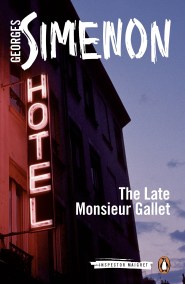


It’s been a number of years since I last read any Georges Simenon — the stark nihilism of The Stain on the Snow (1953) and the diaphanous erotic tragedy of The Blue Room (1964) left an impression if not exactly a desire to read further. Simenon is hard to ignore, however, partly because he wrote so many damn books and partly because Penguin have done such a fine job of reissuing them lately that they take up about 40% of the shelf space in most bookshops. I’ve always been of the impression that he is far more about people than plot…which is probably just as well, since on the evidence of this early effort he can’t plot for toffee.
It’s not a long book, The Late Monsieur Gallet (1931), but it is a very long short story. The discovery of commercial traveller Émile Gallet both shot in the face and stabbed in the heart while staying in a hotel in the provincial town of Sancerre while his wife was receiving postcards from him postmarked Rouen doesn’t really get going until probably chapter 6, with a lot of what comes before being one or two tiny details buried in lots of Maigret walking around in the heat, being a bit downcast, disliking the uptight airs put on by the victim’s widow, and wondering why the case feels odd. It is, to say the least, hardly a kinetic narrative, and written — or certainly translated — in so deliberately low-key a voice that no interesting turns of phrase are even given the chance to assert themselves. It’s not a slog, per se, but neither does it compel.
Once you settle to Maigret’s insanely haphazard way of conducting his investigation — he’s in Sancerre, like, three times before he even looks at the scene of the crime, and will go out of his way to ask three questions of someone and then leave immediately — there’s a certain charm to the fact that Simenon doesn’t really seem to know what he’s doing. He wants, you sense, to examine the palimpsest of the human soul, with its great many wrongs graven and then scored out, only to be written over again and again, but all that quietness eludes him at this stage since he should really provide a murder investigation like wot Gaston Leroux did…not yet comfortable in his own writer’s skin, Simenon shifts awkwardly from foot to foot whenever any direct speech is necessary, and hates interrupting Maigret’s thoughts with, y’know, actions.
It’s not a total failure, but struggles when we’re told things like, at 45 years old, Maigret…
…had spent half his life in various branches of the police force: Vice Squad, Traffic, Drug Squad, Railway Police, Gambling Squad. It was quite enough to dispel any vaguely mystical ideas and kill faith in intuition stone dead.
…only for him to then go an intuit all over the place at the descending of a kepi. Thinks he saw a woman looking at him while he investigates a crime scene? He’s “suddenly as good as certain” that she must be the mistress of the son of the victim. Tracks down a newspaper seller whose name was put on letters sent to the deceased? Intuits on the spot in a moment of inspiration that he’s a go-between for various parties. And the solution, and semi-false solution he presents to the owner of the villa situated next door to the hotel where the crime took place, struggles for any actual…man, what’s the word? Evidence. That’s it: evidence. Yeah, virtually none of that, more just a vague reaching in the dark to some actions that explain aspects of what he thinks might have happened because of…this weirdly mystical intuition he seems to have about everything.
The section of the book that actually deals in meaningful events and the investigation of those events — chapters 6 to 9, I’d argue — are more focused, but inconsequential. When the solution came, I didn’t really care; it seemed we went a very long way around. It’s clearly not Simenon’s idiom and, while I’m not sure how developed this type of investigative narrative was in mainland Europe at the time, it has to be said that others made far more comfortable starts in the same genre. It’s amusing to see some principles played here that would later become fodder for the more criminous-minded, like the notion that four people sat playing bridge is sufficient for them all to alibi each other when Agatha Christie would overturn that quite comprehensively five years later. You get the impression that Simenon viewed this book with horror in his later career, ashamed at the genre boilerplate this crams in when his real interest was in the quiet despair of human existence:
The only one absent was Émile Gallet. He was firmly in a coffin, half his face torn away by the bullet, maltreated by the forensic surgeon who had seven guests coming to dinner, a stab wound through his heart, and his grey eyes were open because no-one had thought of closing their lids.
 The Invisible Event
3 out 5 seems pretty generous for a writer who can’t ‘plot for toffee’ (great phrase), but maybe you were able to appreciate more what Simenon was trying to do.
LikeLike
Well, and here’s a sign of how much I’ve grown, there’s more to books than plot, after all.
I shall now go and lie down in a darkened room.
LikeLiked by 1 person
Yes, Simenon’s detection novels/novelettes are about people rather than plot, and Maigret isn’t Inspector French. But you knew that already, didn’t you, JJ? It’s therefore indeed very grown-up of you to give Maigret a try. I hope the dark room therapy will prove effective!
LikeLike
Have you read any Maigret books that fall more into Simenon’s comfort zone? I know that Jose Ignacio has put up this list of his favourites, but any recommendations that show the two of them in a better light will be appreciated…
LikeLike
The Hatter’s Phantoms is a fascinating simenon crime novel. Not detection, however, and no Maigret in sight. But it’s my absolute favorite of all the Simenon crime novels I’ve read.
Curt has said that Maigret in Holland is the closest to a traditional detective novel he wrote. This is how he characterized it: “…the novel [has a] resemblance to a classical British mystery, which is much more pronounced than what one usually encounters in the Maigret series.” However, I disliked the opening chapters and never finished it. I also never finished a book about a gigolo dancer in Paris. So many of his Maigret “detective” novels didn’t do it for me either. But I did enjoy Rowan Atkinson in all the recent Maigret movies. I think he captured the spirit of the character rather well. I watched them one after the other in a binge “film festival” of sorts in my home over a period of two nights.
The Yellow Dog seems to be very popular. It was reviewed to death back in the early days of the vintage crime blogs when everyone was doing author memes nearly every week or so. When Simenon came up it was the most read and reviewed of his books.
LikeLike
I’m less concerned with detection where Simenon is concerned, because I don’t think it will be where his strengths lie. The little moments of human frustration in this, and the sadness creeping around the edges of the situation, are where he feels most comfortable — and, indeed, that’s what I remember from those first two titles I read — so that’s where he seems to want to go.
Thanks for the steer to The Hatter’s Phantoms, it’s not a title I’d even heard before.
LikeLike
haha. Well you know me, characterisation is important to me, but I feel like Simenon can’t engage me with his.
LikeLike
I read some Maigret books from time to time as they are quick but I never feel the urge to overindulge. They aren’t really about tight plotting, which I can accept fine, but about characters in certain environments, Maigret included. Again, this is fine, but I do find many of the books tilt towards the grim and dour to such an extent and with such regularity that I have to approach them in small doses.
I recently finished Maigret Goes to School, which I think was a bit more balanced.
LikeLiked by 1 person
Have you seen any of the TVisations? I have staggeringly vague memories of the Michael Gambon version from my youth, but didn’t catch any of the recent Rowan Atkinson version. No idea how they stack up against the books.
LikeLike
I don’t recall much of the Gambon series myself. I did catch some of Night at the Crossroads and that seemed to follow the book reasonably well as far as I could tell.
LikeLiked by 1 person
My favorite Simenon is “The Man Who Watched The Trains Go By.” It seems that it is generally considered one of his very best “romans durs.” But it is not a tale of detection, so it probably is not be what you’re looking for.
As to Maigret, I defer to Jose Ignacio who has read many more of those tales than I have. I did like “Maigret se defend” (Maigret defends himself; I presume) quite a bit, and still do, even though I now believe that one link in the chain of events suffers from unexplained looseness (the weakness is not in Maigret’s thought process, but in why a particular event takes place). Assuming Jose Ignacio gave it an A or A+ rating, which I believe he did, I would suggest that particular title.
LikeLike
Thanks for the recommendations — I’m actually not that concerned about detection, I’m more curious to see Simenon on more comfortable ground with Maigret. If I decide to check out this series again, it’d be nice to see them getting along better…!
LikeLike
Simenon’s writing is low key – deliberately. “Adjectives, adverbs, and every word which is there just to make an effect. Every sentence which is there just for the sentence. You know, you have a beautiful sentence—cut it. Every time I find such a thing in one of my novels it is to be cut.”
I’d suggest Maigret a peur [Maigret afraid] (family strife and anonymous letters in a small town ).
LikeLike
Fabulous, thanks Nick — I shall head to that novel next when Jules and I deem each other good company again.
LikeLike
If you ever do decide to dip back into Maigret (which I hope you do as something of a superfan), there’s a few things that’s good to know. The series is divided into three quite distinct periods, separated by different publishers and even decades. The first is the initial Fayard period (1931-34). I always recommend that prospective readers do NOT start with these books. There are some real gems in there, but as a whole, this period is rather uneven in quality. Simenon wrote 19 novels in under four years and it really shows. Again, some are amazing, but (to me) they often read like pulp novels with Simenon throwing everything he could think of at the wall with little regard for structure and plotting. Even the best ones tend to go a bit off the rails in a way I’m sure you wouldn’t appreciate.The second period is the Gallimard period (1942-44), a brief run of six novels written during the war. I’m not a huge fan of these books, but they sort of fall somewhere in the middle. They’re far better than the worst of the first period, but nowhere near as good as the best. To be fair, these are probably the closest Simenon has ever gotten to GAD, but (to me) they often read like he wrote them somewhat unwillingly and without much of his style in them.
The really great Maigret novels were published during the Presses de la Cite period (1947-72). This is the mature Simenon masterfully blending all of the many genres he’s tried out over the years into novels featuring his most popular character. The confidence, the effortlessness, the stylishness, and the ability to evoke atmosphere and characters with incredible minimalism are (in my opinion) unmatched by any crime writer who’s ever lived. I mean, the guy had written like a hundred novels before 1947. It makes sense he’d be good at it.
That said, there isn’t really such a thing as genre consistency with Simenon. One Maigret novel could be a mystery, another could be a spy thriller, another could be a procedural, and some don’t even feature any serious criminal activity. It’s very hard to pick them out at blind, without doing some really spoilery research, and following the public consensus WILL often lead you astray. So, knowing at least a bit of what you tend to enjoy, here are some of my recommendations:
Maigret’s Holiday – my absolute favourite bar none. Immaculate atmosphere, incredibly haunting, the saddest mystery I’ve ever read in my life. Pretty much an inverted mystery, though, with the killer taunting Maigret from the very beginning. Kind of like a Columbo story written by a depressed Belgian. Might give you nightmares.
Maigret Is Afraid – kind of like Holiday-lite. Again, brilliant atmosphere of a rain-soaked French village haunted by a serial killer. Not that difficult to figure out the killer, but thoroughly compelling throughout. I wonder if it influenced some of Paul Halter’s more atmospheric works. Often feels borderline supernatural even though it’s never even suggested.
Maigret Sets a Trap – the finest serial killer police procedural ever written. Brilliant final twist. The scenes in which Maigret outfoxes the press are hilarious. The middle-portion does bother me a bit because it can seem like Maigret is doing absolutely nothing to stop the murders, but it all makes sense in the end.
Maigret Hesitates – the closest Simenon has ever come to writing a GAD novel. Again, the atmosphere and the characters dominate the proceedings, but there is a very intriguing mystery at the heart of it.
Maigret’s Failure – another excellent GAD Simenon-style. Maigret wishes his old bully dead and then the guy actually does get murdered. Very similar to Maigret Heistates in that it’s all about unpicking a profoundly unhappy household.
Maigret’s Little Joke – delightfully clever premise. Maigret solves a murder while pretending to be on holiday. Very funny, light, and features one of Simenon’s better mysteries.
Maigret Has Scruples – not a mystery at all really, but I include it because it’s my second favourite. Funnily enough, it’s probably the novel which I think of the most often. I know, I know, some people think of Dostoyevsky, others of Shakespeare. Me? I’m haunted by this little French comedy of manners. Very clever, very funny, and very, very French.
These are all Presses de la Cite books, if you insist on venturing back into the previous two periods then the best Fayard books are “The Saint-Fiacre Affair” (very Agatha Christie) and “A Man’s Head” (the prototype for the later serial killer novels). The best Gallimard book is “Cecile is Dead”. My least favourites, and the ones I never recommend, are “The Yellow Dog” and “The Madman of Bergerac” (never go full Bergerac!).
LikeLike
This is a superbly generous comment and I’m really grateful for it. I will definitely refer to this in the coming months, and will make is a priority to check out more Simenon before the halfway point of the year.
Thank-you again, and expect developments!
LikeLike
No problem! Happy to be of help.
No idea how I became “steadysuit9001e0b348”, by the way. This website refuses to remember me 😀
Mateja
LikeLike
It seemed like a bot-created sobriquet, but the comment was far too thoughtful to have been machine created, so I knew I was safe 🙂
LikeLike