
Given that an overwhelming majority of modern crime writing really isn’t my thing, it’s always lovely to see Ellery Queen’s Mystery Magazine publish some short fiction for me to get excited about, like a new Paul Halter story or, as in the current November/December 2017 issue, something from Japanese master Soji Shimada (I’ll Westernise his name herein, since that’s what I’ve done previously).
‘The Running Dead’ originally appeared in the May 1985 Japanese edition of EQMM under the title ‘The Running Corpse’, and features the brilliant astrologer Kiyoshi Mitarai who first appeared in The Tokyo Zodiac Murders (1981). There’s much to enjoy in seeing how the plot unfolds, but the essentials are that Mitarai is present at a private gathering of jazz musicians and fans when one of the guests steals a valuable necklace, runs out the door of the twelfth-floor apartment…and miraculously vanishes. There’s a lot more setup around this, including a demonstration of psychic abilities, but I’d advise going in knowing no more. So, well, having said that, what am I going to write about now?
This stands out so much from everything else in this issue of EQMM because of how finely it plays the classic strings: a closed circle, a baffling occurrence, and — once that aspect is resolved — even more bafflement to come, including a dead body turning up where is cannot possibly be and then the additional confusion of what’s found in the corpse’s pockets. Shimada layers puzzle upon puzzle in a calm and effortless way that bespeaks of the illustrious career he has enjoyed and that remains frustratingly out of reach to those of us unable to read Japanese. As with later story ‘The Locked House of Pythagoras’ (2013), there’s a clear sense of physical space necessary to get the full picture of what happened, and no fewer than three diagrams are included to help achieve this (I exclude the third one as it shows a key aspect of how something was worked, so ‘ware skipping ahead when you’re reading this story):

Running Dead Scene 1

Running Dead Scene 2
What’s also interesting about this is how little clewing there is, with virtually nothing to act as a harbinger of the revelations to come, and yet how it still manages to delight with the solution to the various problems. It’s not fair play in the strictest sense, but what it holds back is sort of obvious by implication of the events the unfold…and as someone who feels especially poorly treated by unfairness in declaration of clues when I see it I have to say this didn’t bother me at all here.
There’s also some legitimate humour, which is not something I’ve seen in the small amount of Shimada’s writing that has been translated thus far: one character described as not doing anything in a given situation, “like a politician visiting a disaster area” and an altercation between two people being “even more violent than a Parent-Teacher Association meeting”. Given the slightly sombre tone and the explanation-heavy denouement these unexpected moments of levity jumped out a little as non-sequitirs, but it made me realise that none of the (undeniably very limited amount of) shin honkaku I’ve read actually jumps at humour in quite this way. It’s true that being surrounded by death and confusion is hardly the moment to start cracking wise, but I enjoyed these moments of a slight easing of the tension even if they don’t quite fit tonally.
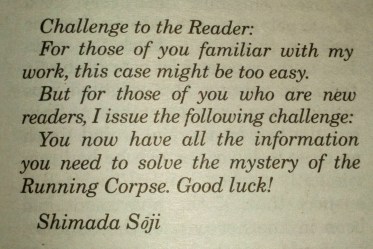
And then, if further delight were needed, there’s the following:
 The Invisible Event
OK, I have obtained the issue of EQMM and will soon be reading it !
LikeLike
Hallelujah for this! Ordering today. Are you subscribed to EQMM or just get the odd one when you see treasure like this?
LikeLike
I currently have a subscription, I may drop down to occasional issues.
LikeLike
I have finished reading the story by Shimada and found it very good.
I think one will enjoy it more if one knows the Japanese word for “seven” !
LikeLike
I happened to be in the library YESTERDAY and picked this up! I saw the story, marveled at the teeny, tiny floor plans . . . and then had to leave. So I will return another day to read this.
I used to subscribe for many years to EQMM. Most of the content was exactly like this. Alas, the magazine has “evolved” with the times. I subscribed last year, but little caught my eye. So I guess I’ll scour copies in the library for the rare treasure in the classic style.
LikeLike
I’d love to be able to access this through the library or some similar forum — it’s less and less my kind of thing, but I do hold out for these occasional treasures (even if they are a let down, like that new Brand story in the previous issue…).
If they committed to at least one or two classic reprints of excellent detective stories from their vailts in every issue I’d sign up for that in a heartbeat, but the increasing suspense-and-unimaginative-crime focus of the newer stories (like the Pronzini one herein, which at least had the decency to be short) just doesn’t quite do it for me.
LikeLiked by 1 person
I have a pipe dream of setting up my own mystery magazine committed to GAD.
LikeLike
I agree with all you say . . . EXCEPT I didn’t think the Brand story was terrible.
LikeLike
Did I say it was terrible? I didn’t mean to say terrible. It was…fine. But merely “fine” from Brand is still something of a let down. The other new story that made it into The Realm of the Impossible — ‘Cyanide in the Sun’ — is definitely the better of the two.
LikeLiked by 1 person
Sounds splendid. I really must read more Japanese crime fiction, because I usually enjoy it when I do (despite a certain recent 600-page experience of astonishing turgidity . . ..
LikeLike
Hm. I wonder where that close-bracket went. This keyboard’s getting a bit tottery.
LikeLike
You sure it’s the keyboard…? 😉
LikeLike
Yes.
LikeLike
I’d love to know what this 600 pager was?
LikeLike
It was Six Four by Hideo Yokoyama. Here are my Goodreads notes.
LikeLike
Oh yes I have seen this around a few places.
LikeLike
Can’t wait to read it . . . and the Szu-Yen Lin story.
LikeLike
Sounds interesting! Sadly I don’t know any place that carries it and I’m not in the mood to subscribe for something where I’ll only enjoy one story every nine issues or so.
LikeLike
Pingback: “The Running Dead”, 1985 by Sōji Shimada, translated by Ho-Ling Wong – A Crime is Afoot