- Comment
-
Subscribe
Subscribed
Have a WordPress.com account? Log in now.

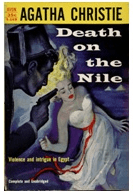 Both books handle reversals of expectation, the hallmark of a good mystery, with panache. The reversal is singular in Nile: Jackie does not have a bone to pick with Simon; rather, they remain lovers out to get Linnet’s money. Having that first chapter (that JJ dislikes) allows Christie to create the illusion of Jackie as woman scorned right away. Christie builds on the obfuscation by placing this love triangle in an exotic setting and surrounding them with fake suspects. True, there are far too many of these — the red herrings are jumping out of the Nile waters!
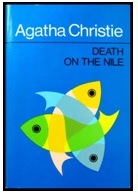 This is illustrated perfectly by the case Poirot outlines against Tim Allerton towards the end, following the killing of Mrs. Otterbourne (which is never really explored or convincingly dismissed despite, I can’t help but feel, being very valid — the clue of the gloves is astonishingly subtle, and Christie through and through) only for Poirot to go “Well, but you’re the thief, so therefore you’re not the killer”. What we have is three people involved in the killing, and everyone else is more or less just there as an accidental smokescreen. Fine, but not difficult to construct.
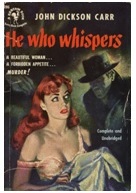 To wit: I always feel Carr requires us to put too much faith in Rigaud’s version of events here. There’s a perfectly valid case — Rigaud sends Harry away from the top of the tower, stabs Harold, throws the briefcase into the trees to salvage later (motive: money), wipes the sword off, and then follows Harry with excuses of talking to his father, only to misrepresent this timeline in his telling later on (there’s no-one else to contradict him, after all…) — that’s never acknowledged or confronted. Rigaud is, in his first and only appearance, cast iron, beyond reproach, even though we have no reason to think him so (had it been Fell, that would be a different matter).
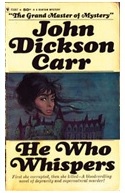 Still, it’s odd that Whispers has virtually no suspects. Most of the characters here exist in the past; only Fay Seton seems to bridge the two eras. Like you, I resisted accepting Rigaud on face value. But we’re forced to do so since the basis of the whole mystery springs from the story Rigaud tells at the start. It’s hard to credibly include Miles Hammond or his sister as suspects . . . suspects in what?!? That leaves Barbara Morell and Stephen Curtis — but he disappears after one brief scene, and the murderer should be someone we see throughout the book. (Them’s the rules; I didn’t make ‘em up!) So really, it all becomes a tale about Fay and her true moral nature.
 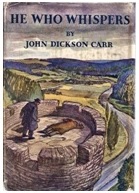 This is sort of what I mean about the depth of it all — Stephen does stand out a mile as trying to avoid Fay, which is a weird piece of clumsy writing from Carr, especially given how well he usually hides his guilty parties — but that scene when he’s about to go into his room only to be told Rigaud is sleeping in there and so spins away apparently in irritation but in fact fear is a moment that plays over and over in my head when I think of this book. It’s one of those tiny moments with huge implications that Carr does so well, and in retrospect gives the whole thing a much more dangerous atmosphere. On which note…
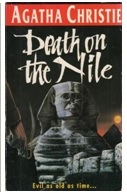 Reading these two has really helped me compare just how wonderful Carr’s use of atmosphere is, and has brought out the simplicity of language that makes Christie so popular. Consider the end of chapter 3 of DotN, when Jacqueline comes out onto the veranda and Christie says — apropos of almost nothing — “There was a feeling in the air of hush, of expectancy…like the moment on the stage when one is waiting for the entrance of the leading lady”. Or chapter seven when Poirot is talking to Rosalie Otterbourne and Christie says “The whole scene had a melancholy, almost sinister charm” — we’re just told that this is the atmosphere, there’s nothing to build up to it.
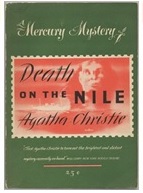 For all the masterful planning of Linnet’s killing, the plan itself is full of ineptitude. For one thing, the red ink is kept in a bottle of the wrong colour — which is stupid and lazy — and then put among Linnet’s things rather than kept by Simon to pass onto Jacqueline later. Better yet, why not throw the bottle away or throw it in the ship’s furnace at some point, since no-one would know to look for it? And since Simon replaces one bullet in the gun to disguise the extra fake shot, why not have two spare bullets to put in the gun and then place the gun back under the settee after shooting himself in the leg? That way, the gun never goes ‘missing’ and has only been fired once when discovered, so Linnet must have been shot by a different gun. Thus, when the partner gun turns up later, that could be used as a bluff against someone else…especially if that had been fired beforehand. I know it’s nit-picking, but the actions Simon undertakes with the gun seems to exist solely to cast suspicion on himself.
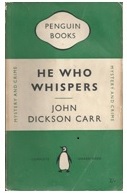 And then I really feel that Carr undersells the impossibility here. Rigaud more-or-less says “I left him at the top of the tower and then later he was found stabbed and the briefcase had disappeared” and that’s it; this section — the impossible crime part of a John Dickson Carr novel — lacks for atmosphere for me. It turns out to be ingenious (see my comments about depth above) but at the time I wasn’t convinced and there are cases not even confronted (the kids who discover him, for instance, are never considered, though this might be my ghoulish imagination getting away from me).
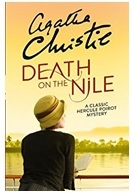 Linnet Ridgeway is in many ways very culpable for what happened — she wasn’t in the relationship with Simon entirely against her own will — but the ending of DotN breaks my heart in so many ways. The hopelessness of Jackie’s murder-suicide, the loss of everything they’d planned and schemed and murdered multiple times for, is actually kind of overwhelming, especially given the stark simplicity of Poirot’s reaction to it all.

Thanks so much for accommodating readers like me with a spoiler-free conclusion. 😀 I look forward to reading this post in detail when I finish “He Who Whispers”. This will only happen when I find myself in the same country as my copy of the novel!
I gather that Brad thinks “He Who Whispers” is one of the best – if not the best – Carr novel he has read, but JJ would beg to differ?
JJ – which Carr novels would you rank above “He Who Whispers”? I’m guessing “Green Capsule” and “Till Death Do Us Part”? Would “He Who Whispers” snatch the no. 3 title in your top ten ranking?
LikeLike
I mention at an earlier point — which you won’t have read — that I don’t even thnk HWW would be in my top 10 Carrs now that I’ve reread it. It’s very, very good, and does a lot of clever things with the genre, but Carr has such a strong catalogue that I could easily put ten books ahead of it.
Not sure if you saw my response to your spoiler-free request before, but all the DotN paragraphs that will be safe for you I put covers of DotN next to (and the same for HWW); so if you want to read some of the thoughts on the Christie just look for the covers…should at least enable you to take part in a partial way if you so wish 🙂
LikeLike
Thanks so much – I do appreciate the attempt at demarcating the post more thoroughly. 🙂
Is your comment that you could find 10 books to rank ahead of “He Who Whispers” hypothetical? Or do you already have a concrete list of top 10 Carr titles? If it’s the latter, I would be most curious. 😀
LikeLike
Aaah, de nada — you’ve bee with me since the start, and I appreciate the loyalty!
My Top Ten Carrs is very theoretical, but I do know that there would be a good twelve or thirteen books that I’d wrangle with ahead of HWW.
The seven that would probably definitely be in there are (going, I believe, chronologically):
Death-Watch
Plague Court
Hollow Man
Green Capsule
Constant Suicides
She Died a Lady
Till Death
And I’m aware that I still have He Wouldn’t Kill Patience, Nine Wrong Answers, Emperor’s Snuff-Box, The Reader is Warned, plus late classics like Captain Cut-Throat and Ghosts High Noon to get through. I’m not going to do a definitive top ten until I’ve read everything, and with about thirty-seven books (plus all these rereads I keep doing) to go, that ain’t gonna be any time soon…
LikeLike
Ok, got to chip in here. Death Watch? Seriously?
LikeLike
Yup, I love Death-Watch — it’s that model of later-early Carr where the first half is the crime becoming increasingly baffling and the second half gradually pulls it apart, and for my tastes it’s the one where he nailed the structure perfectly: there’s so much going on in that house that there’s simply no way it can be explained…and then, with amazing clarity, every facet of it (well, fair’s fair, every facet but one) is shaped into this amazing jigsaw.
What I especially enjoy about it is how Carr manages to make it work without getting drawn into undeniable padding. The White Priory Murders, say, has an exceptionally clever solution, but the book itself is so bogged down in needless diversions that it becomes difficult to recommend to anyone who isn’t already convinced of Carr’s brilliance. Death-Watch, by comparison, is so tighly focussd and so brilliantly unwound that every word and phrase counts. It’s a genuinely masterful bit of construction and plotting, and doesn’t get the love it deserves.
But, yeah, you’re neither the first nor the last person to have this response… 🙂
LikeLike
It was an early read for me so maybe I need to give it another try. But I’ve got it mentally clumped in with the disappointing earlyish Fells, like Eight Of Swords and Blind Barber.
LikeLike
Ha, I agree with you about The Blind Barber, but again there’s a huge amount of cleverness in The Eight of Swords that I feel goes unappreciated — it could do without those three chapters at the end where one guy essentially just follows another guy from place to place, but that setup at the house and how all the inconsistencies are explained is genius.
So, y’know, maybe we just like different things… 😉
LikeLiked by 1 person
That was enjoyable. Yes, these are two very different books, undoubtedly influenced by the sensibilities of the times in which they were written, by two quite different authors.
I think the comparison (contrast?) worked fine under the circumstances as there was a broad consensus that they represented the best of Carr and Christie – by looking at not only the areas of convergence but also those which pertain to the respective strengths of each. HWW comes out easily on top in terms of humanity and atmosphere because that’s what Carr did best, consistently, whereas DotN wins when it comes to the switches and turns of a tricky plot as this was Christie’s real forte.
i couldn’t call one as better than the other as they both have differing goals and means of getting there; that both achieve their aims with some style is enough for me.
LikeLike
I think what Christie achieves ahead of Carr is how delicately she leads you astray. I think Carr generally provides much more in the way of switchbacks than Christie does, but always with a sense of “Haha, this is going to turn out to be something clever”: locked rooms, someone poisoned with the parts of an alarm clock in their pocket, a man calling out that he’s okay every 15 minutes from behind a locked door only to’ve been dead for the last hour and a half…Carr wants you to know something celever is going to happen, and engages in that battle of wits in a very forthright, almost confronting, way.
Christie, by comparison, wants to creep upon you: the ‘bee’ at the start of Peril at End House, the letters at the start of And The There Were None, the discovery of the body in The Sittaford Mystery…the cleverness is much more cloaked, much more ordinary. Brad has to spot on (of course, he knows his stuff) when he says that she deals more in the everyday — before you realise it, the sandwiches were more sginificant than you thought, or that fact that the washing up was done by two people rather than one. Stylisitcally they’re miles apart, but Christie nudges you gently off the rails where Carr just knocks you over.
LikeLiked by 2 people
Yes, that sounds right. I reread A Murder is Announced not that long ago and was really taken by how the clues were presented in that one. Once you know what to look for it’s very obvious and yet everything is laid out in an extraordinarily and subtle, actually humdrum, way.
LikeLiked by 2 people
Well done sirs, a terrific look at two exceptional GAD novels – I found new things to enjoy from what you say here, which is marvelous as I thought I knew these so well. Thanks guys 🙂
LikeLiked by 3 people
You’ve made me want to go back and re-read He Who Whispers, just because of one phrase that Brad used: ” The vamp, the nymphomaniac, the femme fatale . . . they are all sisters under the skin.” It makes me wonder. My sense is that JDC was pretty good about allowing women to own their sexuality and not be ashamed of it, as in, for instance, The Reader is Warned or The Judas Window. But is Carr saying in He Who Whispers that Fay Seton is “vampiric” because she is sexual?
Anyway, getting me to go back and re-read is pretty darn good writing, so thank you both for a job very well done!!
LikeLiked by 2 people
With soooo many books still to read, it’s only because I know we’ll get into these in such depth that I’ve taken the time to read them again, and it’s a lot of fun being more analytical about them second time around. I mean, sure, it’s left me unconvinced about either of them as stone cold classics, but that in turn has helped me figure out what I am looking for in a classic.
And, hey, they’re still very good, enjoyable, well-written, fast-moving, complex-plotted, devious, and inventive takes on the genre…so it’s not like I completely wasted my time. But I’d like to do a spoiler-heavy look at something new to me at some point, if only for the new experience of it.
LikeLiked by 2 people
Feel free to spoil Elephants Can Remember for everyone! You’d be doing them a favor!
LikeLike
Very kind of you to say so, it was a lot of fun to analyse these, and while Brad’s right that the comparison is a little lopsided it’s given me a new appreciation of these two when drawn against each other. Always nice to have a change in perspective on something you feel you know well.
LikeLike
Pingback: THE 2017 CHRISTIE VS. CARR SMACKDOWN | ahsweetmysteryblog
Great work guys! What a joyous read and yes, very little sparks for a one on one fight to the death!
I need to take some more time to think about deeper responses but I will say right off the bat that both your comments on the DotN solution and set up pointed out for me what I felt was wrong with it.
It seemed like the mystery of how it was done lead to it’s solution so easily rather than cloaking it. I think it was Sergio (or maybe even JJ), that wrote (years ago now before I started blogging), that if it was a Christie mystery about who stole a banana, then the one who was allergic to bananas would obviously be the culprit. But that if it was the same written by Carr, everyone would be allergic to bananas and the bananas would all be inside a locked safe.
The moment that Christie told us that Simon was incapacitated I was like, well it was obviously him, and then therefore this is the only way it could have happened, and you would need to have Jackie involved so it all clicked too easily. However, I also guessed HWW fairly early on with the wacking great clue of the blood inside the scabbard, which felt so heavy handed on first read, and therefore kind of spoilt the build of the impossible element.
And in a massive blow to my thoughts on HWW, I have never thought about doubting the tale of Rigaud before, it’s so obvious once you both said it! Maybe I am too trusting (of certain types of characters)?
And man, the attack on Marion and the shoe out of line under the bead, wow, just both so chilling. Really glad that was drawn out by you both. I love how the first shows the deep terror that Carr can produce, and the second the domestic macarbe/horror that Christie so finally walks.
LikeLiked by 2 people
It was Sergio who made that comment about the bananas, and he’s absolutely spot on (as Sergio usually is).
For me, the moment it has to be a setup between Jackie and Simon is when she appears on the boat after Simon and Linnet have very visibly gone off in their car early in the day, heading in the other direction, leaving behind news of going somewhere completely different…and Jackie still knows. Not making it so otherwise impossible for her to follow them would have allowed for more doubt in this element, I’d say, but then I’m not the best-selling and most beloved detective fiction writer of all time. Or am I…?
The only real doubt comes from the acceptance that Simon has to shoot himself in the leg, which is astonishingly badass and simply glossed over like he’s plucking a hair from his nose or something. I mean…sheesh, give the dude some credit!
As for Rigaud…he might be the closest thing we have to a suspect, as Brad rightly raises that there’s really no-one else. It’s interesting, given how good Carr is at tying up all the loose ends, that no-one ever questions his involvement, though. As I said above, had Fell been on-hand to tell that story, you’d know full well that it was trustworthy, and since Rigaud is never even entertained as a suspect he just has to be guilty of someting…but then he’s not, and it feels a bit deflating.
LikeLike
I don’t agree with the comment about the bananas and Christie because her mysteries are not that obvious or easy to point out who the culprit is. And if you can point out whodunit, can you guess how the murder was carried out? Maybe if you read enough Agatha Christie or mysteries over the years you can figure the solution to DotN and maybe you can guess some of the solution, but anyone who figured out half of the mystery only solved 50% of it. I doubt many people can guess everything in the solution correctly.
LikeLiked by 1 person
Sergio was being deliberately simple, though — it’s not literaly the case, more just an exagerated example of the ‘least likely suspect’ that Christie deployed so well. All Carr did was take this idea and dress it up even further by adding additional complications and reversals, not least of which were the impossible crimes which tend to overshadow his equallt superb ‘standard’ detective fare.
In terms of how much DotN can be deduced…well, it’s fruitless trying to apply an overall figure to it. Some people will get none, some will get most or all, but I’d argue that the complicity of Simon and Jackie is easy to spot early on, and once you know they’re involved it’s a half-hop to the how.
As I acknowledged before, the main stumbling block would be believeing that a man would willingly shoot himself in the leg as Simon does. Very little is made of this in the book though — either through different timings of an overheard gunshot, or an acknowledgement that it would have been a staggering thing to do once it is uncovered as the final solution…it’s difficult not to feel that Carr would have done more with it, but such speculation is equally fruitless 😀
LikeLike
I think Death on the Nile can stand on its own as to character development. It isn’t as rich and it doesn’t expand to a wide range of characters as in Five Little Pigs or The Hollow. If it wasn’t for Jacqueline de Bellefort where a lot of good character development resided (aside from Linnet Doyle’s nuanced development) and as Brad said, “those human elements surrounding the two women at the heart of the case” who “makes us both think and feel”, I think DotN would have been one those stories with one-dimensional characters. Or maybe I should say characters who aren’t as well-rounded. They would have been good characters but it wouldn’t have resulted in a memorable story like the one we have. It’s been a while since I read DotN, but think about this, even though I like Salome Otterbourne and the aspect of her being a writer, and with some of her mannerisms and conversations, we don’t get an in-depth look into Salome and the effect alcohol has on her life (we don’t know how long this problem existed) or a subplot with how alcohol has on her relationship with her daughter. Many writers today would draw out this subplot. But I wonder, would this have enriched the story? Would it have an effect on the mystery itself? Every subplot doesn’t have to be drawn out to provide good character development. Maybe Death On The Nile didn’t need broad character development for all the characters. The book probably would have been the worst because of it.
As I said before, I think DotN can stand on its own. Unlike Brad who thinks it was unfair to compare it to a book with more character development, it would have been more unfair to compare He Who Whispers to a Christie’s later mysteries like Postern of Fate or even Destination Unknown (though I think the first half has good character development, but that’s a story for another day). So I’m glad that early Christie is compared to early John Dickson Carr.
LikeLiked by 2 people
You make an excellent point here, and I’d not appreciated how much Christie provides a lot of context and shape to characters without over-burdening it with things like the history of Salome Otterbourne’s alcoholism. Aspects of her conduct, and Rosalie’s responses to her mother, are explained retrospectively, and that’s sufficient.
But, then, all we have is a series of mini-dramas — alcoholism, kleptomania, ‘proper’ theft — that are almost a series of unrelated short stories mixed into the brew around Linnet’s murder. At best, someone happens to see another character behaving suspiciously because they’re (for instance) buying illicit booze off a steward, but nothing more is done with that. A key clue is not stolen by the thief or the klepto, the alcoholic isn’t accidentally drugged because she helps herself to Poirot’s wine…there’s no real intersection fo these plots beyond them happening in the same place. Compare this to Evil Under the Sun and there’s just such a gulf in the plotting it’s almost a different author.
My point? Well, I guess there had to be some character work to fill out the pages. Yes, we can be very thankful that Christie didn’t meader into longeurs about the effect of kelptomania destroying the natiure of trust in the affected household…but without her careful eye for characters there would be very little to compel this as one of her stronger works. I’m still a little baffled how it won, to be honest, and by such a large margin, too…
LikeLiked by 1 person
That’s what I have been thinking. Although I have read not near enough Christies as the super knowledgable on here I have certainly read better than DotN for plot, character and mystery.
LikeLike
I take issue with sbrnseay1’s assumption as to why I felt the comparison problematical. The 1930’s and 40’s were the apex of both Christie and Carr’s work. You could say, then, that Christie took a while to warm up, while Carr pretty much came out of the gate running. You could also say that Christie warmed up slowly, since there are fewer than ten titles to her credit before Roger Ackroyd, while Carr could almost be accused of overwriting since he had sixteen titles to his credit by his sixth year of writing, but it certainly trained him to be a master.
Each title that was selected here comes at about the same time in each author’s career. But there is the issue of the era, and 1930’s novels were quite different from those a decade later. However, I am willing to acknowledge that we would always have a problem, since Christie’s casts were almost always larger than Carr’s, and their styles are so very different.
I love Nile for many reasons, but I happily acknowledge its flaws. One of the points I tried to make here – and that I think JJ agrees with – is that the central relationship between Jackie and Linnet is so powerful, it raises the esteem of this novel, even if one wants to argue that the large passenger list isn’t adequately woven into the “real” murder plot. (I happen to like these passengers, especially the Allertons and the Otterbournes.)
Christie certainly could create a classic on a large canvas (think A Murder Is Announced, ATTWN, or, imho, After the Funeral). She could populate a village with a large group of interesting people (AMiA, The Moving Finger), while Carr kept his focus only on two or three villagers.) Still, sometimes her large cast could be rather shallow (Three Act Tragedy, Hercule Poirot’s Christmas). I tend to champion the titles where she went small in terms of cast and puzzle. I don’t think I could be pinned down to a “top ten” list for Christie, but some of the titles with four or five suspects would rank high:
The A.B.C. Murders
Cards on the Table
Sad Cypress
Five Little Pigs
These books are rich in plot and, especially in the latter two titles and, arguably in Cards, character.
LikeLiked by 2 people
What you’ve made me realise is that I typically go for Christies with a larger cast: I love Three-Act Tragedy, Evil Under the Sun, Mesopotamia, her village mysteries, etc. I appreciate it’s not a hard-and-fast rule — Orient Express, for all its cleverness, is pretty much just a string of dull interviews — but I’m happy to spend the time with Christie giving us a wide variety of interlocking people and intentions — Taken at the Flood, After the Funeral, even Hercule Poirot’s Christmas — because Christie plays these notes so well.
The smaller ensembles — 4:50 from Paddington, Death in the Clouds, Sad Cyoress, N or M? — while still having many very good things to recommend them, tend to be where I feel she comes a little unstuck. Maybe there’s less scope for the ‘normalness’ she spins so easily: a smaller cast invites a certain measure of artifice, what?
And I think what we have with DotN is a fusion of these two and that’a part of why it doesn’t work for me — there’s a big cast, but they’re all involved in ‘small cast’ stories. Hmmm, I think you may have hit something here…
LikeLiked by 1 person
I would also add Murder in the Mews for small cast and small amount of locations, that has always been absolutely one of my favourite Christies.
LikeLiked by 2 people
I remember precisely two things about Murder in the Mews:
1) I read it in the bath, so the pages have a yellow stain on the edges
2) I remember nothing at all about it
LikeLiked by 1 person
Haha, I have read it three times I think. But for me it just works, one location (pretty much) super small cast, 3 plus Poirot and Japp, and and some lovely, and beautifully subtle reversal clues. The involvement of the attache case is legendary.
LikeLiked by 1 person
Well, it’ll definitely be one I circle back around to once I finish her ouevre. The book is three stories, isn’t it? I’m usually worse with the details of short stories than with full novels…
LikeLike
Yeah thats right, MitM itself is only about 100 pages, then two short stories.
LikeLike
Actually, I think it’s published with another novella and then one or two short stories. Dead Man’s Mirror is as long as MitM. Triangle at Rhodes is a short story – and a damn good one, the basis for Evil Under the Sun – and then the British publication added The Submarine Plans, which I think is a so-so short.
LikeLiked by 1 person
My Penguin edition has MitM, The Incredible Theft, Dead Man’s Mirror then Triangle at Rhodes. They must have swapped out The Submarine Plans seeing it wasn’t as good.
And MitM comes in at 67 pages.
LikeLike
No, I was mistaken. It IS “The Incredible Theft.” My U.S. copy does not contain this, only the other three.
LikeLiked by 1 person
1) Yellow stain? What do you bathe in? How dirty were you?
2) That’s too bad because, as TRIW points out, the solution to that one is a keeper and one of only two times Christie ever did this particular thing! (The second time was Taken at the Flood, and the whole situation played out completely differently.)
LikeLiked by 1 person
Reading Sad Cypress at the moment and it’s definitely rich in plot and character– there is more of a complexity. For a long time now I thought about creating a blog, devoting it to the Golden Age mysteries, comparing and contrasting the many different authors and I really thought hard about talking about Sad Cypress and how it stands in the Christie canon and in the Golden Age period as a whole.
LikeLike
Well, I doubt anyone around here is going to dissuade you fom starting a GAD blog…go for it!
LikeLike
Did Carr write a vivid description of an English village in his books? Christie provided sparse description, but in a story like The Murder At The Vicarage, she made the English village of St. Mary Mead come alive mainly with the characters — the gossip, the secrets that they hold, and everyone who knows everyone else in the village. The reader can fill in the details of the village’s appearance in the theatre of their minds.
LikeLiked by 1 person
I don’t think Carr ever quite worked on the Village Tale in quite the same way, though I could be wrong. Elements of, say, The Eight of Swords imply a strong flavour of countrified village life, but at the end of the day it’s more or less set in and around three houses…not enough to qualify.
I get the distinct impression, now that I think about it, that Carr was always much more focussed on smaller locales. Part of this is necessary in capturing the geoography and fundamentals for his impossibilities, but I also feel he just liked working in a smaller area with a smaller cast. Sure, he’d spread his smaller areas over several countries or a whole county, but the sense of a cohesive area wasn’t his focus when it came to villages, though. The closest he probably got was Till Death Do Us Part.
He bloody loved London, though. Mad Hatter, Hollow Man, Bride of Newgate, Devil in Velvet and others each paint a very vivid portrait of that city. So it’s not like he couldn’t give us a village, like it was beyond his abilities; we must therefore conclude that he didn’t want to…
LikeLiked by 1 person
No, YOU hit something, JJ! Trying to draw blood, are we? Now the smackdown truly begins!
I love Christie’s large cast books, and of course you would prefer them because this is where the two authors are at their least comparable.
I would venture that Christie’s small cast mysteries come closest to resembling mainstream novels, while the small cast mystery is Carr’s metier! Does that make him “better” at small cast mysteries, or is it a matter of taste? What I’ll give you is that the machinations behind any mystery plot or misdirection are much simplified in Christie’s small cast tales while they are thrillingly complex in Carr.
LikeLike
What…I was…how did…wait, what? All I’m saying is what you made me realise is probably something true about the Christie books I’ve read. What happened?
I do undeniably think there are ‘types’ of books Christie does better than Carr and vice versa, and — I agree, pay attention — that Carr always finds that additional +++ wrinkle of complexity that Christie rejects on the grounds of artifice, but as I’ve already said I also feel that Carr is more explicit about twisting and twiting you astray, where Christie — even in the smaller cast mysteries — manages to do so much more organically.
The difference is that Chrisitie’s inherent organic plotting doesn’t befit the smaller cat for thie reason; you need much more in the way of coincidence and convenience, and I think she was trying to avoid that as much as possible. One is only ‘better’ if you ignore the virtues of the other, but since we’ve such broad-minded 21st century folk we’re not going to do thar, are we?
Are we?
LikeLike
The first paragraph was a joke, son, I say a joke! Any further snarkiness was the result of someone responding to an early post of mine about Carr with a whole lotta negativity that hit me the wrong way. (He called Poirot “a bore and a prig!” And he suggested that I didn’t respect Carr enough! Say wha – ???) Plus, I had to administer this stupid online test at school when I was trying to focus on the blogs. Really, the interruptions that your job throws at you . . .
LikeLiked by 1 person
Poirot, a bore and a prig?!?! WHAT?!?!?! Poirot is anything but a bore! He’s a very exciting and interesting character. I can’t believe someone would say that. Well . . .everyone has their opinions don’t they? I know Agatha Christie got sick of writing Poirot but I don’t think she ever considered him a bore!
LikeLiked by 1 person
I’m going to sic you on that guy!!! I welcome differing opinions, but that would be like me coming onto JJ’s blog and saying, “All locked room mysteries are stupid, and I demand you retract your praise of them!”
LikeLike
What?! All locked rooms are stupid?!?!??!? Dammit, sir, this will not stand….
(relax, relax, I’m joking)
LikeLike
This comparison of Carr and Christie in terms of cast size is very interesting. And these two almost in some sense show Carr and Christie’s rare weakness in these areas. As was brought out in the post you have very ‘single roll’ characters in DotN, and I confess to getting people confused – apart from Linnet and Jackie which as Brad has been saying are the crux of this work, and so well developed. And then with Carr I have no problem remembering where I am and who’s who, and reading it for a second time it was amazing how much of the atmosphere I remembered and came straight back because he explains these tight situations, characters and locations so well…. but, as was also brought out, there are no suspects, and I have never really thought about that with HHW.
In a way I was thinking, well it’s a Carr so I begin to suspect these people, but then realising from the post that we aren’t really led by Carr to suspect anyone.
What these two seem to do, and possibly why they ranked so high, is smash the tension down so hard through their central women, so much so that it’s often horrific.
LikeLiked by 1 person
I feel with Carr that I remember more during the book, but then retain fewer details as time passes once I’m done. There’s a lesson there, I’m sure, but I don’t know what it is.
LikeLiked by 1 person
Speaking of Murder In The Mews that was discussed earlier, there’s an earlier version called “The Market Basing Mystery” which is included in the U.S. collection “The Underdog and other stories”. The Market Basing Mystery is a shorter version. I guess A.C. was so fascinated with the plot and liked it so much she felt that the premise needed to be reworked. What I love about Christie is that she reuses and expands on her plots turning them into a novella or a novel. I guess some would say she recycles her plots and thumb their nose at that but that is a talent and a skill unto itself. And a lot of times the reworked versions are just as good or even better than the earlier one.
Which of Christie’s short stories do you think she should have rewritten and reworked into a novella? A novel?
LikeLike
Gotta be honest, I remember very few of her short stories; nothing about Christie per se, I’m just bad with short story recall. Only ‘The Dream’ springs to mind — boom, cha — and that was fine as it was.
LikeLiked by 1 person
I think that most of her short stories are very much short stories in that they are single-minded in terms of plot. Pad them into a novel and you basically get what happened when the new Marple series “beefed up” the short story, “The Blue Geranium.” (I think they added another story to the mix, with, er, mixed results.) “Yellow Iris” is a perfectly good short story. I think the murder plot part of it is better than Sparkling Cyanide. But the novel allowed Christie to delve into character more, which is a good thing. I’m not as big a fan of Endless Night as some, and I think that part of the reason is that most of the additional “stuff” that was added to “The Case of the Caretaker” is, frankly, dull, or at least uninteresting to me.
LikeLiked by 1 person
Pingback: CHRISTIE/CARR SCATTERGORIES | ahsweetmysteryblog
Pingback: #229: Carr vs. Christie…the Follow-Up | The Invisible Event
Pingback: Top Ten Lists are boring! | Noah's Archives
I finally got around to reading Death on the Nile and I’m happy to jump into the party with some fashionably late comments. Oh, I’m beyond fashionably late? Oh well… I brought a bottle of wine for the hosts.
As I’ve commented in my review, I unfortunately saw through the mystery at once. There is just something jarringly suspicious about the interaction between the characters in the scene leading up to the shooting. Then of course, the murder occurs and we know that certain characters couldn’t have done it. Well, as I’ve learned from reading a lot of Carr, you should always cast suspicion on the characters who couldn’t have possibly done it. I’d love to make a comparison to a particular less-famous Dr Fell novel, but I’d hate to ruin it via analogy.
However, Carr always concealed his deceit in a massive heap of misdirection (having to avoid spoilers for other titles on this one is going to cause me a fit). It isn’t just that a certain person couldn’t have committed the murder, but we’re bamboozled by time shifts, locked rooms, missing footprints, and centuries worth of seemingly related murders. In contrast, Christie’s deception in Death on the Nile sits starkly naked. Question how the character with the perfect alibi could have done it and it becomes immediately obvious.
Throughout it all, the only clue that didn’t click for me was the bottle of nail polish. I just assumed that the crime had been committed with a horrendous wound, which I suppose didn’t quite make sense given just how bad it was, plus timetables, and lack of blood all over the ship. Those things didn’t come to mind though until I had finished the book, and all of the other clues had clicked into place with my theory during my reading.
As I mention in my recent post, I’m not at all bragging that I figured this out. As with probably anyone else reading this, I love nothing more than being tricked by a mystery. We all think we want to solve these things, but in reality we want to feel as if we had every opportunity and spotted the answer, only to have our hair singed off by a shocking twist that leaves us mortified that the answer was in front of our faces the entire time. For everyone who got that experience with Death on the Nile, I’m jealous of you.
LikeLiked by 2 people
The bit that really tips it for me is when the newlyweds deliberately send a car off in the wrong direction to disguise that they’re getting on the Nile cruise…and when they arrive on the boat Linette is there waiting for them. There’s never any opportunity to suggest that anyone else could have been involved in telling her, so therefore it has to be one of them who did…mystery over.
Add all the alcoholics, kleptomaniacs, spies, and dead maids you like on top of that, as soon as you’re not addressing that obvious conclusion you’ve lost my sympathy because it’s clear you’re hoping no-one will think of it. But, well, millions of people will disagree.
There are far better, cleverer, cannier, subtler Christies around, which at least means you’ll have plenty of joy ahead of you.
LikeLiked by 2 people
Pingback: LET’S FACE THE MUSIC AND RANK: My Top Ten Christies | ahsweetmysteryblog
Pingback: Death on the Nile, 1937 (Hercule Poirot # 15) by Agatha Christie (a re-read) – A Crime is Afoot