- Comment
-
Subscribe
Subscribed
Already have a WordPress.com account? Log in now.

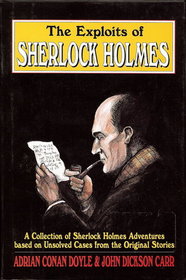 The solution is possibly not completely surprising given the brevity of this form, but shows a deft hand in that Carrian touch of what you have been encouraged to think versus what actually happened and why. The wider game at work, the situation beyond what you’ve been explicitly shown (and the reasoning for your not being shown anything beyond this), is a very Carrian device, too, and one used very successfully both elsewhere and here. And there’s even space for a pleasing false solution that picks up on a thread casually dropped earlier, plus a moment for Holmes’ more human side to shine through in the unexpected reversal of the closing discussion. Yes, the motivation is a touch weak, but it’s fair to say that Doyle Sr. would have been delighted with this one.
 The Invisible Event
I’ve added your link to the FB group page, so no doubt people will be swarming here to read your latest thoughts as we speak. I didn’t realise Carr did any SH stories so thanks for bringing this to my attention. This one does sound good especially, though elements of this do remind me of G. K. Chesterton’s Father Brown stories.
LikeLike
Many thanks, Kate, much appreciated. The Carr Holmes tales are a little variable, but these two offer plenty to enjoy – and with more substance than Cheterton to boot!
LikeLike
Not only had I forgotten that Carr had written these stories, but you have reminded me to put my umbrella in the car. (It looks like rain here.) Thanks, JJ!
LikeLike
Well, we like to provide a multi-faceted service at TIE Towers; I shall quote you in the next round of promotional literature.
LikeLike
“….by my reckoning she died a few years previously and Watson had moved in with Holmes upon the detective’s return to London in 1894…”
You are correct. Watson stayed with Holmes till 1902 when he remarried.
LikeLiked by 1 person
Awesome, thanks Santosh. If you say it’s so, I trust you far more than I trust myself!
LikeLike
Unless you have pre-written a series of posts, I recommend never planning more than one post ahead. Otherwise, it never seems to pan out.
Anyhow, I have a love/hate relationship with this collection of stories, because I hate pastiches in general. Pastiches seldom measure up to the original, rarely stand on equal footing and almost never take the source material to the next level, but Carr and Doyle sure came close in doing exactly that.
Sherlock Holmes and Dr. Watson were kept fairly close to their original incarnations, but were given cleverly plotted, fairly clued Golden Age-type of cases to investigate, which put The Exploits of Sherlock Holmes en route to becoming a potential classic of its kind. What prevented this from happening was Carr bowing-out of the project and Doyle rehashing his father’s plots for the last half dozen stories.
The best tales are (IMHO) The Adventure of the Sealed Room (of course!) and The Adventure of the Wax Gamblers, which could have easily been a Merrivale story.
LikeLike
Given Carr’s affinity with Holmes, is it known why he backed out of the second half? A decent pastiche is hard to do, and I’m with you that this falls down horribly in Adrian Conan Doyle’s sole stories…I’m guessing that he was no-one’s choice if one of them had to stay…!
LikeLike
From memory, he was sick at the time. This was the early 50s, when he was struck down with a fistula.
LikeLike
Ah, well in that case we can forgive him. But, oh, the stories we’ll’ve missed out on!
LikeLike
Pingback: The Tuesday Night Bloggers: John Dickson Carr (Week 2) | Noah's Archives
Pingback: #84: The Tuesday Night Bloggers – The Sherlockian Impossibilities of John Dickson Carr – II: ‘The Adventure of the Sealed Room’ (1953) | The Invisible Event